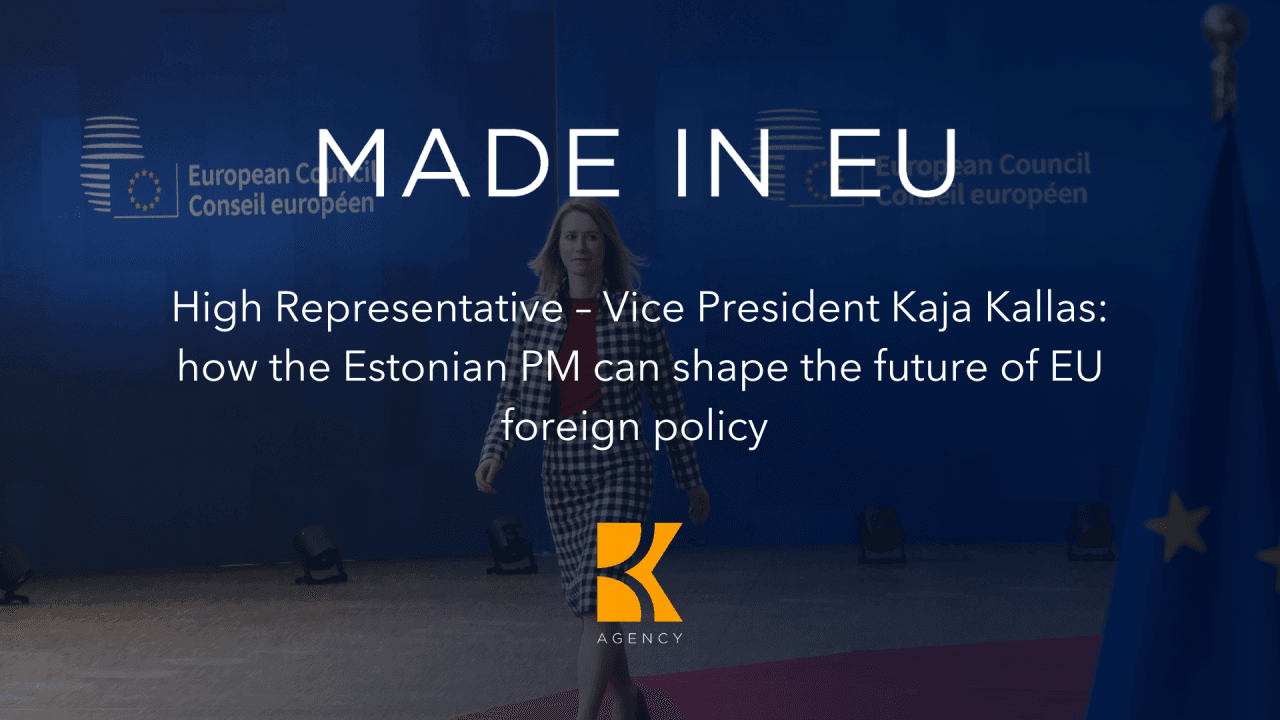
The serving Estonian Prime Minister, Kaja Kallas, looks likely to become the next European Union chief diplomat, succeeding Josep Borrell as the High Representative of the 27-bloc.
Six EU leaders, including France’s Emmanuel Macron and Germany’s Olaf Scholz, struck the deal at the end of June for the top three EU jobs. Poland’s prime minister, Donald Tusk, and his Greek counterpart, Kyriakos Mitsotakis, represented the EPP; Spain’s Pedro Sánchez joined Scholz for the Socialists, while the outgoing Dutch prime minister, Mark Rutte, spoke for the centrist Renew group alongside Macron.
Although Ursula von der Leyen’s confirmation by the European Parliament should not be taken for granted, there are several indicators to believe that Kaja Kallas’s appointment as chief diplomat could revitalise the role of the High Representative.
Firstly, let’s quickly review the primary responsibilities of the person in charge of guiding the European Union’s diplomacy:
- Conducting the EU’s Common Foreign and Security Policy (CFSP) and Common Security and Defence Policy (CSDP).
- Presiding over the Foreign Affairs Council, which consists of EU member states’ foreign ministers.
- Vice-President of the European Commission, ensuring consistency in the EU’s external actions.
- Representing the EU in international forums and dialogues on foreign policy matters.
- Heading the European External Action Service (EEAS), the EU’s diplomatic corps.
- Coordinating the EU’s response to global crises and conflicts.
- Negotiating international agreements on behalf of the EU in areas of common foreign and security policy.
With this in mind, it is evident that the role of the High Representative is one of mediation, meaning having the ability (and the political “flexibility”) to meld 27 voices – most of the time conflicting – into one unified position, putting aside personal political convictions.
And here comes challenges and opportunities for Kallas’ foreign policy in the years ahead.
Unquestionably, Kaja Kallas’s policy has been characterised by one distinctive mark: clarity. It is what has made her the first European leader to be put on a Russian wanted list, accused of “destroying monuments to Soviet soldiers”, a reference to the removal of Soviet-era Second World War memorials in her country.
Kallas, Estonia’s Reform Party leader since 2018, was an MP from 2011 to 2014 before being elected to the European Parliament. She then returned to the Estonian parliament as Reform’s first female leader before being elected prime minister in 2021.
The Estonian prime minister has been one of Ukraine’s strongest supporters, leading efforts to increase military assistance to Kyiv and tighten sanctions against Russia. While other Western and European leaders were trying to deter Putin from starting the conflict with Kyiv, she was one of the most advocative voices in the European Union, claiming that dissuasion with Putin was futile. This is because, in her view, Russia is a revanchist imperial power that won’t stop to Kyiv.
She advocates for closing sanctions loopholes, increasing arms supplies, establishing war crimes tribunals, seizing Russian assets, and banning Russian tourists from the EU—essentially the complete package. Recently, she has broadened her understanding of the Russian threat to encompass other disruptive tactics, such as migration, disinformation, and sabotage, by exploiting the support of allies (notably, China, Iran and North Korea) in its hybrid warfare.
In Ukraine, Kallas’ success will be measured by her ability to revitalise European leaders’ will to pursue sanctions by adapting them when needed. Coordinating defence spending with other allies, notably the United States, in the broader framework of NATO will also play a fundamental role. Domestically, her decision to raise taxes to increase defence spending has cost her much of her popularity. In her favour is the recent decision by 23 Allies to invest more than 2% of GDP on defence.
But Kallas’s challenges won’t stop in Ukraine. She will need to be a 360-degree diplomat who can strike a clear position in the Middle East, China, Latin America, and Africa. For instance, as the High Representative, she will chair the joint commission on the implementation of the nuclear agreement with Iran at a time when the Islamist regime in Teheran has become a threat to the broader region and beyond. She will have to make her positions clear on countless foreign policy dossiers and issues in such a way as to ensure that the positions of the twenty-seven are coordinated around her vision, limiting the risk of free-runners as much as possible.
Following extensive negotiations between EU parliamentary political groups and Commissioners, an EU-specific work program for the next five years has been agreed upon. As the EU’s prospective chief diplomat, Kaja Kallas will face public hearings beginning in late September. Members of the European Parliament’s Foreign Affairs Committee (AFET) and the Security and Defence Sub-committee (SEDE) will thoroughly examine her policy vision. Ultimately, Kallas and the entire College of Commissioners must secure approval through a single vote.
For many, the Russian invasion of Ukraine has been too overwhelming to grasp fully, causing their focus to narrow to immediate, tactical concerns. However, a few leaders have emerged who can think, act, and speak on the scale this moment demands. In Ukraine, Kaja Kallas has demonstrated to be one such leader. Despite leading a small country of 1.8 million citizens, she has effectively conveyed her message to an international audience: Ukraine’s crisis is a European crisis and a challenge for the entire West.
We do hope she will be able to forcefully convey the same message regarding the other geopolitical challenges during her tenure. If she comes out on top, we will be in the position to say that Kaja Kallas has changed the specific gravity of the European Union.