In today’s edition, we look at the Global Gateway Forum. An event taking place in Brussels that the European Council may shadow but that nonetheless can be crucial for the EU’s global ambitions. Enjoy!
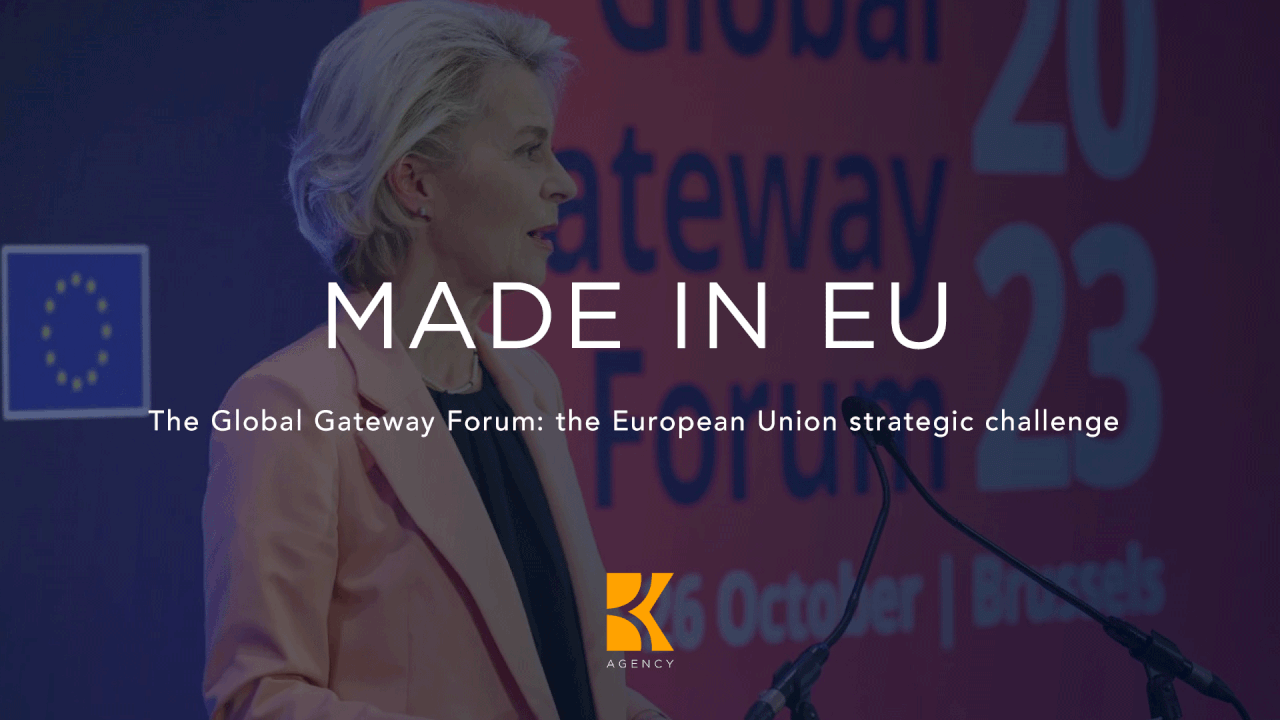
The Global Gateway Forum: the European Union strategic challenge
Sixteen leaders from developing countries gathered in Brussels yesterday and today for the EU’s Global Gateway Forum.
In late 2022 and early 2023, the European Union stepped on the accelerator of the international infrastructure development plan Global Gateway, aimed at increasing Europe’s connectivity with the rest of the world, particularly developing countries and the European neighbourhood. Launched in December 2021, it is part of a broader project to guarantee the European Union’s strategic autonomy in its economy and policies with the rest of the world, encompassing industry, defence, space, raw materials supply and infrastructure.
Many have seen in the initiative Ursula von der Leyen’s bid to confront China’s Belt and Road Initiative (BRI) to build infrastructure across the globe. The event takes place just a week after Beijing rolled out the red carpet for Russian President Vladimir Putin, Hungarian Prime Minister Viktor Orbán and the Indonesian leader Joko Widodo during a Belt and Road summit.
The main question is: with its global infrastructure initiative, will the European Union finally be able to compete with its Chinese counterpart?
Many factors can influence our answer to this question.
Implementing the Global Gateway is the most recent development in a long line of increasing attention to infrastructure and connectivity on the European side and geopolitical risks stemming from other powers’ projects, as in the case of China’s Belt and Road Initiative. One figure is enough to understand the magnitude of the challenge: from 2013 – the year of the launch of the BRI – to date, Beijing has invested USD 885 billion in infrastructure worldwide. The EU, after an initial wait-and-see phase, has changed its attitude. It was precisely the definition of Beijing as a ‘systemic rival’ in March 2019 that signalled a change of pace in the European strategy and paved the way for greater EU activism on the issue of infrastructures.
The EU ultimately aims to become a global setting power. And precisely on this point, the European Union needs to confront Beijing’s un-levelled playing field.
China has penetrated a worldwide financing gap with targeted offers, creating a sphere of dependency that reaches as far as Europe. As of March 2022, 147 nations, including 18 European Union member states, had already established Memorandums of Understanding with China, indicating their participation in the Belt and Road Initiative. Supported by substantial financial resources, this approach has been steadily elevating Beijing’s global presence and sway.
A crucial challenge for the EU will be demonstrating to partner countries that it can make better offers transparently and without debt traps than China.
Moreover, the EU’s focus on its values indicates that projects financed within this new framework will have to meet strict standards concerning both financial and environmental sustainability, transparency in awarding procedures, social conditions in destination countries, and respect for fundamental human rights and the rule of law.
The main unknown factor concerns the reception this initiative will receive in the target countries and its attractiveness in relation to BRI. On the one hand, the Global Gateway seems to want to meet the doubts expressed towards the Chinese scheme and its heavy, albeit implicit, political conditionalities and towards the ‘debt trap’ that often accompanies the most demanding infrastructure programmes. In the case of the EU, political conditionalities are replaced by solid scrutiny of the design, technical and financial feasibility (as well as verification of environmental and social standards). The implication is that the scheme may become too demanding to make it appealing enough. This gap can cost money and political influence in a fast-paced, hyper-connected global infrastructure.
The premises could be better: the most significant EU countries did not send the top brass to Brussels for the two-day event. Climate Secretary Jennifer Morgan represents Germany, while France and Denmark sent their development secretaries. Italy is not represented at all. Moreover, the European Council taking place simultaneously will cast a shadow on the forum’s outcome.
Nonetheless, we must recognise that the Global Gateway Forum can play a crucial role in speeding up the European presence worldwide and boosting its competitive value globally.
The financing of infrastructures abroad could foster the dissemination of European standards and values in the world, reinforcing the objectives of European industrial policy and the market penetration capacity of companies and, finally, it could facilitate the achievement of decarbonisation objectives in the world, which are fundamental principles of the European green strategy. The ambition to go beyond the mere financing of investments and infrastructures is indeed confirmed not only by the Commission but also by the involvement of the High Representative for Common Foreign and Defence Policy, Josep Borrell, as well as the Commissioners for Neighbourhood and Enlargement, and for International Partnerships in the project management.
Global Gateway is, therefore, a candidate to become one of the main instruments of the European Union’s external action shortly and one of the cornerstones of its industrial policy.
The demarcation line between failure and success is not easy to draw. A certain degree of willpower and policy coordination will decide if the latter will prevail.