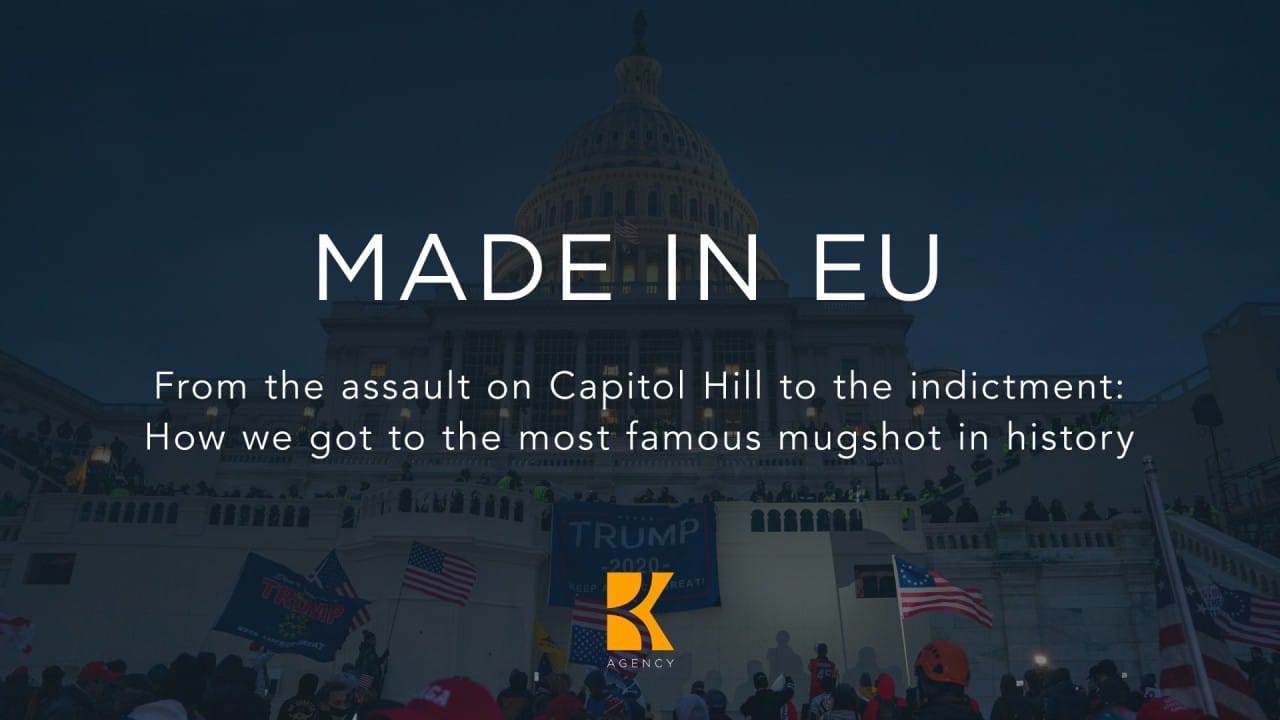
In today’s edition, we dive into the events that brought to the most famous mugshot in history. Enjoy!
From the assault on Capitol Hill to the indictment: How we got to the most famous mugshot in history
Dear reader, do you want to know the truth and nothing but the truth? Are you not afraid of discovering that the system that regulates the world’s greatest democracy is more fragile than you think? Because this is not – only – the story of Donald Trump and his impeachment. This is how America has faltered, threatening to shatter. And with it, the world as you have known it until now.
January 2021. Donell Harvin, Director of Security Intelligence for Washington DC, is not living one of his best days: his men have been gathering unequivocal intelligence regarding thousands of Trump supporters from all over the country planning to march on Capitol Hill. They want to prevent Joe Biden from being proclaimed president. But if the alerts need no interpretation, why do federal agencies continue to turn a blind eye?
Then there’s him, Donald Trump.

Rumours that the electoral system may not be fraud-proof were almost daily during the campaign. Still, the possibility of a “massive bribery scheme” was most clearly evoked on 26 September during a rally in Harrisburg, Pennsylvania. In that circumstance, The Donald says it loud and clear: he assumes that it is the House of Representatives, and not the Electoral College, that will indicate, state by state, the winner of the presidential election. It is a remote yet possible eventuality which is triggered in the event of a tie between the candidates.
One must, therefore, wait until the day of the count, the very early hours of the morning after Election Day, to realise that The Donald will not go quietly. During the press conference that Trump held in front of his team of loyalists in the East Room of the presidential residence, the president manifests his intentions, calling explicitly for fraud.
Trump’s people, faced with those words, feel called into question. Spontaneous demonstrations take place outside polling stations and government offices. And they are only sometimes peaceful. On the other hand, the Democrats are starting to worry. It is clear to everyone that Donald Trump lost the vote. But it is also true that he did better than the polls had assumed in many states. Another element: the Republicans gained seats in the House. The words Trump spoke at that rally in Pennsylvania now resonate like a memento: The Donald has a path to the presidency. He ‘just’ has to challenge the result of the Electoral College. And to do that, he needs a man he considers ‘his man’. He needs Mike Pence.
In those hours, Donald Trump is focused on trying to overturn the election outcome. In a phone call on 27 December to Jeffrey Rosen, the attorney general who took over from William Barr after the resignation of the Justice Department chief, he expressly asks him to play along: ‘Say the election was corrupt and leave the rest to me’. But his most significant efforts focus on Mike Pence, who would gladly do without all the attention he gets, but he can’t. On 4 January, the two meet in the Oval Office in the presence of John Eastman, Trump’s lawyer and former dean of the law school at Chapman University.
He is the one who convinces Trump that it is only a matter of will: the vice-president can exercise his powers over the vote certification process, he can freeze the Electoral College, stop the count and ultimately lead to the proclamation of Trump as president. On the evening of 5 January, from the Oval Office, Donald Trump can hear the choruses of his supporters or – better said – his people.
The rest is history. To be continued.