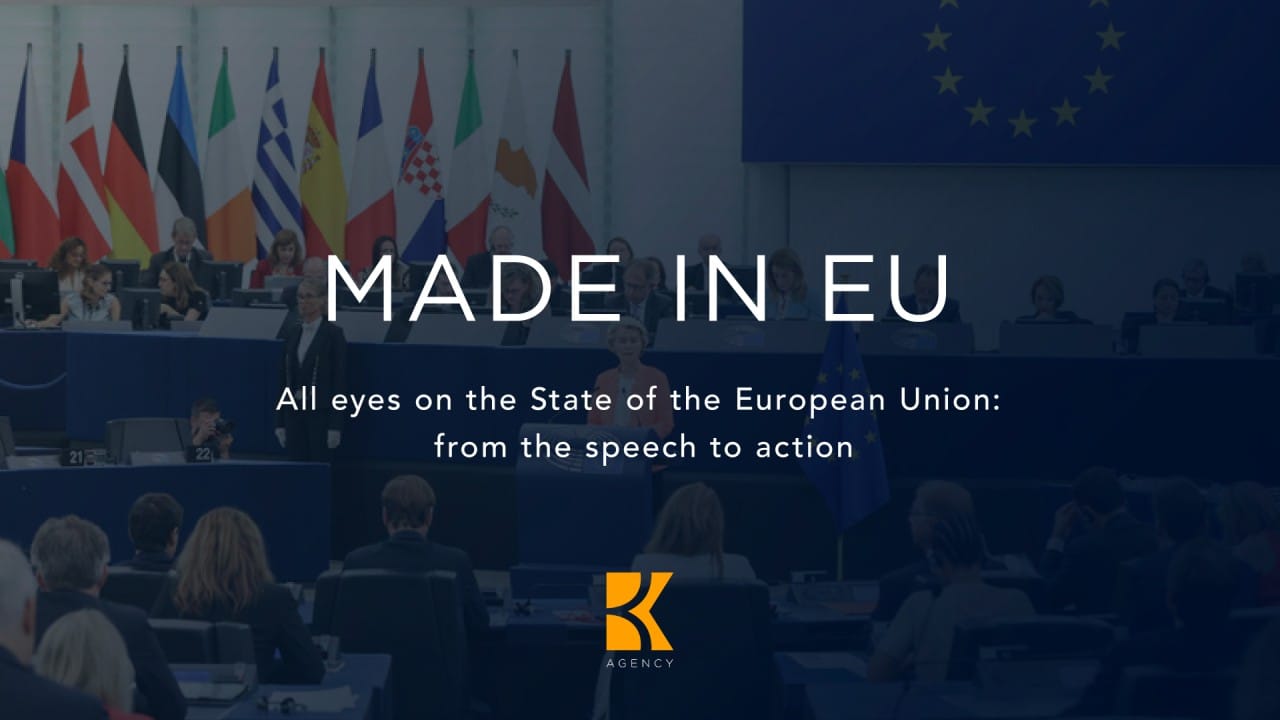
Hello, and welcome back to this week’s Made in EU. This time, we will deep dive into the State of the European Union speech from the European Commission President Ursula von der Leyen.
Many opinions, one Green Deal
In the last annual address of the current term, the EU chief reaffirmed her role as a unifying figure across the diverse political spectrum that endorsed her in 2019, encompassing populists, socialists, and liberals. President von der Leyen introduced her slogan for the months ahead: “What matters to Europeans, matters to Europe.”
In the speech, which lasted just over an hour, von der Leyen tried to meet the demands of her group, the EPP, when it came to the Green Deal agenda while not breaking her commitments to Socialists and Greens at the same time. When she spoke about the controversial Nature Restoration Act and the need to preserve forests and food security, she did so in German. “The loss of nature destroys not only the foundations of our life, but also our feeling of what constitutes home. We must protect it. At the same time, food security, in harmony with nature, remains an essential task.” In particular, von der Leyen expressed her “appreciation to our farmers, to thank them for providing us with food day after day. For us in Europe, this agricultural task – to produce healthy food – is the foundation of our agricultural policy. And for us, food self-sufficiency is also important.” This looked more like a personal address to her party and the most substantial group in the EPP family than anything else. The use of German was a clear message to the EPP president Manfred Weber: You signed a deal in 2019; you need to stay on track with that, even if European elections (and German local elections) are approaching fast.
All eyes on China
The news of the day is the launch of the investigation into China. For the first time, the European Commission will investigate Chinese subsidies to electric vehicles. “Global markets are now flooded with cheaper Chinese electric cars. And huge state subsidies keep their price artificially low,” von der Leyen said in her remarks. “This is distorting our market.” This is a bold move from the EU Commission; it could not stop the subsidies war on solar panels and showed the lack of ideas on how to move most of the chip productions from China. It could be the beginning of what the President in her address called “de-risking” or the beginning of a trade war with China. The following few months will tell us. One thing is sure: if she wanted to address her critics at home, this part should have been in German.
The maintenance of competitiveness remains crucial for European industry, especially if the opening of the investigation will lead to the trade war with China. With the possibility of the trade war in mind, von der Leyen asked the former Italian prime minister Mario Draghi, “one of Europe’s greatest economic minds,” to prepare a report on the future of European competitiveness, as “Europe will do whatever it takes,” she said, citing the words spoken in 2012 by the then President of the ECB, to defend the Euro.
Small enterprises in the big Union
Regarding the economy, the President identified three challenges: a shortage of labour and skills, inflation, and improving the business environment for our companies. On inflation, the President noted that “Christine Lagarde and the ECB are working hard to keep it under control” but acknowledged that “returning to the ECB’s medium-term objective will take time.” In October, the Commission will present the first legislative proposal to reduce reporting requirements for businesses at the European level by 25%.
By the end of the year, the Commission will appoint an EU envoy for SMEs that will report on the current challenges directly to von der Leyen. If the envoy had been appointed four years ago, maybe we wouldn’t be facing these problems now, but better late than never.
The challenges of enlargement
The speech, though, did not present any new solutions to address the immigration crisis. The President urged the EU Parliament to reach an agreement with the Council on the new Pact on Migration and Asylum, which introduces “a new balance” between “border and people protection,” “sovereignty and solidarity,” and “security and humanity.” She then pointed to the partnership with Tunisia as a model to replicate and promised an international conference on combating human traffickers. She also emphasised that “we must show the same unity of purpose towards Africa as we have shown towards Ukraine” and “we must focus on cooperation with legitimate governments and regional organisations. And we must develop a mutually beneficial partnership focusing on common issues for Europe and Africa.” She mentioned the Cotton Road initiative as a virtuous example of building alliances with emerging countries through investments.
Finally, Ukraine and the challenges of enlargement. As an example of the tragedy of the Ukrainian people, von der Leyen remembered Victoria Amelina, a poetess killed by a Russian missile in early July, to which the Chamber paid a long and heartfelt applause.
The President reiterated that access to the EU is “meritocratic,” but the Union must also prepare itself. The Commission is ready to support Treaty amendments. Still, the President knows this is a lengthy and complex process, so she proposed a pragmatic approach by addressing “practical questions about how a Union of over 30 countries will work,” the key question being if the Union of 27 countries still struggles to act fast, how will a larger Union succeed?
From January on, the Commission will start working on the pre-enlargement policy reviews to assess how each area may need to be adapted under the Belgian presidency. Interesting timing, considering that the anti-expansion parties in Belgium are quoted more than 10% in the polls, and Belgium is going to elections next year at the same time as the European Parliament.
It will be a busy time for EU institutions, completely changing the way we know the European Union. And while we will see how much of the Commission agenda will be delivered by next year, we hope we won’t need the President of the European Commission reminding MEPs (and citizens) something that we thought was granted: “NO means NO, always”. It’s 2023, not 1623.