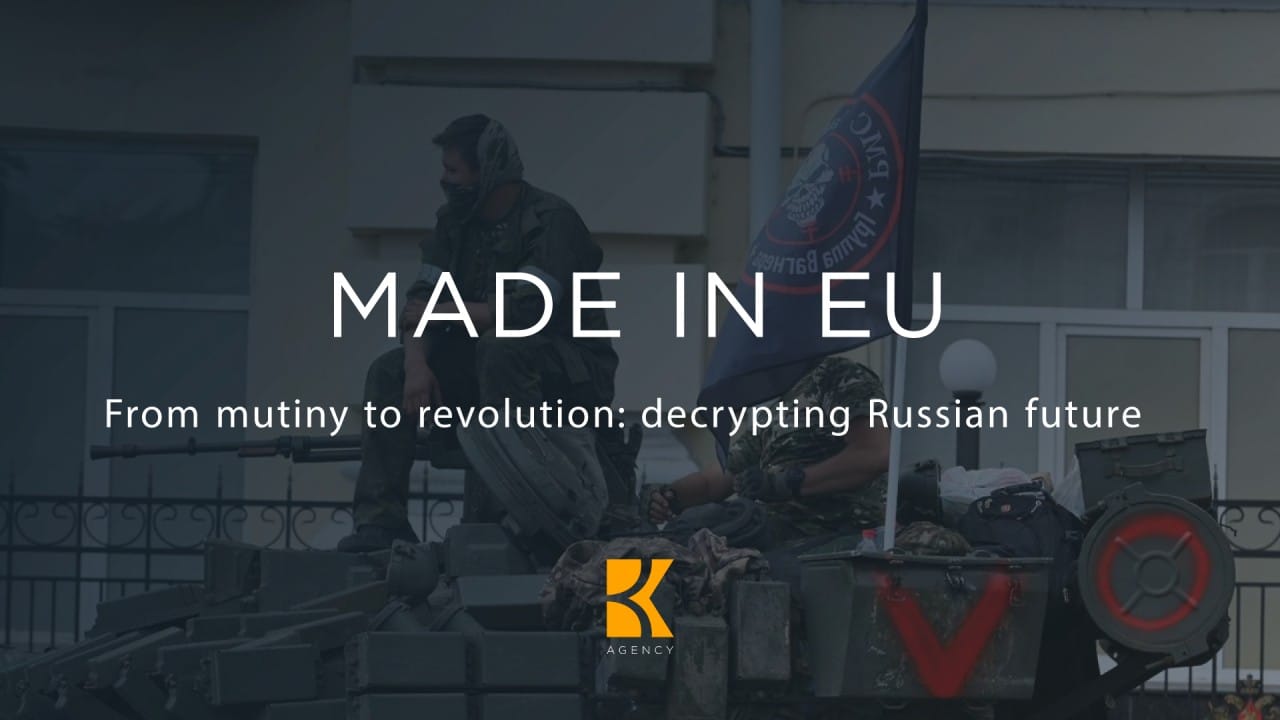
In today’s edition, we dive into Prigozhin’s June mutiny and try to sketch future scenarios for Russia through the lenses of international protagonists. Enjoy the read!
From mutiny to revolution: decrypting Russian future
CIA director William Burns claims that Prigozhin’s mutiny has been the most direct attack ever brought against the Russian state in Vladimir Putin’s 23 years in power, a direct challenge to the Russian state.
Given the level of approximation finally shown by the leader of the mercenaries, it is harder to believe. Still, on 24 June, for a few hours at least, a window of opportunity for a regime change in Moscow opened in earnest.
The Washington Post, quoting senior Western officials, describes in great detail the paralysis the Russian president experienced in the first hours of the attempted uprising.
Vladimir Putin is alerted by the secret services 48-72 hours before Prigozhin’s moves. Enough to order the raising of the security level to guard strategic structures (Kremlin included) and to distribute weapons to the personnel of the presidential guard, massively deployed to protect the leader. But left unguided, torn by doubts, military structures called upon to manage the situation are also victims of disorientation.
When they see Wagner’s troops enter Rostov, a city of over a million inhabitants penetrated without a shot, the local officials find themselves at an existential crossroads.
The military leaders decide to ‘do nothing’, to stand by and watch. Some of them are convinced that the conspiracy theory circulating on some Russian military blogs is finally confirmed: they believe that the Kremlin somehow orchestrates the rebellion, and they are confident that the president’s angry address to the nation, as well as the arrest order issued against Prigozhin, are nothing more than scenographic moves, cleverly devised by the leadership to muddy the waters for enemies inside and outside the country.
But then the situation soon becomes severe.
These are elements of a larger puzzle, only comprehensible in the logic governing the Russian state, in many ways similar to that of a mafia-like organisation. Former Russian intelligence colonel, Gennady Gudkov, argues that Prigozhin’s challenge showed a Putin ‘unable to make serious, important, quick decisions in critical situations’, that it offered the spectacle of a leader who ‘simply hid’. And this, he warns, ‘was not understood by most of the Russian population. But it has been understood very well by the elites: the president is no longer ‘the guarantor of their security and the preservation of the system’.
In the words of CIA director William Burns, Prigozhin has done away with the more or less tacit social pact Putin proposed to Russian oligarchs more than two decades ago: keep out of politics in return for high living standards and eternal impunity.
This is where the dangerous disorientation arises.
For years, Mikhail Borisovich Khodorkovsky, an oligarch in exile for the past few months whom Moscow has classified as a ‘foreign agent’, has been studying revolutionary tactics, devising strategies, making influential contacts in anticipation of the hour, which he says is getting closer and closer, when his sworn enemy will leave power. When that day comes, democratic Russia will have to be ready, he says. It will have to do the opposite of what it has done in recent years. Actually, in recent weeks. Because insinuating itself into the Kremlin’s apparent weakness was possible.
There is a reason, then, why Khodorkovsky, in the first hours of the uprising, calls on Russian citizens opposed to the war in Ukraine to take to the streets to side with the ogre Prigozhin. It happens because he knows the urgency is to bring down the regime. This is because Khodorkovsky also knows something else: crucial to his march is the active support of the army and the population.
And it is precisely the capital that becomes key. In those minutes, the people of the capital must take to the streets to show their support for the domestic opponent to call for the regime’s ouster. Under those conditions, according to Khodorkovsky’s calculations, unthinkable numbers are not even needed. With thousands of troops deployed from the centre, called to defend the outer belt of the capital, unarmed 15-20,000 people on the streets are ‘enough’ to shake the regime, to drive it out.
In this state of chaos that 10-15 thousand people ready to take ‘active measures’ should take up arms: take control of state buildings, occupy communication centres, and free political prisoners. There it is, the dark side of the moon, the one that Russia’s democrats, until now, have refused to explore.
This a double regret since, according to Khodorkovsky, the revolutionary potential exists. It is enough to observe the support that many young Russians show in Prigozhin during the hours of the uprising, and their indignation at the sudden reversal, just a few kilometres from Moscow.
And this is where the critical question arises: what role can the West play in this process? Khodorkovsky suggests that the West must realise that as long as the Putin regime continues to exist, long-term peace on the continent is impossible; changing this regime without the intervention of internal Russian forces and using force is unfeasible. In his words: “The West must understand that, in its desire to lead the revolutionary process, the Russian democratic opposition will be forced to lift the internal ban on the use of force and the threat of using it in its clandestine struggle, excluding only extreme terrorist methods; and that in the modern world, such work requires the technological support of communications companies and the lifting of certain bans by Western states. It must also recognise that part of these revolutionary tactics will require the use of one group of Kremlin gangsters against another; that recognition of the democratic coalition as the political representative of the part of Russian society that does not support the Putin regime would be substantial moral support; and that such support would allow the part of Russian society that can act against Putin to unify more quickly and broadly, and to accelerate coordination with the West. Finally, the West must consider that, if drawn up with the Russian democratic coalition in mind, sanctions – and the procedure for lifting sanctions – could become an important element in encouraging participation in the fight against the regime”.
For the Russian democratic opposition, this is not year zero. Something moves towards what Khodorkovsky calls ‘acceptance of the inevitability of an underground struggle involving the use of force – or the threat of force – during the upcoming confrontation with the Kremlin’. Because this is what he does not doubt: another opportunity will come again sooner rather than later.