In today’s edition, we try to give you a perspective on how the second richest country in the EU got socially broken. Enjoy our analysis!
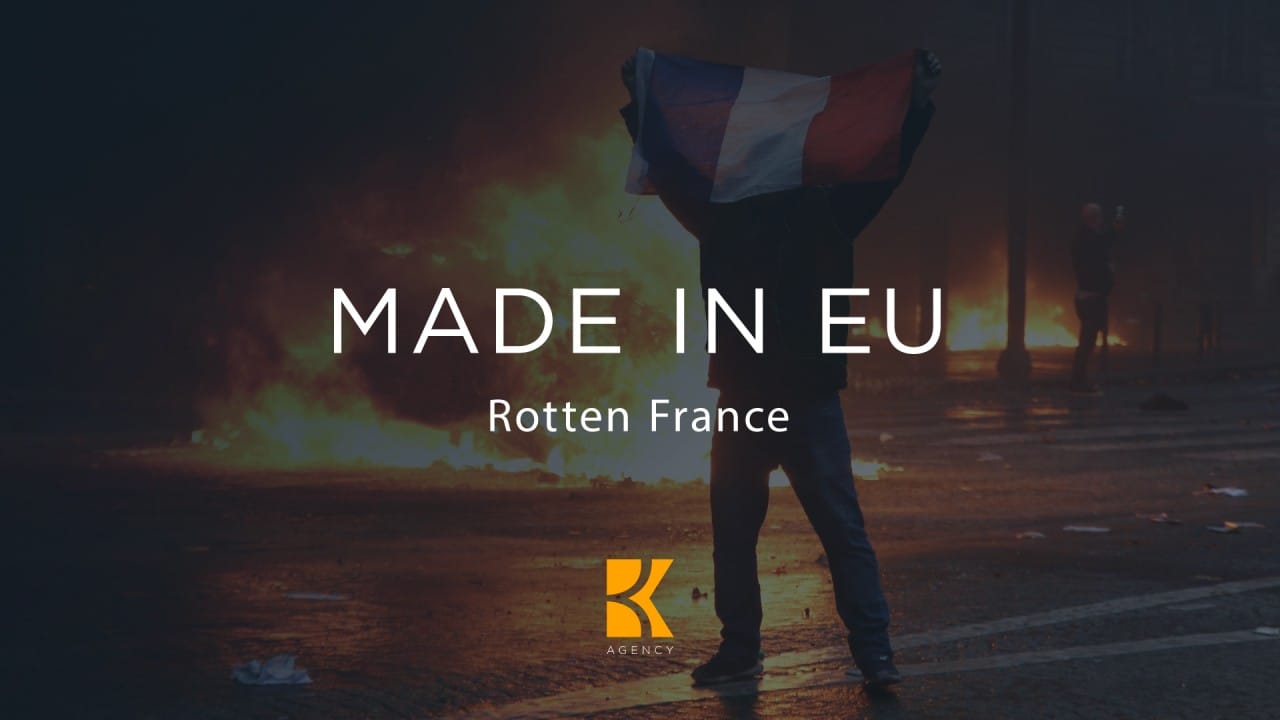
Rotten France
“Everything was stolen, even the cash registers before they set fire to destroy”, said Geoffroy Roux de Bézieux, president of the leading association of French entrepreneurs, about the stormed businesses. According to the transport authority in the Paris region of l’Ile-de-France, the damage to public transport amounts to EUR 20 million.
Elsewhere in France, violence has targeted many symbols of the French Republic: schools, police stations, libraries, and other public buildings.
France is rotting in violence: clashes and protests continue in Paris and other cities, including fires and looting. It all started after the killing of Nahel, a 17-year-old boy, who was shot dead Tuesday of last week in Nanterre (near Paris) by a policeman during a traffic control. The officer who killed the boy is being investigated for voluntary manslaughter and is in pre-trial detention. Immediately after the facts, Emmanuel Macron had strong words for the episode, calling the young man’s death ‘inexplicable’ and ‘unjustifiable’, saying that ‘nothing justifies the death of a young man’. But the uprising still inflamed France, starting in the Nanterre banlieue and igniting one after the other all the other suburbs of Paris and beyond. Suburbs that have never been pacified, where, as the events of these days show, anger soon turns to violence.
What is really happening in the country? France has a long history of immigration: a country sparsely populated if compared to its size and repeatedly involved in ruinous wars.
It has had a demographic and labour market supply problem for at least two centuries. This, combined with industrial development and colonial history, has made France one of the main poles of attraction for immigration in Europe. In 2021, 7 million immigrants resided in France, accounting for 10,3% of the residents, according to the INSEE.
At the same time, the country has historically cultivated an inclusive approach towards newcomers and their children: five years to access citizenship and almost automatic right of soil (ius soli) for those born in France. Turning foreigners into Frenchmen is still a guiding principle of immigration policies, albeit more cautiously in recent decades.
France does not like communitarianism and does not even collect ‘ethnic statistics’, e.g., on school results, for fear of constructing distinct population categories. The republican idea of the nation as the common matrix of all citizens remains a guide, especially regarding immigrants.
However, greater pessimism about the effective integration of immigrants, mainly North Africans of the Muslim religion, has grown in the new century. France under Sarkozy implemented an at least symbolic turn in its policies towards immigrants, introducing the concept of ‘civic integration’ and asking newcomers to adhere to an ‘integration contract’: integration was recodified from a public policy objective to a commitment of ‘loyalty’ for resident foreigners. As and more than in other countries, language tests at various levels (entry, long-stay permit, naturalisation) should check the progress of residents on the road to integration.
However, that hasn’t stopped the rising polarisation after the Bataclan and Nice terrorist attacks. The polarization does not only invest politics but also ordinary citizens, as shown by the collection for family members of Nanterre policeman that raised almost one million euros.
Many French parliamentarians are also mayors of their cities, and while in the National Assembly, they proclaim the principles of secularism, at the local level, they have no problem inaugurating mosques, receiving Muslim delegations, and financing Islamic associations. It is a matter of seeking votes and noting that religious institutions help build cohesion and solidarity among foreign enclaves under challenging suburbs.
Even in France, immigration policies are the stakes of symbolic conflicts that hinder the search for pragmatic solutions to problems of an essentially social nature.
After the riots, French President Macron must fix a broken France.
The roster of meetings at the Elysée Palace is a familiar sight and a sign that the government is in crisis mode: the need to reconcile the country and embody law and order at a time when his margins for manoeuvre are limited after losing a parliamentary majority last year is no small task for Macron. Decades of public spending on integration projects have led to short-sighted and temporary solutions without tackling the issue’s core: France needs to fix its internal migration policy, or the spectrum of a civil war won’t be relegated to a populist discourse anymore.