In today’s edition, we analyse David Cameron’s unexpected comeback to British politics and the world stage. Enjoy!
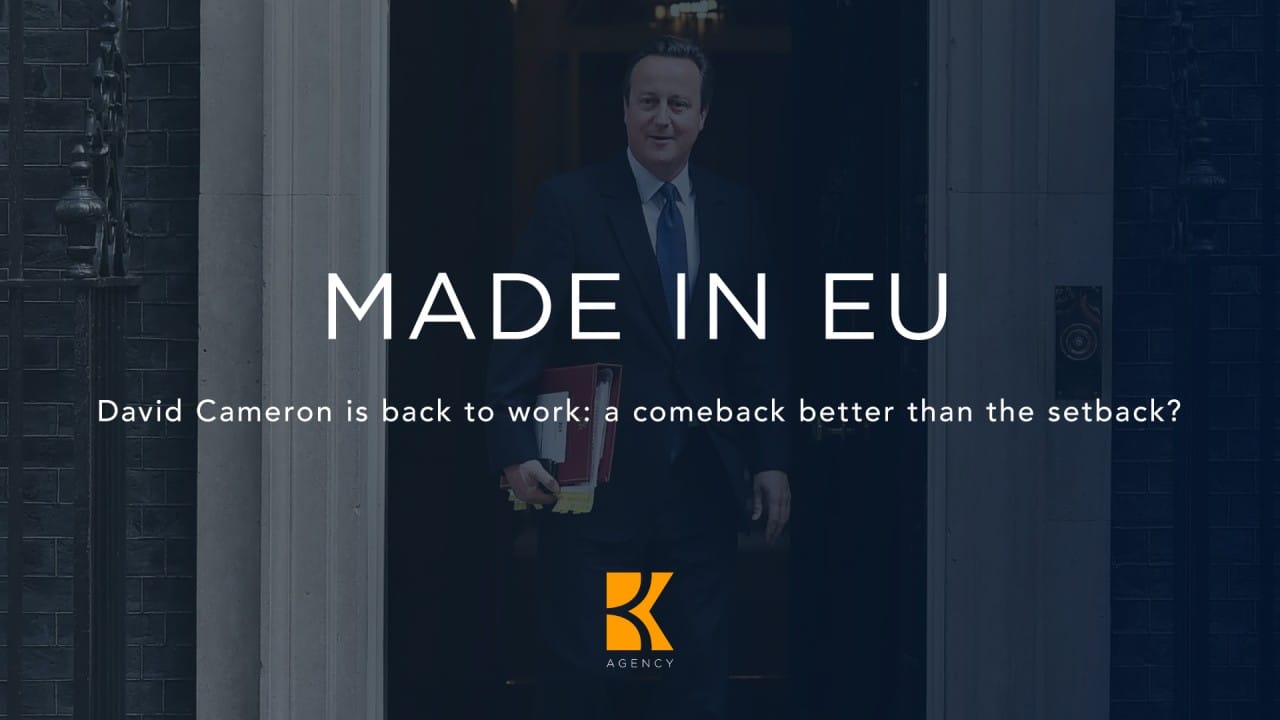
David Cameron is back to work: a comeback better than the setback?
It was minutes before 9 a.m. on 13 November when a black car pulled up in Downing Street, and David Cameron popped out, trotting up the road to the door of No.10 like he never left. Westminster took a sharp intake of breath and still hasn’t quite come to terms with it.
Just half an hour before, as part of a broader government reshuffle, top U.K. interior minister Suella Braverman was fired by Prime Minister Rishi Sunak after she accused police of ‘playing favourites’ ahead of a weekend Pro-Palestine demonstration in London.
However, David Cameron’s comeback to a position in Government has many implications and carries more significance than previous attempts at a “reset”, both inside and outside Britain.
First point. David Cameron is not a rookie. Seven years out of the political game do not erase his eleven years as leader of the Conservative Party, let alone his six as Prime Minister of the United Kingdom. His unexpected comeback shows that we are discussing a heavyweight in British politics.
Internationally, Cameron will not need too many introductions or a settling-in period. He will likely be left almost entirely in charge of the foreign dossier during maximum tensions in Ukraine and the Middle East.
While finding a more ‘authoritative’ candidate among the Tories for the role of Foreign Secretary was challenging, Cameron’s foreign policy during his tenure as Prime Minister left many raised eyebrows. We are talking about the prime minister who has invested much of his political capital in the ‘Golden Age’ of relations with China.
When the Chinese leader Xi Jinping visited the UK in 2015, the back-then PM Cameron inked an estimated £30bn of trade and investment deals.
One of the most significant developments of that visit was the decision to allow Chinese involvement in the UK’s civil nuclear programme.
Since leaving office, Cameron has continued to engage with Chinese interests, behaviour that has attracted criticism from the increasingly vocal figures in British politics who are critical of the UK having a close relationship with China.
On multiple occasions, Rishi Sunak declared the golden era of UK-China relations to be over, as the British government is increasingly concerned about the security implications of Chinese investment in the UK’s critical infrastructure.
On this issue, many Tories MPs will want to verify that Cameron is a minister in the Sunak government and will abide to the PM’s line. At the same time, the US cannot afford to have his closest ally floundering and jeopardising the geopolitical priorities of the Western camp. Moreover, Cameron was also the Prime Minister who backed former French President Sarkozy in the unfortunate decision to bomb Libya without a credible post-Gaddafi plan. And he is also the one who lost a crucial vote in the Commons in 2013 on possible UK military action alongside the US in Syria, being defeated by his own MPs.
On the most pressing issues, Cameron is a supporter of Ukraine (in the first weeks of the invasion, he personally drove vans of humanitarian aid to Poland), but there is no shortage of shadows in his past relationship with Vladimir Putin. When it comes to Israel, David Cameron is undoubtedly a staunch backer of the Jewish State, but in the past, some of his statements were controversial, above all the one in which he called Gaza ‘a prison’.
The domestic front is no less critical. Let us expect several stomach aches in the coming week in the more conservative fringe of the Tory party. Cameron is a liberal and a moderate. Years ago, it is no coincidence that someone dubbed him ‘Tory Blair’. With his appointment, Sunak probably hopes to recover some of the ‘blue-wall’ voters in the south who voted against Brexit. The aim is to fend off the advance of the Lib-Dems in this segment and to attract (and federate) all the souls of the alternative world to the Labour bloc.
On the EU’s side of the Continent, Maros Sefcovic, the EU Commission Vice President overseeing European Union relations with Britain, extended congratulations to James Cleverly, the newly appointed Interior Minister. Cleverly’s tenure as Foreign Minister under Prime Minister Rishi Sunak marked a significant shift in post-Brexit EU-UK relations. The relationship transitioned from stubborn, bitter stand-offs to pragmatic negotiations, resulting in several key achievements.
During the current year, Cleverly and Sunak’s administration successfully negotiated a simplified shipment process from mainland Britain to Northern Ireland, avoiding a hard border with the EU member state, Ireland. Additionally, they signed a cooperation pact on financial services and agreed to Britain rejoining the EU’s flagship Horizon scientific research program.
Both parties are now working towards a deal to prevent tariffs on electric vehicle trade. Notably, the EU and Britain have collaborated closely within NATO and the G7, particularly in imposing sanctions against Russia.
It will now be up to David Cameron to maintain the progress made in the EU-UK revived partnerships after several difficult years following the 2016 shock.
It was a government merry-go-round likely to have profound implications for the course of British politics for the next 12 months. Prime Minister Sunak will likely be able to concentrate on the domestic front in the run-up to the vote: from now on, proving himself capable of winning the next election becomes Sunak’s political priority. Cameron will be left almost entirely in charge of the foreign dossier during maximum tensions worldwide.
There is no place more than the United Kingdom where time is a gentleman.