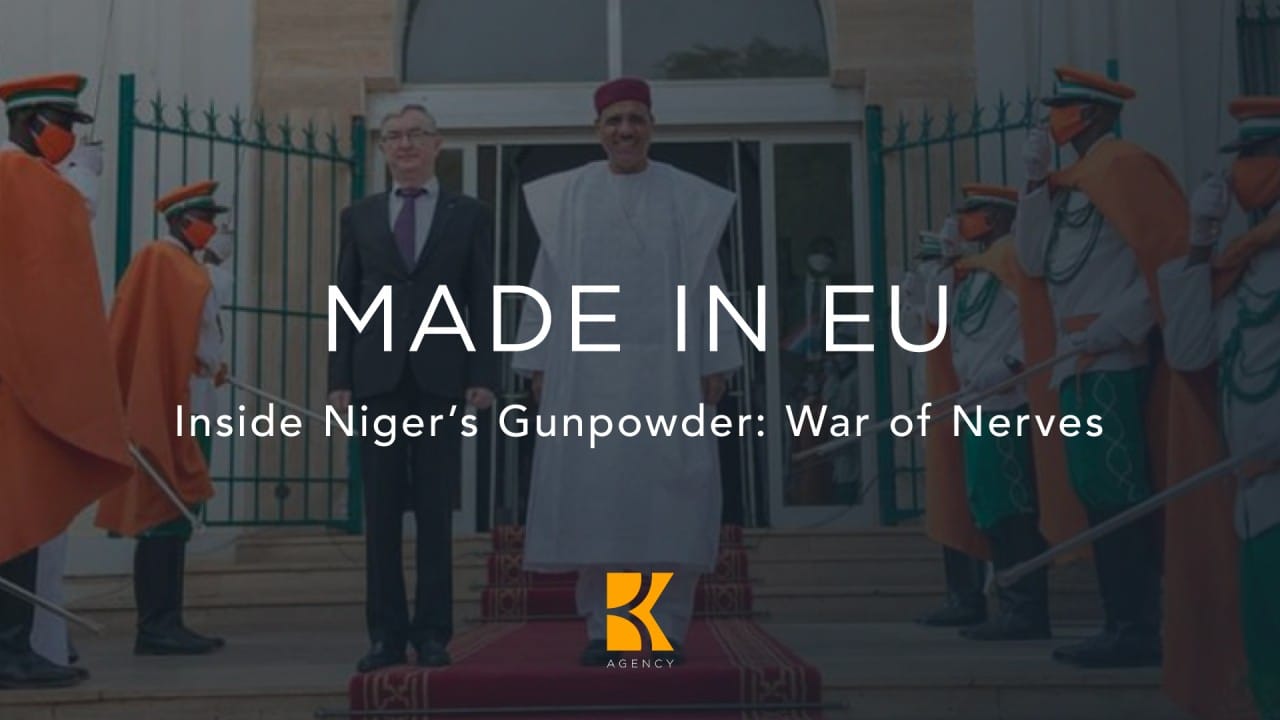
In today’s edition, we bring you inside Niger’s gunpowder. Could Africa be the next battlefield of the tensions between the West and Russia? Enjoy our analysis!
Inside Niger’s Gunpowder: War of Nerves
At dawn on 26 July, the legitimate president of Niger, Mohamed Bazoum, still has no idea that his life may be in danger. Recently there have been tensions with some elements of the presidential guard, but a coup is not on anyone’s mind. Inside the palace, then, the head of state feels safe. So, when armed men tell him that a coup d’état is in progress and that he will soon be deposed, Bazoum is surprised.
No one touches a hair on his head. And the same goes for his family members. Because as hostages, they represent their captors’ most valuable asset, the only life insurance policy for the coup plotters. But who is the instigator of the conspiracy? Who betrayed President Bazoum?
There is little doubt, at least about this: it was Abdourahmane Tchiani, the commander of the presidential guard.
When Bazoum came to power in the spring of 2021 to preserve the delicate balance of a country scarred by coups, he resisted the temptation of a repulisti, agreeing to keep Tchiani in his post, even though he was aware of his loyalty to former President Issoufou.
For some months now, however, an idea has been brewing in Bazoum’s head: he wants to change the army’s structure to surround himself with people he trusts. He needs it, Europe needs it, as Niger represents the last western outpost in the Sahel, after that, Mali and Burkina Faso have fallen.
And so here it is, the bone of contention. The spark that ignites the fire.
This controversial general of the Niger army does not accept the hypothesis communicated to him a few days earlier: the idea of being replaced as head of the presidential guard did not sit well with him. After all, it is not a trivial role. It is a matter of power. The division consists of around 700 men, augmented by some 20 armoured vehicles: tasty morsels for anyone aspiring to have a say in the country.
Many things are said about Tchiani in Niger. Still, one is more disturbing than others: the accusation, never officially proven, that he had already taken part in a coup attempt, in that case, a failed one. This experience may allow him to move with ease and to think of all the details valid for the success of his plan. First, he has all entrances to the presidential palace blocked; then, he sends his snipers to the rooftops to ensure that no one approaches and that someone doesn’t get the idea to stage a raid to free the hostages.
The first dispatches from Niamey, the first reports of a potentially critical situation for President Bazoum, are enough for alarm bells to ring in the West.
Who can communicate with the coup plotters? Who can establish contact to convince them not to commit rash actions? Everyone thinks of one man: Mahamadou Issoufou, Bazoum’s predecessor, the man General Tchiani has sworn allegiance in the past.
As soon as rumours of a coup spread in the capital, his security raised all security measures to protect him, preventing Issoufou and his wife from leaving their residence, fearing that someone might be interested in removing him from the scene. Yet suspicions are also gathering around the former president: right from the start, some identify him as one of the possible coup instigators, given his closeness to Tchiani. Issoufou denies all charges and publicly condemns the coup attempt to prove his good intentions. He then picks up the phone. He speaks to the president of neighbouring Nigeria, Bola Tinubu, and those of Guinea-Bissau and Benin, all interested in understanding what is happening in Niger and what action could be taken to restore order. To each of them, Issoufou explains that he is in contact with Commander Tchiani, that he has even met him three times since the coup began, but that he has in no way succeeded in bringing him to his senses.
By the hour, the situation seems to be precipitating for President Bazoum. At first, confronted by Tchiani, the Niger leader is convinced he can get back in the saddle by conducting ordinary negotiations. But it takes little to realise that the negotiations will not achieve the goal. A pessimism that quickly starts to infect Niger. On day two, Russian flags appeared among the demonstrating crowd.
People shout anti-French chants. Wagner’s leader, Evgenij Prigozhin, who has made Niger an outpost of Russian regional interests, congratulates Tchiani. Even the hope of an intervention by the army, long trained by Western troops, suddenly seems to be dashed. Tchiani appears on state TV, making the seizure of power official. Is it all over? Perhaps not. For President Bazoum, hope still exists.
Many of the army seem not to have abandoned the legitimate president to his fate. The country risks becoming the umpteenth gunpowder of the Sahel. This is one of the few reasons why the Western powers, for the time being, believe that something can be done to save the Bazoum presidency. The Niger leader has refused to resign, while an interim government led by the foreign minister, Hassoumi Massaoudou, has appealed to ‘all patriots and democrats of Niger’ to reject the coup. The feeling, however, is that an internal outburst of pride will not be enough to restore the established order.
They say Nigeria’s newly installed President Bola Tinubu is nothing short of furious, even tempted to test the mutineers. The Beninese Patrice Talon even took the trouble to travel to Niamey, except to backtrack once he realised that the coup plotters had no credible representative with whom to negotiate: ‘All means will be used to restore constitutional order in Niger,’ he warned, however. Strong words, to the point that some have interpreted them as not excluding a military intervention. In this regard, there are rumours of a time window of about two weeks to make a final decision. That is if there is time. To not violate international law, the operation must be blessed by the UN Security Council (and Russia could veto it) or be officially endorsed by Bazoum himself.
Side note: in St Petersburg, during the Russia-Africa summit, the Kommersant, a daily newspaper very close to Vladimir Putin, used to quip: ‘If only Mohamed Bazoum had decided from the outset to participate in the summit, he would not have had such problems…’. When they say, “What goes around, comes around”…