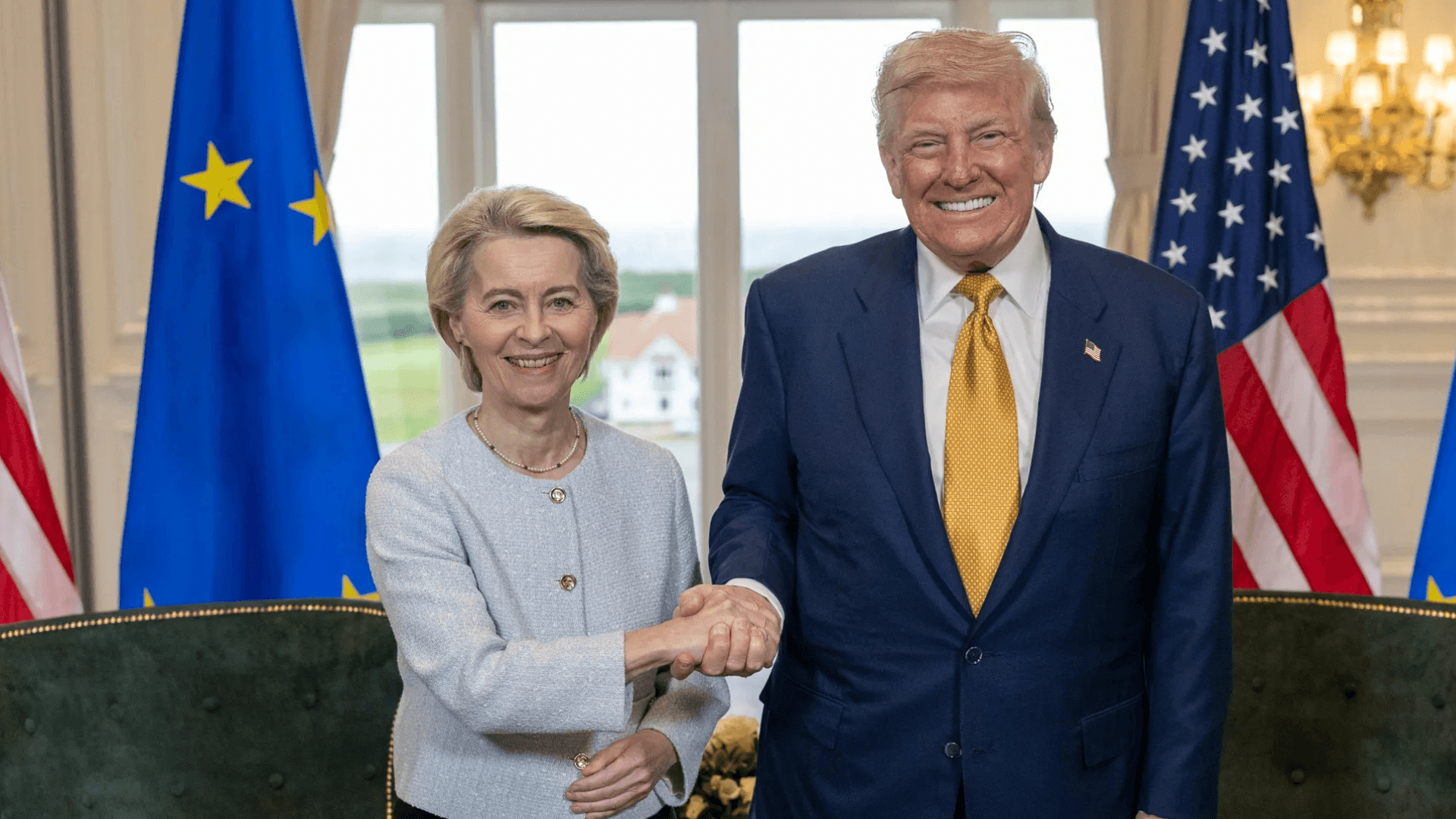
The European People’s Party and its Spitzenkandidat Ursula von der Leyen won the European elections. The EPP not only confirms itself as the leading group in the next European Parliament, but with 185 seats, it increases its share of elected representatives. According to the almost final results, the Socialists & Democrats group is expected to gain 137 seats, leaving its number of MEPs unchanged.
The Liberals of the Renew Group come out heavily downsized with 79 elected, some 23 fewer, but retain their third place in the European Parliament. The success of the nationalist parties was less significant than the polls predicted. The national-conservative group European Conservatives and Reformists gains 73 seats, while the far-right group Identity and Democracy stops at 58 elected, scoring a +8 compared to the previous term but falling short of becoming an incontournable force in the hemicycle. The Green group slips to sixth place with 52 seats, while the Left group remains last, with 36 elected.
However, the projections are set to change in the coming weeks and months: about a hundred of those elected belong to the non-attached category or are classified as unaffiliated. The buying campaign by the groups is already underway.
Von der Leyen’s future
In her speech last night, von der Leyen stressed that “the centre is holding”. Meaning: she would first seek support from the socialists and the liberals, who backed her for her first term. The hypothesis was clearly supported by the EPP President in the EP, Manfred Weber, who called French President Macron and German Chancellor Scholz to officially support the former German Defence Minister for a second term. If, in the days and weeks ahead, EU leaders agree to nominate von der Leyen for a second term, she will still need the support of 361 MEPs in the newly elected Parliament. That will involve striking alliances with other parties on the centre, left or even — potentially — further to the right.
This is where the game begins: on paper, the numbers appear to be in her favour. Combined, the three groups — the EPP, Socialists & Democrats, and Renew — are projected to hold 402 seats in the European Parliament, according to recent figures. She needs only 361 votes to secure her nomination.
However, not all EPP lawmakers will support her, particularly the French EPP politicians who view her as a loyalist to their rival, French President Emmanuel Macron, rather than their political family.
Experts and party officials estimate that more than 10 per cent of lawmakers in each of the three centrist groups — including her own EPP — will either oppose her or abstain from voting.
More intriguingly, she will probably need to look beyond these groups to gather the necessary support. This could involve some risky decisions: she might seek support from the Greens, but this could alienate some conservative members of her own EPP who oppose key Green Deal climate measures.
On the other hand, if she decides to continue courting the ECR President and Italian Prime Minister Giorgia Meloni, she risks losing the support of the socialists and liberals.
The centre and left are likely to be particularly wary of any alliance with hardline right-wingers, especially after the far right’s significant gains in France and Germany.
The capitals’ future
Voilà voilà. Polls predicted, French citizens delivered. A surge in far-right populism in France prompted President Emmanuel Macron to call a high-stakes national election that could shape the future of both his country and the European Union.
The far-right National Rally, led by Marine Le Pen and her enfant prodige Jordan Bardella, overwhelmingly defeated Macron’s liberal Renaissance party and other contenders.
The National Rally secured 31.5 per cent of the vote — more than double that obtained by Macron’s Renaissance party.
Macron gambled that voters would reject the far-right surge and demonstrate that Marine Le Pen’s National Rally cannot succeed at a national level in a bold move to reclaim political dominance.
“France needs a clear majority in serenity and harmony. To be French, at heart, is about choosing to write history, not being driven by it,” Macron stated.
The National Rally’s performance in the upcoming snap elections on June 30 and July 7 will be closely watched as an indicator of whether Le Pen—long a secondary figure in French politics—can leverage her party’s momentum into a presidential bid in 2027.
On the other hand, Macron’s gamble could be successful in putting a brake on Marine Le Pen until 2027. There are two options on the table: a) either a winning cordonne sanitaire of voters will secure Liberals, Republicans and a left coalition enough seats to outnumber Le Pen’s MPs, or b) if she wins, as a President of the Republic Macron would be able to veto any legislative initiative she might take until 2027.
The far-right surge in France was mirrored elsewhere in Europe. In Berlin, Olaf Scholz’s ruling coalition parties were defeated by the far-right Alternative for Germany (AfD), which finished second to the conservatives of the CDU (which obtained a remarkable 30,2 per cent) with an all-time highest score of 16 per cent, compared to less than 14 per cent of preferences for the socialists. The real question is whether Scholz’s government will survive. German coalitions rarely collapse before the end of a term, but this one is atypical because it includes three parties (Socialists, Greens and Liberals) instead of the customary two of the Grosse Koalition, which makes it more volatile.
Een zwarte zondag (Black Sunday) was avoided in Belgium, where citizens (and a significant number of expats) voted to renew the European Parliament, as well as the federal and regional governments. ID-affiliated Vlaams Belang’s rise, which since 2019 was predicted to become the first party in the country, was stopped by the Flemish nationalists of the N-VA (ECR) and his leader Bart De Wever, who unexpectedly scored 16,7 per cent at the national level against the 13,8 per cent of the far-right party. The French-speaking liberals of the MR (Renew) scored an all-time high since 1975, with 29,6 per cent of preferences in Wallonia. However, the results didn’t come without a shock: following the disastrous score (five per cent) of his party Open Vld (Renew), Prime Minister Alexander de Croo resigned, leaving now to De Wever’s N-VA the possibility to start negotiations to form a new government. De Wever’s idea is to form a minikabinet to pass a much-needed constitutional reform to transform Belgium into a confederation and a comprehensive budgetary reform to face a critical public deficit, which starts to be a concern in the EU. However, Belgium as a country should continue to exist for the next five years, too.
Moving to the sunny south, Rome speaks Giorgia Meloni’s language. Prime Minister Giorgia Meloni’s conservative Brothers of Italy group secured the most votes in the recent European parliamentary election, enhancing her domestic and international influence. With nearly all ballots counted, Brothers of Italy achieved 28.8% of the vote, more than four times its share in the 2019 EU election and surpassing the 26% it garnered in the 2022 national election, which brought the party to power.
The opposition centre-left Democratic Party finished second with 24% of the vote, while the 5-Star Movement came in third with 9.9% — its worst performance since its founding in 2009. The EU ballot indicated that Meloni’s ruling coalition, which spans from the centre-right to the far-right, saw its support increase to over 47% from just under 43% in 2022.
Forza Italia, founded by the late Silvio Berlusconi, placed fourth with 9.7% of the vote that, coupled with their regionalist allies of the SVP, reaches 11%, surpassing Matteo Salvini’s League, which had 9.1% and his founding father, Umberto Bossi, voting for another party.
Speaking on the radio, Meloni said it was too early to decide whether she would support a second term for centre-right European Commission President Ursula von der Leyen. Her party’s lawmakers could be pivotal if Meloni backs von der Leyen, potentially giving Rome leverage over the new EU executive.
Sunday also marked a significant success for Meloni’s main opponent, Elly Schlein, who took over the centre-left PD party in 2023 and had struggled to assert her authority. The PD improved on its 19% share from the 2022 national election.
The hard-left Green and Left Alliance won about 6.7%, ensuring that its candidate, Ilaria Salis, an Italian activist detained in Hungary for allegedly assaulting far-right militants, is now an EU lawmaker.
In Spain, an attempt to present the election as a plebiscite on Prime Minister Pedro Sánchez failed: his Socialist party nearly tied with the centre-right People’s Party (34 vs 30 per cent), undermining the conservatives’ bid to use the results to bring down his minority coalition government (for now).
Looking east, centrist, pro-European and pro-Ukraine parties saw significant success or a strong affirmation.
In Poland, final results show Prime Minister Donald Tusk’s centrist Civic Coalition (KO) won with 37,06 per cent, positioning itself as the leading political force, narrowly ahead of the national-conservative PiS (ECR), which obtained 36,16 per cent of the preferences. The result means that yesterday’s elections are the first since 2014 in which PiS has failed to finish first. During that time, the party or its candidate came top in eight consecutive elections – parliamentary, presidential, local and European.
Amid the ongoing war in Ukraine and a migrant crisis on the Belarus border, Tusk portrayed the Polish vote as a crucial decision between a secure, EU-aligned future and a riskier path under the nationalist Law and Justice (PiS) party, known for its disputes with Brussels.
Hungary saw Prime Minister Viktor Orban’s nationalist Fidesz party secure the top spot, but with its poorest performance (43,8 per cent) in nearly twenty years in national or EU elections. Support increased for the pro-European Tisza party (31 per cent), led by newcomer Peter Magyar who promises to combat corruption and restore democratic checks and balances, reportedly weakened under Orban.
In Romania, the ruling coalition of the leftist Social Democrats (PSD) and centre-right Liberals (PNL), running on joint lists, achieved 54% of the votes. The far-right AUR, founded five years ago, placed second with 14% of the votes.
In Slovakia, the liberal, pro-Western opposition party Progressive Slovakia (27,81 per cent) defeated the largest party in the leftist-nationalist government, SMER-SD (24,76 per cent), led by Prime Minister Robert Fico, who recently survived an assassination attempt.

What these elections mean for the EU policy agenda
The European elections have set the stage for significant changes in the EU’s political landscape and policy agenda. The rise of the far-right in France and Germany, coupled with the consolidation of conservative parties in Belgium, Italy and other member states, will likely push the next European Commission’s agenda towards a more conservative stance on different topics in order to counterbalance the populist narrative of those parties. For instance, we could witness a recalibration of many chapters of the European Green Deal, with the centre of attention shifted towards competition, job creation, and economic growth.
The far-right’s and conservative’s gains will also increase pressure on the EU to address issues such as immigration, security, and national sovereignty. This could lead to a more restrictive approach to immigration and a greater focus on protecting national borders, as already preconised by the Commission’s green light to the Italy-Albania migrants deal. However, sic stantibus rebus, this shouldn’t significantly impact the next Commission’s agenda on EU enlargement.
The election results will also have implications for the EU’s foreign policy. The rise of nationalist and conservative parties could lead to a more assertive EU on the global stage, resulting in a more confrontational approach towards countries such as Russia and China while waiting for the US Presidential election.
The coming months will reveal how this new political landscape will shape the EU’s policy agenda and its relations with the rest of the world. What remains is once again a great exercise in democracy which the European Union has demonstrated in recent days.