Executive Summary
The current volatility in Iran has transitioned from localised domestic unrest to a systemic risk threatening the architectural stability of the Middle East and the global East-West balance. B&K Agency assesses that the “muddling through” strategy of previous decades is no longer a viable baseline.
We further assess that the Iranian state is currently in a state of terminal friction, where the survival of the Supreme Leader, Aly Khamenei, is no longer the most probably long-term outcome. Instead, the central analytical question has shifted to whether the stat can manage a transition to a constitutional monarchy under the Pahlavi line, or if a pre-emptive military coup will occur to preserve the IRGC’s economic and security interests.
The convergence of a catastrophic currency collapse – with the rial plummeting to 1.48 million per USD in January 2026 – and the military fallout from the “12-Day War” in mid-2025 has created a terminal friction point for the Islamic Republic. The following scenarios outline the potential trajectories of the Iranian state, supported by the latest intelligence on economic degradation, security apparatus loyalty, and the shifting geopolitical alliances involving Russia and China.
Scenario 1: The Syria Model
The “Syrianisation” of Iran represents the most catastrophic scenario for regional security. In this trajectory, the central government collapses but is not replaced by a unified successor. Instead, authority dissolves into a patchwork of ethno-geographic enclaves. This refers to the period of fragmentation and proxy competition observed in ther Syrian civil war, rather than the transition led by Ahmed al-Sharaa in Damascus following the fall of the Assad regime in late 2025. This model focuses on the collapse of the central monopoly of violence.
Current OSINT intelligence indicates that regime control in the Kurdish West and Baluchi Southeast is already functionally compromised, with local councils and militant groups like the Kurdistan National Guard reportedly launching strikes against IRGC bases as recently as 9 January 2026.
If Tehran loses the ability to pay its security forces, these regions would likely assert immediate autonomy, drawing in neighbouring powers such as Turkey and Azerbaijan to secure their borders or pursue irredentist claims. This fragmentation would turn the Iranian plateau into a theatre of permanent proxy warfare. For the global economy, the primary risk is the loss of maritime security in the Strait of Hormuz.
Localised warlord factions, utilising the regime’s residual anti-ship cruise missile (ASCM) stockpiles, could extract transit fees or launch asymmetric attacks, creating a permanent risk premium on global energy prices that would bypass traditional OPEC+ stabilisation efforts.
In such a fragmentation scenario, organised exile opposition groups would seek to exploit the collapse of central authority. The Mujahedin-e Khalq (MEK), currently based in Durres, Albania, lacks meaningful domestic legitimacy or territorial presence inside Iran. Yet it maintains a disciplined external political infrastructure and longstanding relationships with Western policymakers. In the absence of a unified successor state, the MEK could attempt to position itself as a provisional interlocutor or transitional actor in exile-led forums, particularly if recognised by external powers. This dynamic would not stabilise the country. Rather, it would risk further factionalisation by deepening divisions between internal resistance networks, monarchist currents, and residual IRGC-aligned forces competing for post-regime influence.
Scenario 2: Restoration of the Pahlavi Dynasty
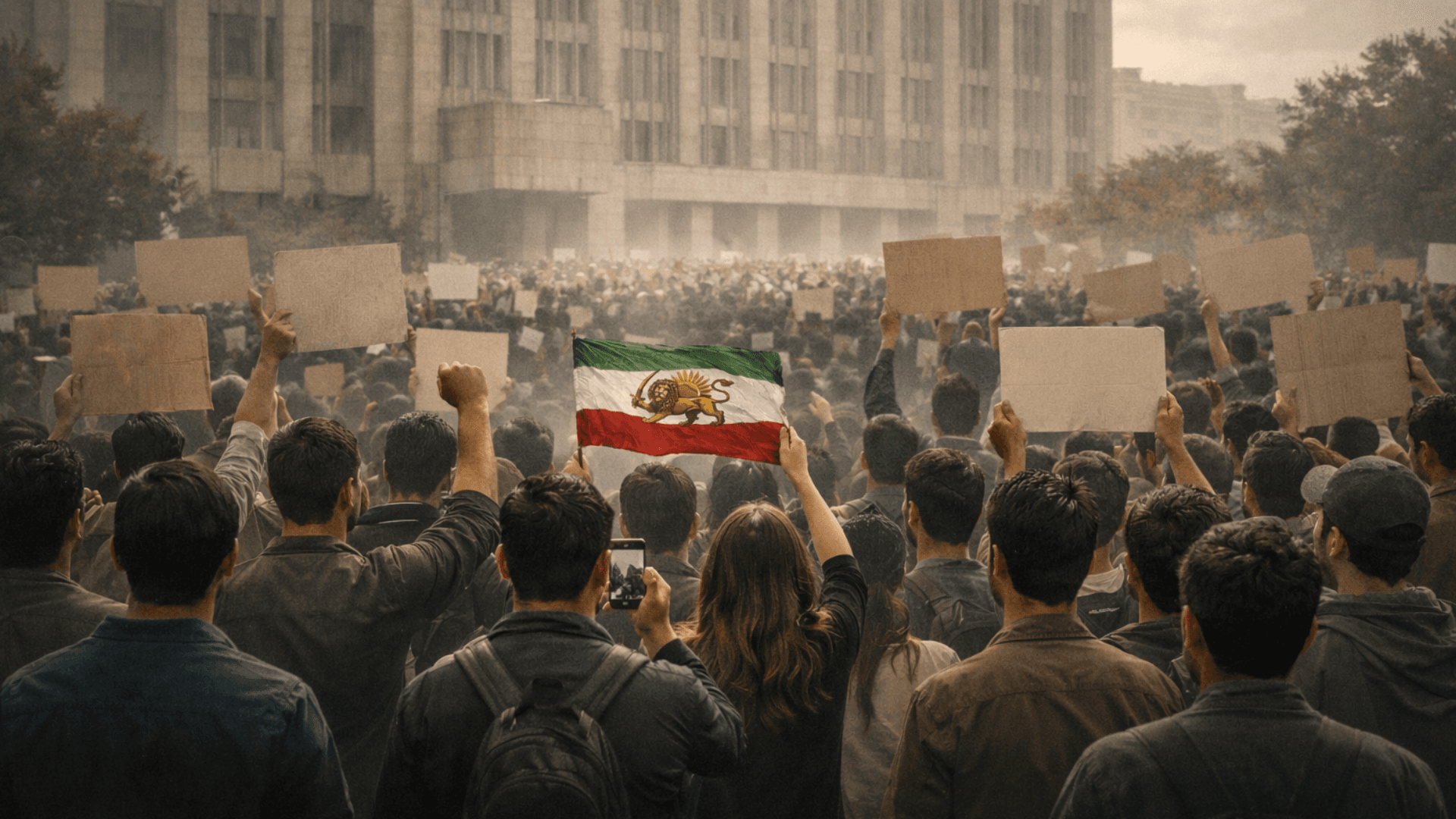
A restoration of the Pahlavi throne, led by Crown Prince Reza Pahlavi, is increasingly viewed by the protest movement as a “unifying brand” capable of preventing total state collapse. This scenario has gained weight following reports that merchants in the Tehran Grand Bazaar and segments of the professional middle class have adopted monarchist slogans to bridge the gap between various opposition factions.
Geopolitically, this would represent a total strategic realignment towards the West. A restored monarchy would likely move to immediately terminate military co-operation with Russia – specifically the export of Geran-3/4 jet-powered drones – in exchange for the lifting of the 2025 UN “snapback” sanctions. Such a shift would severely impact the Russian war effort in Ukraine, potentially depriving Moscow of its primary souce of low-cost loitering munitions and creating a strategic voic in the China-Russia-Iran alliance.
However, the stability of this model is precarious. It depends on the Crown Prince’s ability to prevent a “counter-revolution” by hardline religious elements who still command the loyalty of an estimated 150,000 IRGC personnel. Success requires the integration of the professional military (Artesh) into a new security framework while managing the high expectations of a population suffering from 75-80% real inflation in essential goods.
Scenario 3: The Spanish Model
The most sophisticated path towards a stable, democratic Iran is the “Spanish Transition” model. This specific label draws from the Spanish Transition (1975-1978), where King Juan Carlos I, having been designated the successor to the dictator Francisco Franco, dismantled the authoritarian institutions from within to establish a constitutional monarchy.
In an Iranian context, this would involve the existing military elite or a designated successor negotiating a transition that preserves the state’s integrity while transferring executive power to democratic institutions. This trajectory envisions a dual-track governance structure where a restored Shah serves as a symbolic, non-political head of state – a “secular bridge” – while a multi-party parliament holds executive power.
This model is strategically optimal for the European Union, as it provides a clean break from previous diplomatic failures. The JCPOA, having failed in its primary objective to permanently halt the Iranian nuclear programme, is now considered a dead letter by most Western chancelleries. Under the Spanish Model, the defunct nuclear deal would be discarded entirely and replaced by a comprehensive co-operation agreement, a new legal framework to facilitate the restoration of trade and reintegration of Iran into the global financial system.
By separating the cultural identity of the nation from its political administration, a constitutional monarchy could pacify the traditionalist rural heartlands while satisfying the democratic aspirations of the urban youth. This scenario also offers the highest probability for a permanent nuclear settlement. Recent IAEA reports confirm Iran’s stockpile includes 440kg of 60% enriched uranium, however a democratically accountable government would likely mothball this programme to secure the foreign direct investment (FDI) necessary to rebuild the country’s crumbling energy and water infrastructure, which has been a primary driver of the January 2026 protests.
Scenario 4: Pragmatic Military Autocracy
Facing an existential threat from the streets, the leadership of the IRGC may choose to “save the state by sacrificing the clergy.” In this scenario, the military seizes power in a palace coup, sidelines the clerical establishment, and establishes a secular, nationalist dictatorship. This scenario implies that the Ayatollah and the theocratic superstructure would fall, replaced by a junta that prizes national survival over ideological purity. Evidence for this path lies in the IRGC’s own internal Intelligence Organisation, which recently admitted to dealing with acts of abandonment within the ranks.
Potential contenders for the leadership of such a regime include figures such as Mohammad Bagher Ghalibaf, the current Speaker of the Parliament and a former IRGC commander, or other high-ranking technocratic generals who have historically managed the IRGC’s vast economic conglomerates. This nationalist-military regime would likely grant significant social concessions, such as the total abolition of the morality police and the mandatory hijab, to neutralise the protest movement while maintaining the IRGC’s grip on 30-40% of the national economy. A military-led Iran would likely be nationalist and transactional rather than strictly ideological, allowing it to pivot towards a “Middle Power” stance, playing China, Russia, and the West against each other.
While this avoids the chaos of Balkanisation, it would likely preserve Iran’s ballistic missile arsenal and regional proxy networks, albeit under a banner of national security rather than Khomeinist expansionism.
Scenario 5: Regime Survival
Despite the intensity of the 2026 insurrection, the possibility of regime survival through “Total Securitisation” remains high. In this scenario, the Islamic Republic survives by deploying extreme lethal force against protesters. As of 22 January reports by the UN Special Rapporteur on human rights in Iran, citing doctors inside the country, suggest the civilian death toll may have reached 20,000, while verified figures from human rights organisations like HRANA confirm at least 4,902 deaths following the massive crackdown between 8 and 10 January.
Survival would result in a “North Koreanisation” of the Iranian state: a total digital blackout, the institutionalisation of permanent martial law, and an economy entirely tethered to Chinese energy demand and Russian military technology. Under this trajectory, the regime would likely accelerate its nuclear enrichment to 90% (weapons-grade) as a final deterrent against external intervention.
For the West, this represents a permanent “black hole” in the Middle East – a hyper-antagonistic, nuclear-capable pariah state that uses regional subversion as its primary tool for survival, ensuring that the “Axis of Resistance” remains a permanent fixture of global instability and a constant threat to the flow of global trade.
Implications for the Russia-China-Iran Nexus
Any transition within Iran will have immediate second-order effects on the Russia-China-Iran alliance. A military coup or a Pahlavi restoration would likely see Iran scale back its support for the Russian war effort in Ukraine as it seeks to negotiate the lifting of sanctions and secure its borders. This would force Russia to look elsewhere for tactical drones and ballistic missiles, significantly increasing the cost of its military operations. For China, the collapse of the clerical regime represents a threat to its energy security, as Iran remains a vital node in its “Belt and Road” energy architecture. Consequently, Beijing may move to mediate or support a pragmatic military junta to ensure the continued flow of oil.
For Israel, the internal distraction of the Iranian state provides a strategic window to degrade Iran’s terror proxy networks like Hezbollah and Hamas, which are already suffering from a reduction in financial and arms transfers from Tehran. However, the risk of a “dying sting,” where a collapsing regime launches a desperate missile strike against Israel to trigger a wider regional conflict, remains a credible threat that necessitates high alert for the IDF’s multi-layered missile defence systems.
Concluding Assessment
B&K Agency assesses that the current crisis has reached a definitive decision point between clerical survival, monarchical restoration, and a military-led autocracy. While Supreme Leader Ali Khamenei has survived the January 2026 insurrection through unprecedented brutality, his authority is now functionally restricted to a securitised bunker, leaving a vacuum in civil administration.
Our analysis indicates that a Pahlavi restoration, while possessing high symbolic value for the urban middle class and Western diplomatic circles, remains a low-probability outcome due to its lack of a domestic coercive apparatus. Conversely, the aforementioned “Pragmatic Military Autocracy” led by the IRGC is the most probably successor state.
The IRGC already controls the essential levers of the economy and the monopoly on violence, and a palace coup represents a survival mechanism for the deep state to discard a spent theological ideology in favour of a nationalist-transactional model. For the West, this means the question is no longer “whether” the Ayatollah survives, but how to engage a nuclear-capable military junta that will trade ideological expansionism for regional legitimacy. For Russia and China, the preservation of the Iranian state under a military banner is preferably to a pro-Western Pahlavi restoration, ensuring that while the Russia-China-Iran nexus may evolve, the Eurasian bloc remains structurally intact.