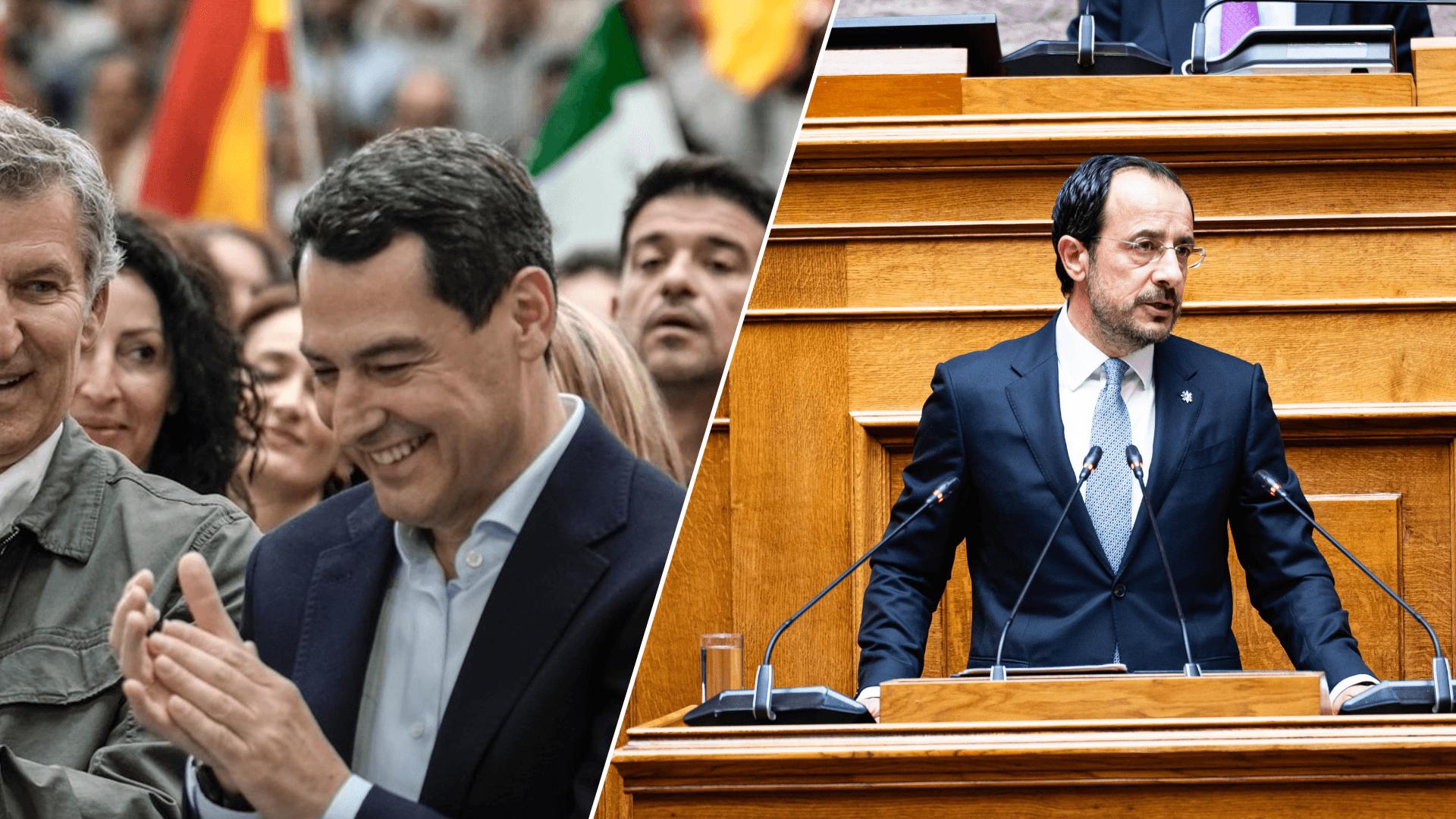
Last week’s regional election in Andalusia saw the doubling of votes for the Spanish far-left and at the expense of the Socialists and the incumbent Partido Popular. This shift could reflect a broader trend in Southern European politics, which will be tested on 24 May when Cypriot voters are headed to the polls to elect their new parliament.
The final results of the Andalusian regional election held on 17 May have delivered a change of course in Spain’s most populous region. Although these elections were framed by the conservative leadership as a referendum to weaken Socialist Prime Minister Pedro Sánchez, the outcome suggests that the internal balance of power within the opposition centre-right People’s Party (PP) has altered.
At the same time, the focus shifts to the Eastern shores of the Mediterranean Sea as Cyprus’ legislative elections are scheduled for 24 May. This election cycle was marked by the newly formed parties consistently polling in the 7-10% range, showing that the traditional dominance of legacy parties can be weakened this weekend.
Breaking Down the PP’s Pyrrhic Victory
The current regional president and a member of the PP Juan Manuel Moreno secured first place but failed to maintain his absolute majority. His list managed to secure 53 out of 109 seats in the regional parliament, which is two seats short of the majority threshold and a drop from the 58 seats won four years ago. The Socialists (PSOE), led regionally by national Budget Minister María Jesús Montero, fell to a historical low of 28 seats. The political vacuum created by the weakening of the two main parties was absorbed by the other political players. The right-wing Vox party climbed to 15 seats, while the left-wing regionalist party Adelante Andalucía experienced a surge, growing from two to six seats.
Moreno’s failure to secure a solo mandate can be explained in several ways. Primarily, a prolonged healthcare controversy that involved regional cancer-screening backlogs damaged the PP’s administrative reputation among centrist and undecided voters. On top of that, the contributing factor was the widespread voter dissatisfaction regarding the hike of urban rents and housing shortages. This was seen as an especially important topic in big hubs like Seville and Málaga, and it detached a segment of the domestic electorate from the PP platform.
At the same time, an important factor that can explain the low result for the legacy centre-left PSOE is the national corruption allegations surrounding the party. The Socialists also failed to capitalise on the PP’s domestic troubles, which in effect pushed some of their dissatisfied left-wing voters to more radical regional alternatives.
National Implication and the 2027 Horizon
Moreno is now forced to negotiate a deal with Vox to secure his place in the office. This reality directly impacts national PP leader Alberto Núñez Feijóo, who has consistently leveraged Moreno’s moderate and centrist image as the way to go for the 2027 general election without dependencies on the right-wing parties. The Andalusian result shifts internal party leverage away from Feijóo’s moderate wing and makes the case for the more identity-driven faction championed by Madrid President Isabel Díaz Ayuso. Ayuso’s recent highly publicised diplomatic friction with Mexico’s government over colonial history reflects an attempt designed to absorb Vox’s base instead of negotiating with them. The Andalusian election signals that the conservative path to the national executive in 2027 will remain structurally bound to Vox, and that in current situation, even the most resilient moderate strongholds need to adapt to the new political reality.
The Cypriot Legislative Election: Newcomer Parties Rise in Polls
The weakening of traditional majorities around the political centre and the rising premium on anti-establishment factions is not isolated to the Iberian Peninsula. This approach mirrors a broader Mediterranean (and some would say European) architecture of political fragmentation. Cyprus faces an interestingly similar fracture ahead of its legislative elections scheduled for 24 May where the voters will decide the allocation of 56 seats in the House of Representatives. The election features a record 753 candidates across 19 political formations, making the competition intense for the 29-seat threshold needed to form the government.
Internal party friction and the loss of public trust have weakened the traditional duopoly of the center-right Democratic Rally led by Annita Demetriou (DISY) and the left-wing Progressive Party of Working People led by Stefanos Stefanou. While both are projected to remain the largest parliamentary blocks, their overall numbers are expected to fall. The far-right National Popular Front led by Christos Christou (ELAM) is on the path to secure a historic finish as the third largest parliamentary faction, overtaking the centrist Democratic Party for the first time. ELAM has successfully institutionalised its presence by capturing mainstream right-wing voters – this process was accelerated by people from the legacy parties, such as former DISY vice-president Marios Pelekanos, becoming the representatives of ELAM.
The electoral math is further complicated by two significant anti-establishment newcomers capable of clearing the 3.6% parliamentary threshold. First of it is the centrist ALMA party founded in May 2025 by former Auditor General Odysseas Michaelides following his highly controversial institutional dismissal. This movement campaigns entirely on a platform of anti-corruption platform and transparency. The other novel player is the Direct Democracy party led by an influencer Fidias Panayiotou; this platform represents a volatile and anti-political movement that has drawn unpredictable polling numbers from historically apathetic younger voters.
Conversely, smaller legacy centrist and left-wing factions are facing a drop in their electoral score, risking complete elimination from the legislature.
What the Future Holds for the Southern Europe
As regions and countries adapt to this fragmentation, the general public must anticipate two scenarios across these jurisdictions.
A fragmented Cypriot parliament that hosts seven or even eight different parties will complicate the forming of stable legislative alliances. Independent President Nikos Christodoulides, who relies on a weakened centrist minority, will face a parliament that will become increasingly less cooperative. Key structural adjustments regarding the policies such as the national pension system reform or energy market deregulation will likely slow down as parties are expected to engage in competitive populist spending to defend their fragmented bases. A parallel reality faces Andalusia, where a prolonged negotiation period between the PP and Vox could freeze regional infrastructure procurement.
The second scenario includes a coalition of the right-wing ELAM and the anti-systemic bloc in Nicosia. This would institutionalise public discontent regarding migration management and institutional governance. This shift would prompt Cyprus to adopt a significantly more transactional posture within the European Council which it is currently leading, mirroring the sovereignist politics that can be seen in parts of Central Europe. Furthermore, a successful debut for ALMA directly prepares its leader Odysseas Michaelides into a serious contender for the presidential cycle scheduled in 2028.
In Spain, the normalisation of a PP-Vox executive in Seville could secure more protectionist procurement policies and strict national priority clauses for public services. Such an approach on the national scale could create more battlefields with the EU institutions, should the right-wing bloc create the government in the aftermath of the parliamentary elections expected next year.
Image sources: Official X account of Alberto Núñez Feijóo, Member of the Congress of Deputies of Spain & Government Portal of the Republic of Cyprus