
Rewiring Europe:
Path to Energy Security
For a large part of the past two decades climate change was a primary issue that the European energy policy wanted to resolve.
However, both geopolitical shocks and internal challenges such as high electricity prices and insufficient grid and storage infrastructure, expose Europe’s energy vulnerabilities. Therefore, Europe’s energy policy has become a border strategy that includes energy security, industrial competitiveness, infrastructure investment, technological sovereignty and geopolitical diversification.
FOSSIL FUELS
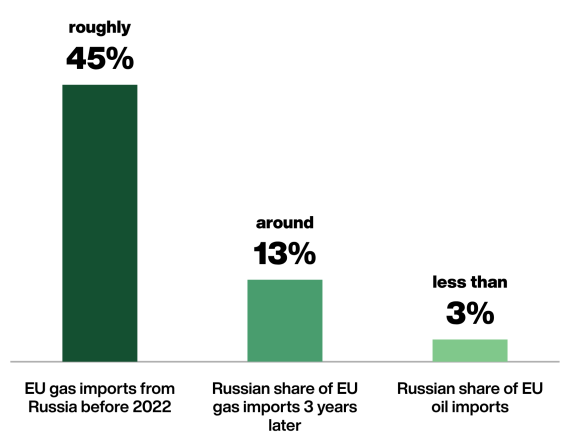
No element of this policy shift matters more (symbolically and practically) than the effort to eliminate Russian fossil fuels from the European energy system entirely.
Swapping dependence on Russian pipeline gas for dependence on American LNG could potentially risk creating the same structural vulnerability under a different flag
RENEWABLES
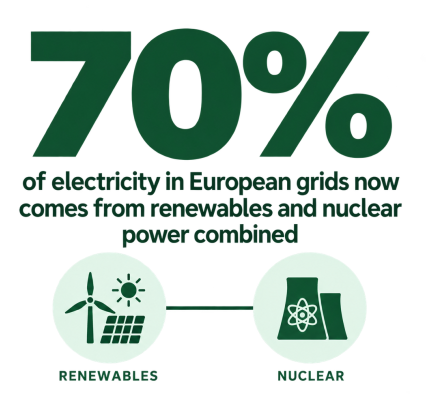
Around 70% of the electricity going through European grids now comes from renewable sources and nuclear power combined.
This expanded capacity was tested directly in early 2026. When the outbreak of the war in Iran threatened oil and gas flows through the Strait of Hormuz, European power markets absorbed the shock without significant price spikes, largely because renewables now supply enough of the grid to ease the impact of a gas price spike.
Yet, electricity remains almost three times more expensive than gas in much of the EU.
FROM NUCLEAR TO
CLEAN ENERGY
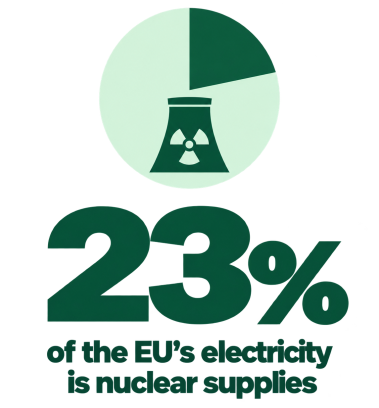
The most unexpected reversal in EU energy policy over the past year or two concerns nuclear power. Nuclear currently supplies around 23% of the EU’s electricity and roughly a third of its low-carbon electricity. Following the Small Modular Reactor strategy alongside the updated Nuclear Illustrative Programme, the Commission estimates that the EU’s nuclear ambitions will require around €241 billion in investment by 2050.
Europe’s electrfication ambitions will require hundreds of billions of euros of investment in electricity grids, while the planned expansion of energy storage would require almost a 300% increase in installed capacity by 2030.
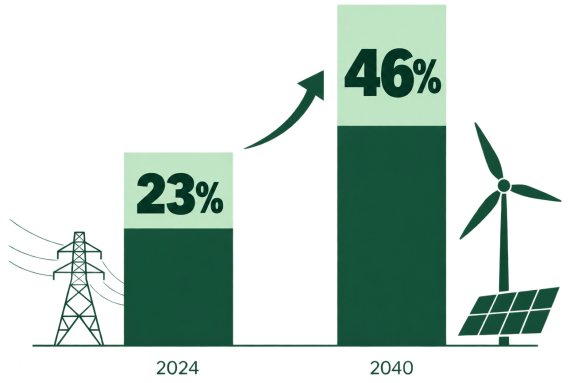
EU ELECTRIFICATION AMBITION
The Electrification Action Plan sets an indicative target of raising electrification from 23% to 46% of energy use by 2040, setting new requirements for electric cars and a reform of the EU carbon market. An energy simplification file (Omnibus) is also on the Commission’s agenda.
However, the elctrification creates a problem that can’t be solved just through simplifiation.
GRID CAPACITY AND STORAGE
Europe needs enough grid capacity and storage to physically accommodate the demand for electricity. In this sense, the success of the plan will heavily depend on new infrastructure being built.
Even if the businesses and households switch to electricity, it will not translate to greater energy security if the network can’t deliver power where and when it is needed.
THE NEW GOLD:
DATA CENTERS AND AI
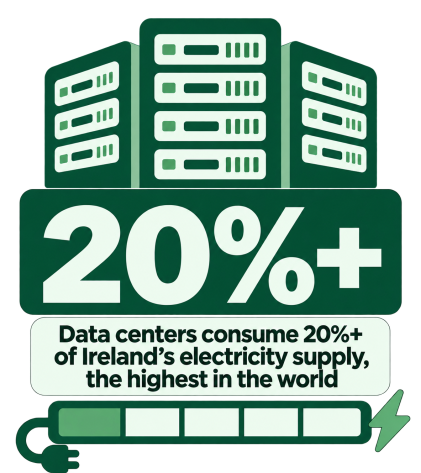
At the heart of all the electricity appetite is artificial intelligence. Electricity consumption from European data centres could double or even triple over the next decade, driven almost entirely by the AI infrastructure boom. Ireland already offers a preview of what that looks like at scale. Some argue that the demand by data centres is what is driving the costs of household electricity bills up as well. It remains to be seen if Europe can pursue tech sovereignty and energy security at the same time, or if it will resort to trading progress on one for stalling the other.
The energy sector is among most strategically important ones inside the EU, and as such, can’t be separated from the wider map of alliances and rivalries surrounding it, and 2026 has sharpened nearly every line on that map.
From Ukraine’s dual role in the EU energy transition to security and independence, to an ongoing struggle in the Strait of Hormuz, the EU is on the outlook for new strategic partnerships, such as India-Middle East-Europe Economic Corridor, the Southern Gas Corridor with Azerbaijan, and such.
To understand emerging trends on Europe’s energy security, read the full report below.