In this week’s edition, we analyse the historic appointment of Sanae Takaichi as the new Prime Minister of Japan and what can be expected in regard to the domestic policy and regional stability in East Asia.
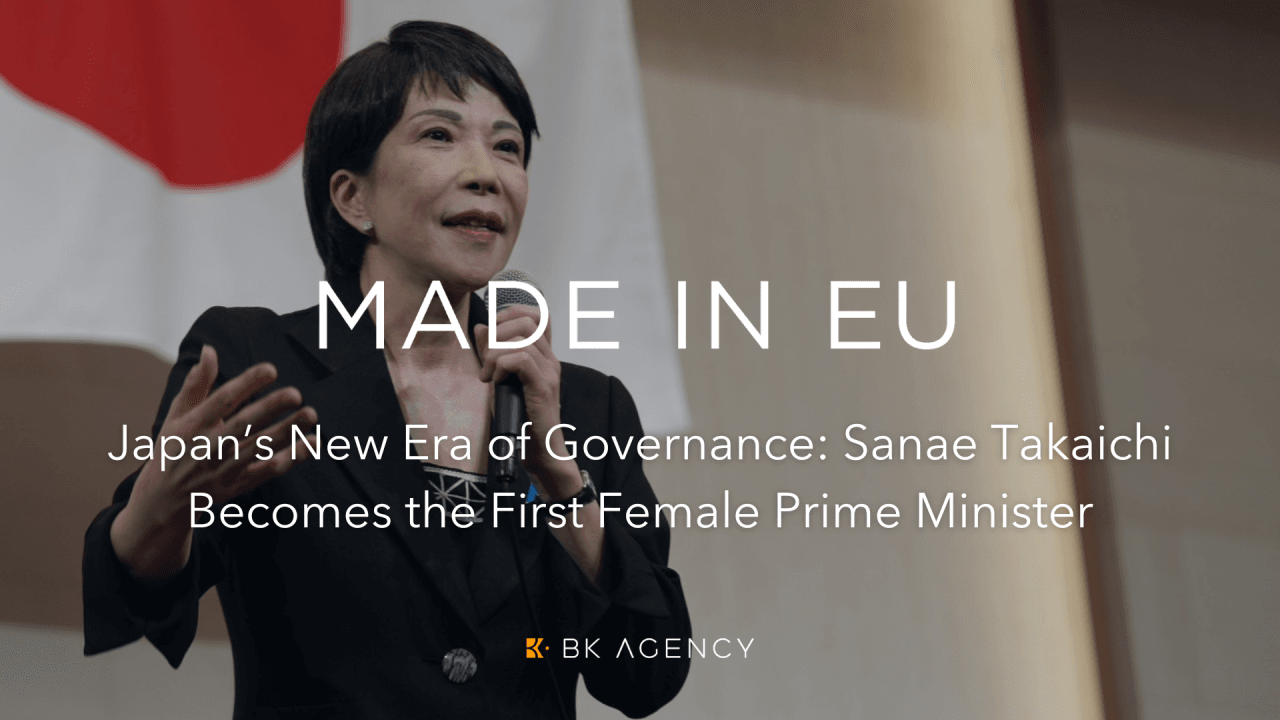
Japan’s New Era of Governance: Sanae Takaichi Becomes the First Female Prime Minister
On 21 October, Sanae Takaichi was formally elected by the National Diet (Japan’s parliament) as the new prime minister, becoming the country’s first female head of government. This moment is not an indicator of a liberal shift in Japanese gender politics, as it might look at the first glance, but rather the strategic consolidation of a conservative wing within the ruling Liberal Democratic Party (LDP).
The Rise to Power
Sanae Takaichi is a conservative politician, often described as a protege of the late Prime Minister Shinzo Abe and an admirer of former British Prime Minister Margaret Thatcher, which is why she became known as the “Iron Lady”, borrowing the nickname from Thatcher. As a consistent party loyalist, she has held several high-level cabinet posts, including Minister of Internal Affairs and Communications and, until previous year, Minister of Economic Security.
Her path to the premiership was relatively complicated. Takaichi first won the presidential election within the LDP, making her a likely candidate for the role of Prime Minister. Her ascension to the LDP presidency was, among other things, the result of general dissatisfaction within the party following the 2024 parliamentary elections where the LDP suffered significant losses, losing its majority in both the upper and the lower houses.
Most importantly, Takaichi’s victory in the National Diet was only secured by a last-minute coalition agreement with the right-wing Japan Innovation Party (JIP). This alliance was necessary in the light of the LDP’s long-term junior coalition partner, the Komeito party, deciding to withdraw its support. A shift from the more moderate and centrist Komeito to the right-wing JIP was essential to cross the majority threshold in the lower house of the parliament.
Japan’s Political Direction
Overall, Takaichi’s policy platform is conservative and nationalist. Similarly to her predecessor, Shinzo Abe, her focus is put on a robust economy and a more assertive foreign policy. It is no secret that Takaichi is a supporter of so-called “Abenomics”, a term created to describe the economic ideology of the late Prime Minister. This includes support for larger government spending and continued monetary easing, which clashes with the Bank of Japan’s approach to monetary policy. Her victory caused a rise in the stock market, as the market actors expected sustained expansionary economic policies. On top of that, she has stated that tackling rising inflation (especially reflected in higher consumer prices) and stagnant wages will be a top priority for the new government, a statement which was met positively by the general populace.
Her stance on security is a strong pillar of her premiership and the main reason why many expect the country to make a shift to the right. Takaichi is a vocal advocate for revising Article 9 of Japan’s post-war constitution to formalise and strengthen the Self-Defence Forces as a National Defence Army and increase the country’s defence spending. This move aligns with the US administration’s push for its allies around the world to take on more responsibility for regional security. Another policy area that has led the media to describe her as “ultraconservative” is her social views. Despite being the first female prime minister, Takaichi is not an advocate for liberal social reform. She holds deeply traditional positions, such as opposing married couples retaining separate surnames and supporting male-only succession to the Imperial Throne of Japan. She has also expressed negative views on same-sex marriage.
The Geopolitics Behind
Takaichi’s rise is met with mixed emotions across the world, particularly in the Indo-Pacific region. The relationship between the United States and Japan is expected to strengthen, especially with regard to security. The new prime minister is committed to maintaining strong ties with Washington and supporting strategic coordination, although her “Japan First” ideas on economic matters could cause friction over the trade agreements that her cabinet inherited from the previous administration. On the other hand, the relations with China and South Korea are likely to become more strained. Takaichi openly supports closer security cooperation with Taiwan. Her history of visiting the controversial Yasukuni Shrine, which honours Japan’s war casualties including some convicted war criminals, and her wartime historical revisionism are perceived by Beijing and Seoul as provocative.
The news about the new PM echoed far beyond the Pacific and East Asia – similarly to the US, the European countries and Japan see each other as partners in a number of fields. This cooperation is most importantly economic. Takaichi supports the liberalisation of trade, which could strengthen the ties between the EU and Japan on top of the existing EU-Japan trade deal. The “Iron Lady’s” track record as a minister in previous governments clearly shows that she, much like the European countries, is committed to reducing dependency on other countries (especially China) when it comes to essential resources and technology. The cooperation between the Old Continent and the Empire of the Sun is also of geopolitical significance. Japan is perceived by the Western countries as a reliable partner with aligned interests in the region.
What Next?
There are still some uncertainties surrounding the new Cabinet of Japan. Possibly the most significant structural problem on the Prime Minister’s agenda is the political position of the current-day LDP. The party has been weakened, and her new coalition now lacks a stable majority in both chambers. This will most likely make it difficult for her to pass key legislation, which could make her government unstable. It remains to be seen whether Sanae Takaichi and the LDP as a whole still have what it takes to strike a balance between the new political coalition, their political opponents and the international players in order to make their governance effective and deliver on their campaign promises.