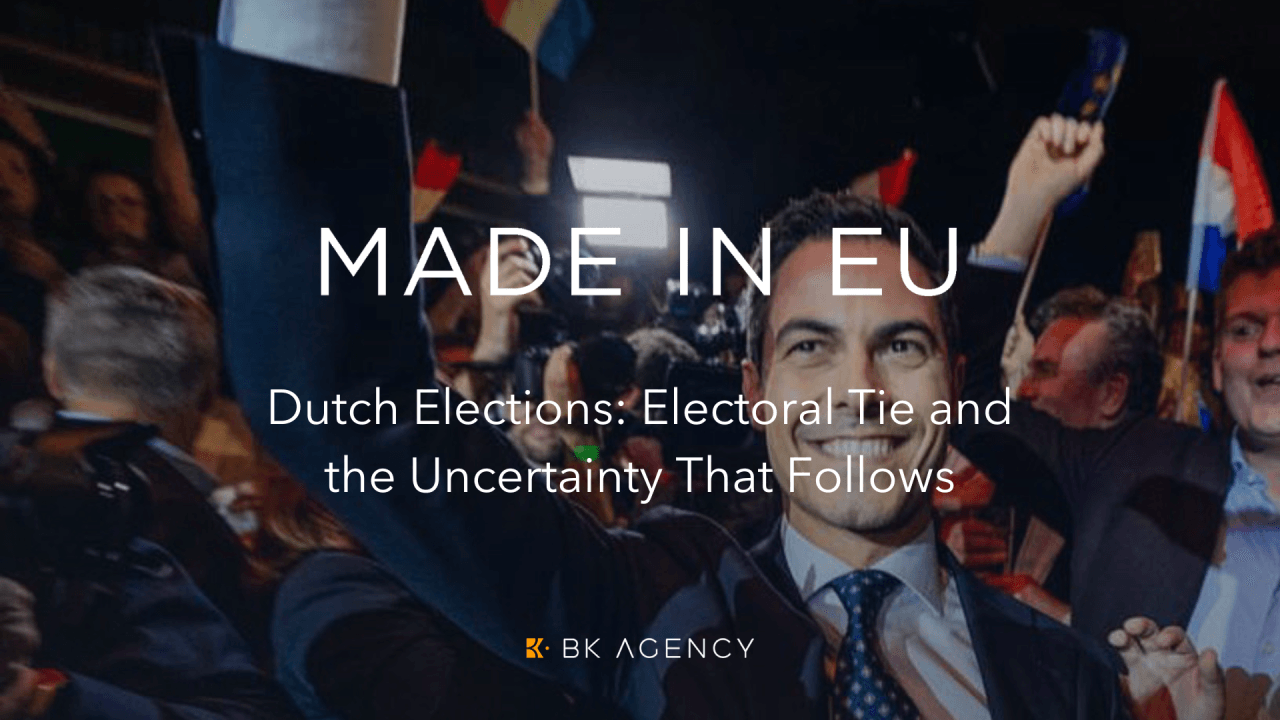
Projections from the Dutch elections are in: centrist D66 and far-right PVV both won 26 seats, ending Geert Wilders’ lead in parliament and prompting Frans Timmermans to step down after a disappointing result.
The Past
After the parliamentary elections held in November 2023, Geert Wilders’ Eurosceptic Party for Freedom (PVV) became the largest party in the House of Representatives. Following negotiations, a majority coalition was formed between four parties – PVV, the liberal-conservative People’s Party for Freedom and Democracy (VVD), the Christian-democratic New Social Contract (NSC), and the agrarian, right-wing Farmer-Citizen movement (BBB).
A former intelligence director, Dick Schoof, was nominated for the position of the Prime Minister in July 2024, after an agreement has been reached by all four parties. This coalition lasted until June of this year, when the PVV decided to leave the coalition over the disagreements on the immigration and asylum policy – Wilders wanted to introduce measures such as the rejection of all asylum seekers. Shortly afterwards, the NSC left the coalition over disagreements regarding the approach to the foreign policy in the Middle East.
The snap election was scheduled for 30 October, and the electoral campaign was mostly surrounded by the topics such as rising housing prices, immigration and general discontent about inflation and the cost of living. The high degree of political fluidity and the large number of political parties participating in the campaign made the outcome fairly unpredictable, with new or previously fringe parties gaining more prominence as part of the voters seemed dissatisfied with the current political landscape.

The Present
According to the projections, the vote resulted in an unprecedented two-way split for the most seats in the Dutch House of Representatives. Wilders’ PVV lost its position as the largest party in the parliament, instead gaining 26 MPs in the 150-seat lower house – the same number as the social liberal, pro-EU Democrats 66 (D66) led by Rob Jetten, a former minister for Climate and Energy Policy. The parties are separated by just a several thousand votes, with the D66’s electoral performance being its biggest success since its formation in 1966. Jetten’s party ran on the progressive platform, promising to raise the quality of healthcare and education in the country, as well as to focus on the affordable and green energy in order to keep the prices down.
The established liberal-conservative VVD came third with 22 seats, closely followed by the centre-left coalition (GL/PvdA), led by former European Commission Vice-President Frans Timmermans that won 20 seats. During the election night, Timmermans offered his resignation and announced his retirement from national politics as the coalition he led was expected by supporters to finish near the top but eventually lost some seats in the parliament.
The fifth place was taken by the centre-right Christian Democratic Appeal (CDA), securing a total of 18 seats. The remaining 38 seats were distributed among ten smaller parties, each winning less than ten seats, with the New Social Contract losing all 20 seats that they previously had. This result shows that no two or even three major parties can secure the necessary 76 out of 150 seats necessary to form a government on their own, requiring at least four or possibly more parties to be a part of the majority coalition.
The Future
There are several possible coalition scenarios for the Netherlands. The most immediate path to a majority would involve a broad centre-leaning coalition. A scenario that bypasses the PVV and includes the traditional political centre would be a coalition between D66, VVD, GL/PvdA and CDA, which collectively gather 86 seats. While these parties would easily form a majority, coalition talks would most likely be extremely difficult as it would force centre-right liberal parties and Christian Democrats to find a common ground with the social democratic, green-oriented bloc. This common ground would be essential, particularly with regard to social spending, taxation and the environmental policy, potentially leading to a large need for compromise that might not satisfy all the voters of the governing parties.
An alternative scenario would be an attempt to form a majority on the right, centred around the Wilders’ party and the VVD, with the addition of the Christian Democratic Appeal and the right-wing JA21, which managed to secure 9 seats in the parliament. According to the current projections, this would amount to a total of 75 seats. The inclusion of either the agrarian Farmer-Citizen Movement, the far-right Forum for Democracy, or the conservative Reformed Political Party would bring the total over the 76-seat threshold. This coalition would probably face serious ideological disagreements on the inside, in addition to historical differences and personal animosity between Geert Wilders and the leaders of the VVD and CDA. The success of a PVV-led coalition would depend on the willingness of the centre-right parties to overcome their previous political red lines regarding the cooperation with the Party for Freedom.
Considering the fragmentation of the electoral map and the near-equal strength of several political actors, the negotiations are expected to be challenging. Another complication might arise from the situation where at least four parties need to be involved, some of which campaigned on platform points diametrically opposed to one another. Ultimately, the next Dutch government will be defined by two factors. First, who is deemed the most important political partner, and second, which parties are willing to negotiate the most to secure a stable majority. Whatever the outcome, the resulting government is expected to be a government of necessity, rather than a government of shared vision and ideology.