In today’s newsletter, we analyse the implications of the release of hostages held by Hamas and the beginning of the ceasefire for the Middle East and Europe.
Gaza Ceasefire Deal: What Is Next for the Middle East
On Monday, after more than two years of captivity, the hostages held by Hamas in Gaza were finally released. Achieved under a fragile US-brokered ceasefire, the release signals both an end and a beginning: the close of one of the most painful chapters in Israel’s recent history, and the start of a difficult transition toward peace.
This development coincided with US President Donald Trump’s high-profile visit to Israel, during which he delivered a speech to a special session of the Knesset. True to his character, the speech was forceful, personal and anchored in his “peace through strength” doctrine. Trump spoke of forging new bonds of commerce and cooperation, envisioning trade routes from Haifa to Beirut and from Tel Aviv to Dubai, linking Israel’s newfound security to regional prosperity.
The timing was no coincidence. While Israel paused its military campaign, Trump sought to frame the ceasefire not as a compromise, but as a victory — a moment to transform battlefield gains into enduring peace.
From Deterrence to Stability
Israel’s position today reflects a decisive, if costly, success. The war, which began with Hamas’s brutal attack on Israel on 7 October 2023, has dismantled its military and political infrastructure, crippled its command capabilities, destroyed its allies in Syria and Lebanon, and forced its regional sponsors, namely Iran and Qatar, to reassess their position. The Israeli Defence Forces have achieved restoring deterrence while avoiding a regional war. However, this raises a broader strategic question: how can Israel convert military success into long-term stability? The principle behind this approach is that conflicts are most likely to end when one side establishes credible deterrence and a clear advantage on the battlefield. The current phase emphasises decisive outcomes rather than prolonged engagement or open-ended negotiations. For Israel, the challenge now lies in leveraging its operational gains to create a sustainable security framework, manage regional relationships and prevent renewed escalation, while integrating diplomatic and reconstruction efforts into a coherent post-war strategy.
Europe Steps Forward: Endorsing the Peace Vision — with Caution
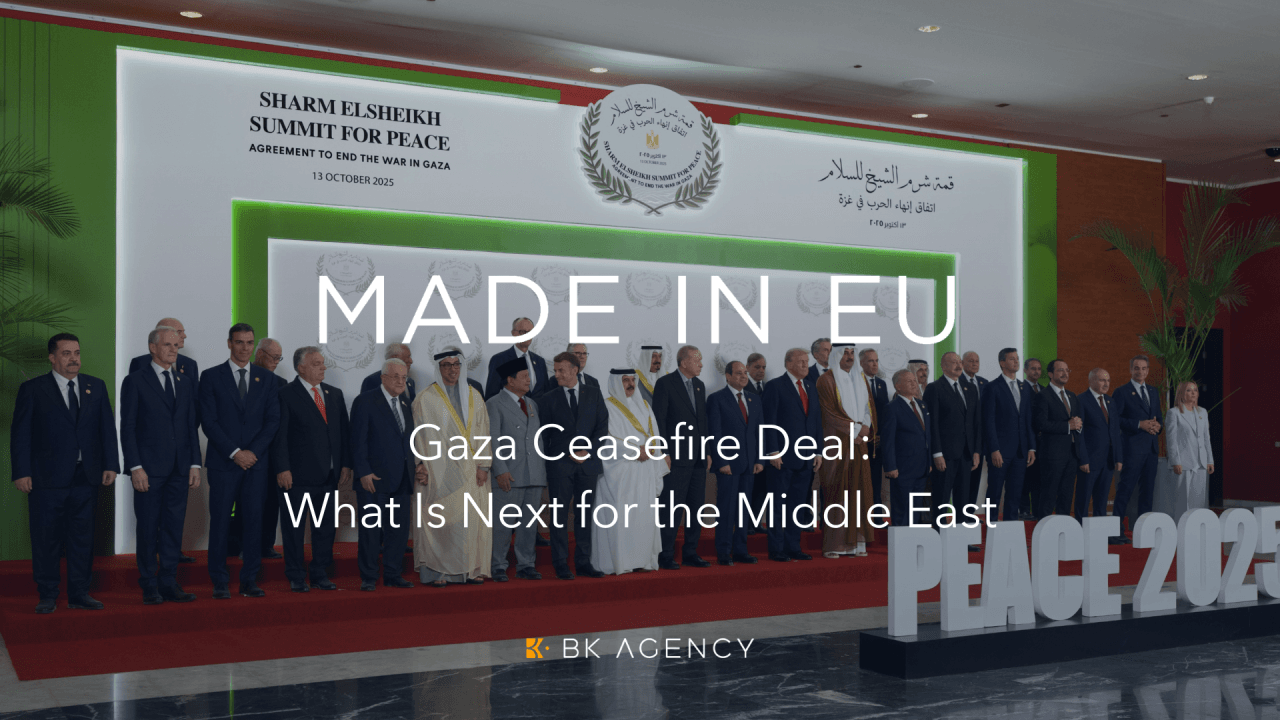
While the guns fell silent, another kind of diplomacy unfolded in Sharm el-Sheikh, Egypt, where world leaders gathered to discuss the future of Gaza and its reconstruction. Those present included Italian Prime Minister Giorgia Meloni, German Chancellor Friedrich Merz, French President Emmanuel Macron and UK Prime Minister Keir Starmer — a line-up that underscored Europe’s desire to remain involved in the peace process.
Their presence alongside President Trump and key Arab leaders marked a shift from observation to engagement. For Europe, this was an implicit acknowledgement that the US-led framework is now the only practical path forward.
Italy and Germany, in particular, have emerged as the strongest European supporters of the American approach. Rome sees this peace architecture as an opportunity to reinforce its Mediterranean diplomacy — an area where Meloni has positioned Italy as both a bridge and a broker between Washington and the northern Arab world. Meanwhile, Berlin, is aligning pragmatism with principle by recognising Israel’s military success as a foundation for peace rather than a pretext for endless debate.
Yet Europe remains divided. Macron continues to emphasise humanitarian responsibility and Palestinian rights, while the European Union as an entity struggles to find a united voice and vision. The reality is that the EU risks irrelevance if it fails to adapt to the new geopolitical landscape emerging from Sharm el-Sheikh.
Still, the symbolism of European attendance was powerful. For the first time in months, Europe was not merely reacting to the conflict but helping to define its aftermath. The discussions in Sharm focused less on aid packages or resolutions and more on how to integrate Europe into the new regional order that Washington, Jerusalem, and several Arab countries, such as Saudi Arabia, the UAE, Bahrain, Morocco and Egypt, are already sketching out.
From Sharm to Strategy: Trump’s Vision for a Connected Middle East
That new order was precisely what Trump outlined in Jerusalem, building on years of diplomacy. The American president envisioned a Middle East defined not by frontlines, but by corridors — trade, energy and infrastructure routes —linking Haifa to Beirut, Jerusalem to Damascus and India to Pakistan. It was a sweeping, almost visionary, roadmap for a post-war region bound by commerce rather than ideology.
The current US approach emphasises pragmatic, results-oriented engagement, focusing on concrete outcomes rather than abstract principles. It prioritises decisive action, clear incentives and translating military and diplomatic leverage into regional stability. In this context, Europe’s participation in Sharm el-Sheikh and its coordinated discussions with US and regional leaders reflect a shared recognition that the ceasefire and post-war arrangements must be consolidated through multilateral engagement and integration rather than isolation. The aim is not just to end the Gaza war, but also to reshape Middle Eastern diplomacy into a pragmatic network of cooperation that includes even former adversaries. It also signals to China and Russia, which have invested in the Middle East in the past years, that the United States considers the region as part of its sphere of influence, a message that was shown to the world at the Sharm El Sheikh summit.
Managing Peace After the Ceasefire
With the hostages freed and the ceasefire in place, Israel now faces its most complex phase yet: the management of peace. Implementing the ceasefire will test not only the resolve of Israel and Hamas, but also the credibility of the international mediators and guarantors. Even minor incidents could quickly unravel the fragile balance that has been achieved. For now, the reunions offer a sense of closure — and perhaps a glimmer of hope. However, the real challenge lies ahead: rebuilding trust, securing Gaza’s reconstruction and preventing the resurgence of extremism.
Whether this can be claimed will depend on what happens in the coming weeks, when the euphoria of victory gives way to the harder work of governing, rebuilding, and believing that this time, peace might just hold.