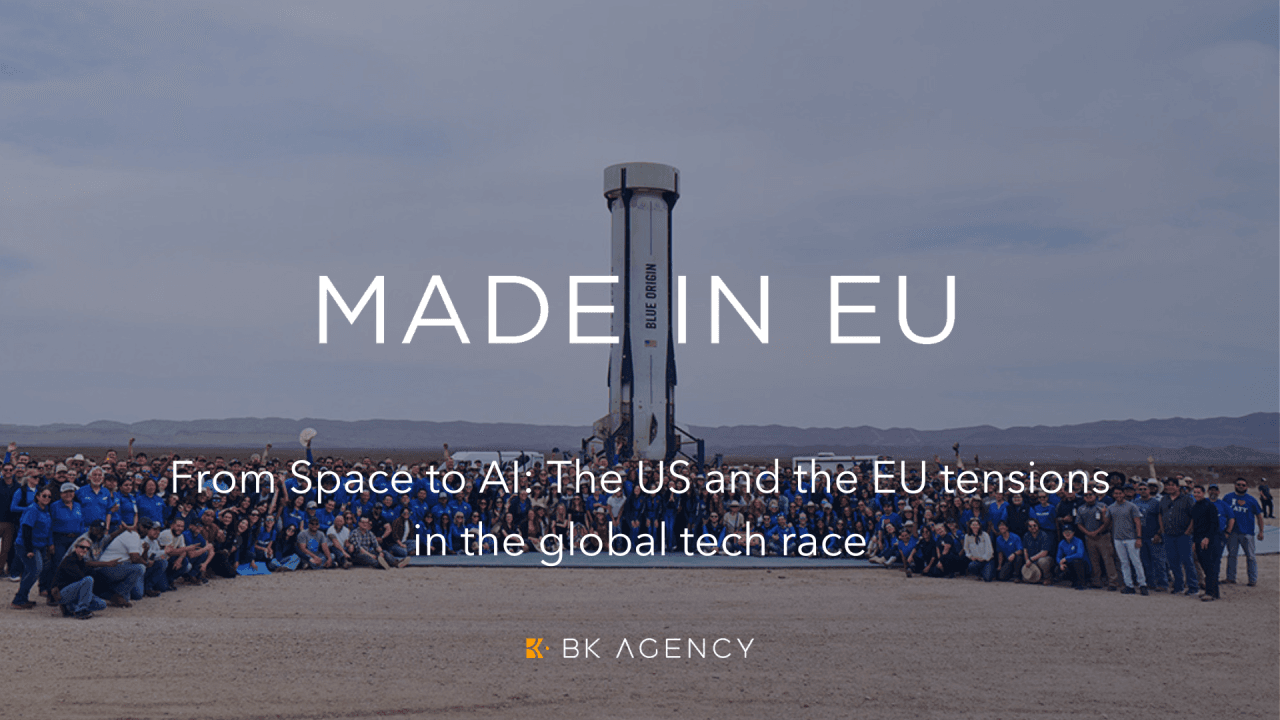
In this week’s newsletter, we look at the Blue Origin launch and what it reveals about the EU space market, along with the latest developments in European and US AI. Enjoy!
The New Shepard Blue Origin launch
On Monday afternoon, a crew of six launched into space for an 11-minute flight on a rocket belonging to Blue Origin, the US space technology company owned by Amazon founder Jeff Bezos. With vehicles such as the New Shepard, the company aims to radically reduce the cost of access to space, with rockets designed to be reused. Later this year, Blue Origin’s New Glenn rocket, which can orbit the Earth, is expected to launch for the second time.
The high-profile success of the mission highlights the leadership of private US companies not only in developing new technologies, but also in promoting cost efficiency allowing to increase the frequency of launches in space or at suborbital altitudes. Another leading company is Elon Musk’s SpaceX. In the past years, the company has been working on developing a reusable launch system to also reduce the costs of operating space flights significantly. The Chinese space programme has also been advancing to compete with the US.

The European space market’s ability to adapt
While more actors are present in the space market, European companies are lagging behind. An example is the Ariane 6 launch system, developed by the French company Arianespace for the European Space Agency (ESA). Ariane 6 was meant to be the main competitor to SpaceX, although the first launch was delayed until 2024 and was ultimately more expensive than existing alternatives already on the market. While the Ariane programme has always been at the forefront of innovation, recent years have highlighted that the EU seems to be lacking the ability to adapt to the rapid technological developments of its competitors. Another example is IRIS2, the EU’s programme to develop a satellite constellation for safe connectivity. While this won’t be operational until 2030, Elon Musk’s Starlink is already widely available.
This can have significant implications not only from a competitiveness standpoint, but also for security and defence, which are the main priorities of the current European Commission. Access to space is crucial to improve EU satellite-based connectivity, increasing secure and resilient connectivity for the economy and businesses. Attracting the necessary private and public investments is a key component in this. According to experts, to bridge the technological gap, it is crucial to invest in research and development and to simplify institutional procedures, fostering cooperation among innovative SMEs and businesses across European countries for a competitive space sector.
Increasing independence in critical technologies
Similar concerns are being raised about other technological developments, such as AI, where the EU has pledged to become a leader in production but where differences with other countries are becoming increasingly evident. Last week, the US chip manufacturing company Nvidia announced plans to build a nearly $500 billion AI infrastructure in the country over the next few years, supported by their partners from TSMC, among others. Earlier this year, TSMC had agreed to invest almost $100 billion in the US, including the construction of five additional chip facilities.
Investment in European AI companies also increased in the first quarter of 2025 compared to the numbers from the previous year, although the EU still does not have the same infrastructure capacities as its counterparts. An additional challenge for European companies is the volatile trade environment in response to Trump’s announced (and then paused) global ‘retaliatory’ tariffs. European companies are largely dependent on semiconductors and processing units that are produced in Asia. The latest Action Plan does not provide an immediate response to the disruptions and price increases which can be expected from US tariffs.
On the other hand, according to experts, the uncertainty could also spur European companies and governments to keep investing in local manufacturing and R&D. Another potential avenue is for the EU is to focus on specific AI applications derived from the big models. This could help create a lively environment for small businesses and startups to develop better products and services for people. This approach would let European startups save on training costs and make it easier to use models in markets that need specific applications.
New European strategies: The AI Continent Action Plan
To address many of the challenges, the European Commission is rolling out several new strategies. Last week it unveiled its AI Continent Action Plan, with its cornerstone ambition to increase the development and use of AI by building a network of European AI Factories and Gigafactories. These could provide the data and computing resources to develop AI models and applications on a large scale. Nonetheless, no new funding was included to implement the Action Plan, beyond the €200 billion investment in AI announced earlier this year under the InvestAI initiative.
Despite persisting challenges, initiatives such as this underline that the EU can work side by side with innovative businesses that can drive the greatest change, such as SMEs and startups to foster European innovation. The public consultation that was opened last week might provide further insights into stakeholder priorities, challenges to the uptake of AI, and the relevance of proposed solutions and policy approaches, for a stronger EU digital policy.