B&K Agency congratulates Pope Leo XIV on his election as the new leader of the Catholic Church. In this newsletter, we explore his stance on key matters and the potential role he could play in addressing today’s most pressing global and societal challenges.
The Vatican Has Spoken Out
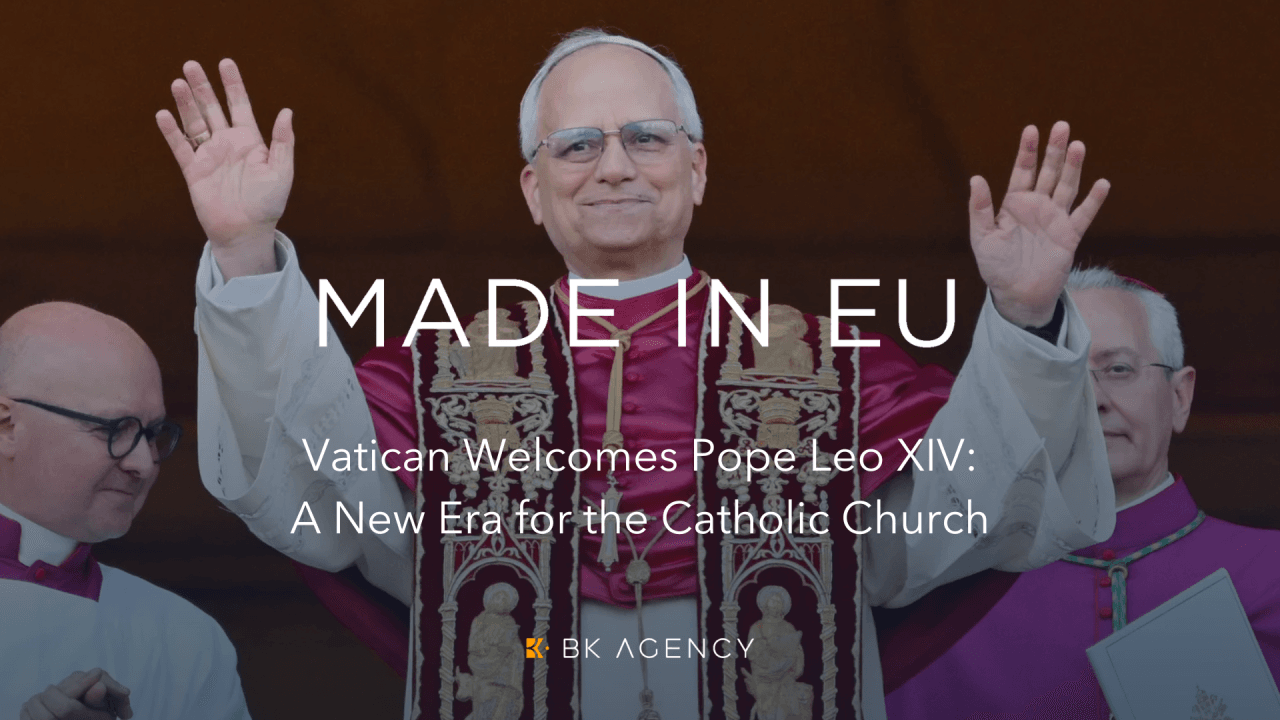
Pope Leo XIV’s election—the first for an American-born successor—signals both a nod to tradition and a fresh chapter for the Roman Catholic Church. Robert Francis Prevost emerged from a two-day conclave to follow the late Pope Francis, whose progressive tenure emphasised mercy, social justice, and outreach to the marginalised. While Leo XIV shares many of these priorities, his style is more reserved and his outlook leans towards continuity with established Church customs.
Almost immediately, he signalled change by returning to formal papal dress, trading Francis’ simple robes for the classic cassock and cape, and moving back into the Apostolic Palace instead of the modest Casa Santa Marta. These symbolic choices underscore his intention to blend reverence for tradition with the pastoral care that defined his predecessor’s papacy.
As the first pontiff from the Order of St. Augustine—a community founded in 1244 and now home to about 2,800 members—Leo XIV brings Augustine’s guiding principles of truth, unity and love to the forefront of his leadership. This emphasis shapes his approach to reforms: instead of grand public gestures, he prefers quiet, consensus-driven change within the Church’s governing bodies.
He has already expressed support for expanding the role of women in the Vatican administration, continuing reforms he helped implement as a bishop, though he stops short of endorsing female deacons. He maintains a more traditional stance on questions of gender and sexuality, declining to bless same-sex unions or promote gender theory in schools, while still urging compassion and respect for every individual’s dignity.
On environmental matters, Leo XIV echoes Francis’ call for concrete action on climate change, praising the Vatican’s previous sustainability efforts and warning of technology’s potential to harm both nature and human relationships. His time ministering to Venezuelan migrants in Peru has also deeply influenced him. He plans to focus on practical, local initiatives for displaced people rather than staging high-profile political critiques.
By choosing the name “Leo”, he deliberately honours Pope Leo XIII (reigned 1878-1903), who first articulated the Church’s social doctrine through the encyclical letter Rerum Novarum, which addressed the social and economic changes brought about by the Industrial Revolution, marking for the first time in history the stance of the Vatican and the Catholic Church in the global social affairs. The encyclical supported the right to private property, emphasised the dignity of labour, promoted social justice for the poor and called for cooperation between workers and employers, while rejecting both socialism and unregulated capitalism. By choosing the name Leo XIV, the Pope has clearly stated that he will not be silent on the global social issues.
Shaping Ties with the US Administration
Although the Vatican remains officially nonpartisan, Leo XIV’s American roots and centrist approach may carry particular weight in US political life.
According to Politico, he has voted for the Republican Party or the Grand Old Party (GOP) candidates in every US election since 2006, a detail that underscores his longstanding political leanings. American Catholics—no longer a majority, but still a crucial voting bloc—may find themselves weighing his moderate, institution-focused Catholicism against voices like J.D. Vance, the leading GOP contender for 2028, whose ideas on immigration and other social issues now find a strong competitor. Leo’s past advocacy for racial justice, immigration reform, and public health measures suggests he will encourage American bishops and laity alike to pursue social unity over division. Will JD Vance try to win over Catholics by changing his view on immigration, or will he keep his hardline stance and risk having the highest figure in the Catholic Church against him?
Combining Augustinian values with a careful, managerial approach, Pope Leo XIV offers a papacy that honours time-tested traditions even as it faces the pressing challenges of today’s world. His is a quieter, more measured leadership—yet one whose influence could resonate far beyond the walls of the Vatican.