The beginning of the year was all but uneventful for Europe, with the US Operation and the subsequent fall of Maduro’s regime receiving mixed reactions from EU countries, and Cyprus assuming the Presidency of the Council.
Operation Absolute Resolve and the New European Landscape
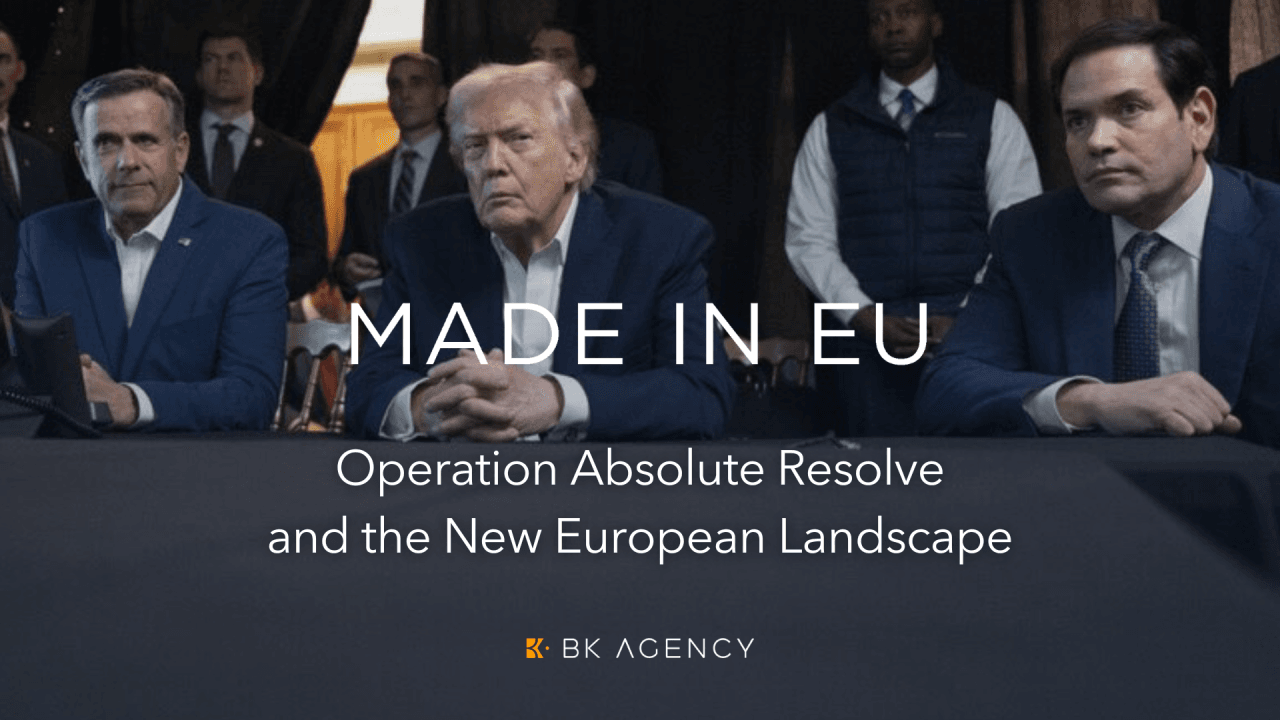
The events of 3 January 2026 represent a definitive pivot point in modern geopolitics. The successful execution of the attack, codenamed Operation Absolute Resolve, and the subsequent extraction of Nicolás Maduro and Cilia Flores have signalled the dawn of a “Restorative Era” in the Western Hemisphere.
By transitioning Venezuela away from a regime defined by narco-terrorism and into a period of provisional oversight, the United States has reasserted its role as the primary guarantor of stability in its own backyard.
This move was a necessary surgical intervention to neutralise a criminal enterprise that had metastasised into a global security threat, warning revisionist powers that sovereignty is no longer an absolute shield for those who facilitate transnational crime and host adversarial shadow networks.
A Closer Look at the January 3 Events
After the Maduro regime’s blatant disregard for the democratic outcomes of the last year’s election, the United States moved beyond traditional economic sanctions towards a policy of active measures.
Trump’s “Maximum Pressure 2.0” included a total blockade of Venezuelan oil exports, designed to provide the regime with multiple off-ramps towards a peaceful transition. When these were ignored, the narrative shifted from political disagreement to a judicial imperative.
The unsealing of updated indictments by Attorney General Pam Bondi provided the legal framework for the 3 January operations, framing the intervention as the execution of high-level arrest warrants for narco-terrorism and cocaine importation.
The precision ground raid, conducted under the cover of sophisticated strikes on air defence nodes, demonstrated an unprecedented level of intelligence depth and tactical mastery, ensuring that the mission was accomplished with minimal collateral damage while securing the primary targets for trial in the United States.
The Transatlantic Rift
Europe’s reaction to Operation Absolute Resolve has exposed a deep rift within the transatlantic alliance, separating strategic realists from the legalist establishment.
The “Old Europe” bloc remains deeply unsettled by the apparent disregard for the UN Charter’s principles of non-interference, fearing the emergence of a “post-law” era of American enforcement. This scepticism, however, is tempered by the prospect of a revitalised Venezuelan energy sector under American stewardship, offering Europe a pathway to complete independence from Russian gas and oil.
By contrast, in Warsaw and the Baltic states, the operation is widely regarded as a masterstroke that has effectively opened a “second front” against Russian influence.
These nations, which view the war in Ukraine as an existential threat, are prepared to overlook the unilateral nature of the strike in exchange for the tangible degradation of Putin’s financial networks; for Poland, a Venezuela purged of Russian proxy influence translates directly into a safer Europe.
The pragmatic trade-off for the EU is straightforward: it may condemn the method in the halls of the UN, while eagerly participating in the economic windfall of a stabilised Caribbean energy hub.
If you are interested in how this will influence the neighbouring countries and other continents, as well as what will happen in the immediate future in Venezuela, check out our new blog post about the fall of the Maduro regime.
Cyprus Takes the Reins in the Shadow of the American Operation
It is worth noting that the new year brought another novelty. On 1 January 2026, the Republic of Cyprus assumed the rotating Presidency at the Council of Ministers, taking over the role from Denmark. This was the last transition of the current three-piece Presidency (consisting of Poland, Denmark and Cyprus) and comes at a moment when the Union is facing several challenges, most notably regarding competitiveness and a volatile geopolitical environment.
Nicosia’s motto for the next six months is: “An Autonomous Union. Open to the World”. This can be analysed as a calculated attempt by an island nation between three continents to strike a balance between Europe’s internal regulatory focus and its urgent need for global strategic relevance.
The Next Six Months in the EU
Several trends can be expected as Cyprus takes the steering wheel in the EU. Firstly, a more active Mediterranean policy is likely. The maritime, energy and telecommunications sectors should look for new investment frameworks connected to the Pact for the Mediterranean. Secondly, Cyprus is elevating water scarcity to one of the most important political issues. New legislative proposals aimed at cross-border water management are expected, as the water scarcity is becoming a competitiveness issue for European agriculture and industry. Lastly, after the 2025 shift towards simplification, the Cyprus Presidency will likely favour pragmatic and sector-specific deals to ideology-based regulations. The focus will be on empirical results that can be felt by citizens, especially in affordable housing and mental health.
For those operating in the EU market, the next six months will probably not be focused on the excessive adoption of new regulations and directives, but rather on the rigorous, and possibly challenging, implementation of existing ones. If you are interested in reading a more detailed analysis of the Cyprus Presidency of the EU Council, make sure to read our latest blog post about it.