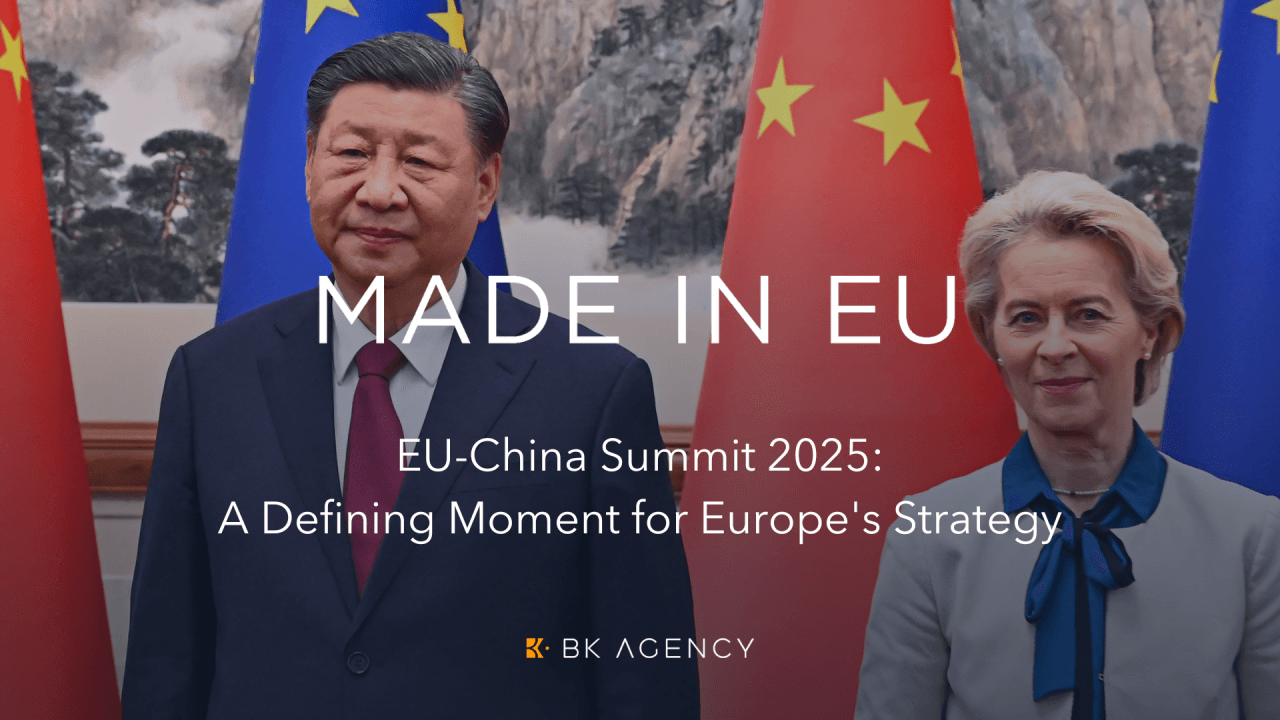
In this week’s newsletter, we analyse the potential outcomes of the EU-China summit taking place next week. Enjoy!
A Defining Moment for Europe’s Strategy
Next week’s EU-China summit arrives at a time when the long-standing partnership between Brussels and Beijing is being tested as never before. Five decades after diplomatic relations were established, the real question is no longer whether Europe and China can cooperate, but rather how the EU can protect its interests while navigating a complex relationship marked by rivalry, economic imbalances and political tensions. With growing challenges in areas such as trade, technology and geopolitics, this summit will reveal whether the EU is ready to move beyond cautious engagement and demand the level playing field it so urgently needs.
Trade remains the most pressing issue. Europe’s trade deficit with China, estimated at between €400 billion and €467 billion, reflects long-standing frustration. European companies continue to face significant barriers when trying to access Chinese markets, while Beijing’s industrial policies is skewed in favour of domestic producers and subsidised firms. The summit’s shortening and shift to Beijing signals China’s limited appetite for concessions on these fronts. Realistically, the best the EU can hope for is a renewed commitment to dialogue without sweeping new agreements.
Yet, the time for dialogue alone is running out. The EU must now insist on more than just words. Continued support or tolerance of unfair trade practices risks cementing China’s strategic advantage at the expense of European competitiveness. It is essential that Europe pushes Beijing to finally open its markets to EU companies and enforce the protection of intellectual property rights — two indispensable prerequisites for a genuinely reciprocal relationship.
Current frameworks, such as the Comprehensive Agreement on Investment, have failed to produce meaningful progress. Chinese export controls on crucial raw materials like rare earths jeopardize Europe’s green and digital transitions, leaving limited mechanisms to hold Beijing accountable. At this summit, Europe must move beyond polite requests and enshrine binding commitments with enforceable timelines, ensuring that market openness and IP protection become tangible realities rather than diplomatic niceties.
More broadly, the geopolitical divide complicates matters further. The EU will likely urge China to reduce its indirect backing of Russia amid concerns about sanctions evasion, while Beijing will demand a softer narrative from Europe and reaffirmation of the One China principle. With the EU increasingly aligned with US security priorities in the Indo-Pacific region, this summit will, at best, serve to maintain stable channels of communication rather than ease tensions.
Climate cooperation offers a rare window of shared interest. However, even here, industrial policy differences and strategic mistrust will probably confine the outcomes to general declarations without substantive follow-through.
Ultimately, the success of this summit should not be measured by grand breakthroughs, which remain elusive. Instead, the EU must seize this moment to recalibrate its strategy. Dialogue remains important, but it cannot substitute for firm demands that China play by fair rules. Europe must adopt a more assertive stance, combining regulatory tools, targeted tariffs and stronger enforcement measures to protect its economic sovereignty.
This summit must mark a turning point: a shift from cautious engagement to strategic firmness. The EU can no longer afford to tacitly support an unbalanced relationship that undermines its companies, technologies and long-term competitiveness. By insisting on market access and IP protection as non-negotiable terms, Europe can start shaping a fairer and more sustainable partnership in a rapidly evolving global order.
The upcoming summit offers a critical test of the EU’s ability to defend its economic and geopolitical interests amid shifting global dynamics. While dialogue has its place, Europe must now demonstrate that it will no longer accept unequal terms or ambiguous commitments.
The future of EU-China relations depends on Europe stepping out of the diplomatic comfort zone, demanding fairness and taking decisive action to back up its words. This is not just a negotiation over trade or technology — it is a defining moment for Europe’s strategic autonomy and economic resilience.