In today’s newsletter, we touch upon the weekend’s events at St. Peter’s Basilica in Vatican City and their potential impact on the future of global diplomacy.
A Reason to Seek Diplomatic Solutions
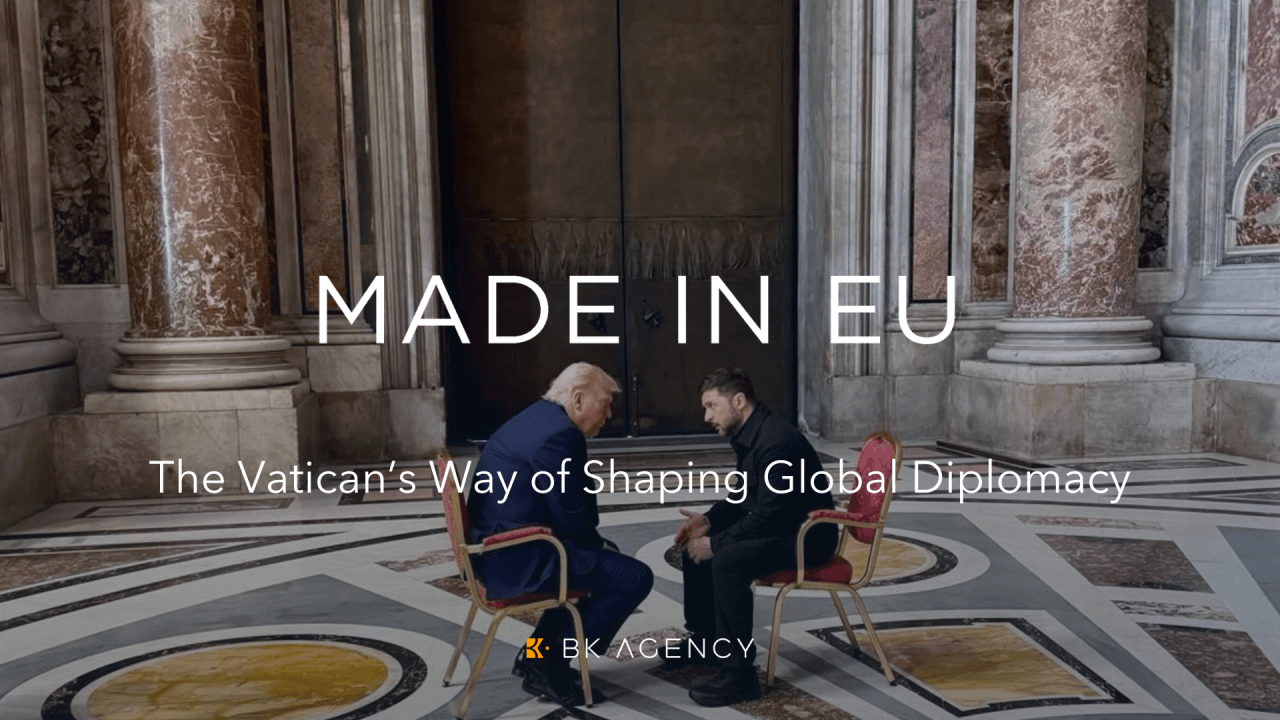
On Saturday, the saddest day for millions of Christians around the world, the Vatican achieved a remarkable feat where Europe and its leaders had failed. Just before the funeral of Pope Francis, U.S. President Donald Trump and Ukrainian President Volodymyr Zelenskyy met face-to-face in St. Peter’s Basilica, seated as if engaged in confession. This moment left a lasting impression on many minds. However, behind the striking photograph lies a complex and meticulously crafted diplomacy.
Ukrainian President Zelenskyy used the unexpected opportunity of the Pope’s funeral to host a series of high-level bilateral meetings, including with French President Macron, Italian Prime Minister Meloni and U.S. President Trump.
The protocol seemed unusually choreographed, with Zelenskyy arriving just before Trump, allowing them to meet inside the basilica. This was no mere coincidence; it reflected the Holy See’s persistent and discreet aspiration to serve as a mediator for peace.
Formal Politics or Informal Discussions?
The most significant development happened away from the cameras. Ukrainian media reported that Zelenskyy met with Cardinal Pietro Parolin after the funeral —not during the public ceremonies, but behind closed doors at the Secretariat of State. This is noteworthy because during the sede vacante (the period when the papal seat is vacant), all top Vatican posts are technically suspended. Cardinal Parolin, who is no longer officially Secretary of State, held the meeting in the absence of Archbishop Paul Richard Gallagher, the Vatican’s foreign minister.
Zelenskyy’s office treated the encounter as an official bilateral discussion. The statement emphasised their focus on the path towards a just and lasting peace and the efforts of Ukraine, the United States, and Europe to achieve a full and unconditional ceasefire.
Ukraine also extended its gratitude to the Vatican for supporting its right to self-defence, and for upholding the principle that peace cannot be imposed on a victim. It expressed the hope that the Holy See would continue contributing to the unification of international efforts for peace, the return of Ukrainian children deported by Russia, and the release of prisoners. These gestures are not merely symbolic, they signal that the Vatican’s behind-the-scenes diplomacy remains active, even in the absence of a reigning pope.
Italian media have suggested that ongoing, informal communication continues between Andriy Yermak – Zelenskyy’s chief of staff and closest adviser – and Cardinal Parolin. Yermak has persistently urged the Holy See to act as a platform for peace, and the Vatican has responded positively. Even if the funeral was not the ideal moment, the opportunity was created by the great work of Vatican diplomacy. The coordinated arrivals of Trump and Zelenskyy were no coincidence. The chairs may have been found fast, but the intention behind the dialogue was anything but improvised.
Such delicate yet intentional moves demonstrate that the Holy See’s diplomacy – focused on neutrality, moral authority, and global reach – remains a critical force in world affairs. At a time when multilateral diplomacy often stalls or fractures, the Vatican stands out for its unique ability to bring adversaries to the same table – even if that table is a pair of chairs in a basilica.
Behind The “Road to Peace”
The Pope’s funeral also unveiled some unexpected surprises. For instance, among the guests (though not part of any official delegation) was Dzianis Kuchynski, an adviser to exiled Belarusian opposition leader Sviatlana Tsikhanouskaya. This revelation raised eyebrows in Belarus and Russia, given that Belarus had recently announced the establishment of a permanent embassy to the Holy See and sent a full delegation, including its appointed ambassador and the speaker of parliament. It is obvious that the Vatican is not aligned with autocrats.
These details suggest that Vatican diplomacy operates behind the scenes, always working in favour of peace and democracy globally.
In a world that is becoming more and more divided, the Vatican is like a beacon of calm in the midst of chaos. It is one of the few places where people can come together and talk, even when things get really heated. Its influence might not be showy, but it’s worth noticing. The scenes from St. Peter’s Basilica were more than just pretty pictures; they showed that diplomacy can work, even when it’s not about military power but about principle.