As thousands of people illegally entered Spain from Morocco last week, the EU countries are confronted with the evergreen issue of balancing the budgets, especially in the modern era of immigration pressure and external security threats that keep intensifying since the beginning of the war in Ukraine.
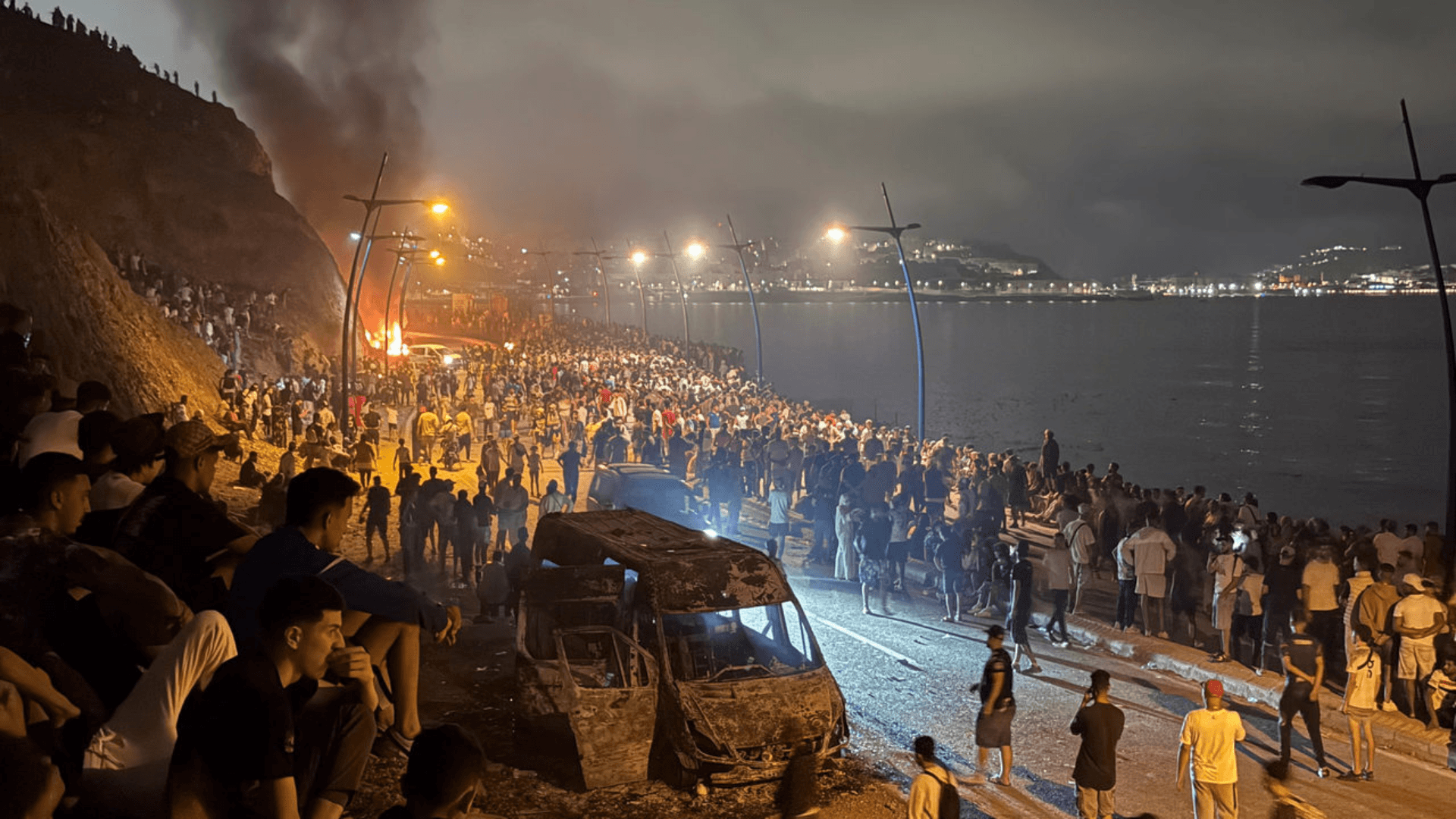
In the last week of July, almost 60 000 migrants crossed from Morocco into Ceuta. This occasion was the largest influx that the small Spanish enclave in Africa has ever seen. Spain returned most of them within days, but the episode has again opened a debate in Brussels that goes well beyond one border post – how the EU manages migration, funds its own defence, and protects itself from a war that keeps getting closer to its own territory.
Several factors appeared to be a trigger. A Spanish Supreme Court ruling on 29 June found that migrants intercepted at sea trying to reach Ceuta or Melilla could no longer be returned to Morocco automatically and had to go through the slower ordinary asylum procedure that gave people more chances to stay instead. That ruling, together with rumours circulating on social media and the aftermath of a mass regularisation scheme Madrid launched in January for undocumented migrants, is widely seen as the encouragement for the surge. Morocco already denied intentionally loosening its own border controls and blamed smuggling networks instead.
The diplomatic fallout has been sharper than the crisis itself. More than twenty governments in EU, led by Italy and Denmark, wrote to President von der Leyen criticising Spain’s migration policy. Some of the countries went as far as to explicitly call for suspending Spain’s participation in the Schengen area (Meloni’s administration in Italy has already done so unilaterally). Interestingly, Spain’s land neighbours, France and Portugal, did not sign. Spanish PM Pedro Sanchez accused critics of prejudice, while von der Leyen took a more nuanced approach, praising Madrid’s handling of the crisis while agreeing it should be a starting point for stronger border controls across the continent.
Putting the Frontex in Front
The Commission was already planning to reform the European Border and Coast Guard Agency (better known as Frontex) before the Ceuta situation, and this crisis will likely add more momentum. A new legislative proposal is expected in the next several months, and the Commission already hinted towards tripling its personnel target to roughly 30,000 officers, together with a much larger role in carrying out deportations and operating in countries outside of EU.
A parallel proposal to strengthen Europol, the EU’s police cooperation agency, is also in the Commission’s work programme for this year, aimed at giving it more capacity to tackle the smuggling networks that profit from crises like this one. Both files will need approval from the European Parliament and EU governments before becoming law, which will likely take at least one year and give national governments room to reshape the final text.
Budgets, Borders, and Ballistics
Ceuta has also brought forward an argument that has been inside NATO and the EU for months. The question that arises is whether generous social and migration spending exists on the expense of defence budgets in some Member States, especially at a moment when that spending gap has real consequences elsewhere on the continent. Spain is a very good example. It was the only NATO member to reject the alliance’s new target of 5% of GDP on defence and security spending by 2035, formally capping its own commitment at around 2.1%. Madrid’s own justification is explicit – Sanchez administration has stated that reaching 5% would require roughly €780 billion over the next decade, which it argues is incompatible with maintaining its welfare state. That stance has drawn public criticism from Washington, with President Trump characterising Spain as a free rider and hinting at possible trade retaliation.
Whether migration costs specifically, rather than pensions or other social spending, are the real driver of Spain’s argument is a contested question, and Madrid’s own framing points to the broader welfare model rather than migration alone. But the argument connects to events in the eastern part of the bloc. On 30 July, a Russian cruise missile crossed into Polish airspace and crashed near the town of Lublin. This was just one of many recent instances of drone and missile incursions along NATO’s eastern flank over the past year. Ukrainian President Zelensky has stated that delayed or insufficient air defence supplies from allies contributed to civilian deaths during recent Russian strikes. Critics of uneven defence spending argue that when some Member States don’t invest enough, the burden of holding the line (both financially and militarily) shifts disproportionately onto countries Poland and the Baltic states and most importantly Ukraine itself. Defenders of the opposite position counter that European security also depends on domestic political stability, and that a consistent and uncontrolled migration crisis paired with a shrinking welfare state carries its own destabilising risks.
Fixing the Defence Supply Chain
Alongside the border reforms, the Commission is also due to table a proposal in the third quarter of this year to simplify the rules on how EU governments buy defence and sensitive security equipment. The reform will update a directive from 2009 that is often regarded as too slow and fragmented. The goal is to get closer to a single market for defence goods, making it easier for a government to quickly buy equipment from a manufacturer anywhere in the EU rather than going through a significant amount of national procurement rules – this could especially help the already mentioned Member States on the EU’s eastern border. This comes alongside the EU’s new SAFE instrument, which aims to raise €150 billion on capital markets specifically for joint defence investment. Looked at it together, these measures suggest Brussels sees more and efficient integrated defence procurement as at least a partial answer to the capability gaps exposed by incidents coming from Russia.
More Funds and More Uncertainty
For defence contractors and dual-use technology firms, faster and more harmonised EU procurement rules should mean shorter contract cycles and a more integrated market to sell into. Still, the transition will create uncertainty in the short term as 27 national systems aget replaced by a single one. Border technology and surveillance firms (along with logistics and shipping companies operating in Gibraltar and Morocco-Spain trade corridors) should expect increased demand tied to Frontex’s expansion, alongside greater compliance and human rights scrutiny. Companies with operations spanning Spain, Italy and other countries that signed the letter to the Commission could benefit from watching if this dispute leaves any lasting mark on Schengen’s normal functioning. Even a temporary suspension of free movement could carry large costs for logistics and labour markets.
The episode has exposed several debates inside the EU between southern states more exposed to migration and northern and eastern states more exposed to Russian aggression, with each camp increasingly framing the other’s spending priorities as a liability. How that tension is resolved, whether through the Frontex and Europol reforms or the new defence procurement (or continued ad hoc solutions), will likely shape the credibility of the EU’s general claim of building a security and defence union.