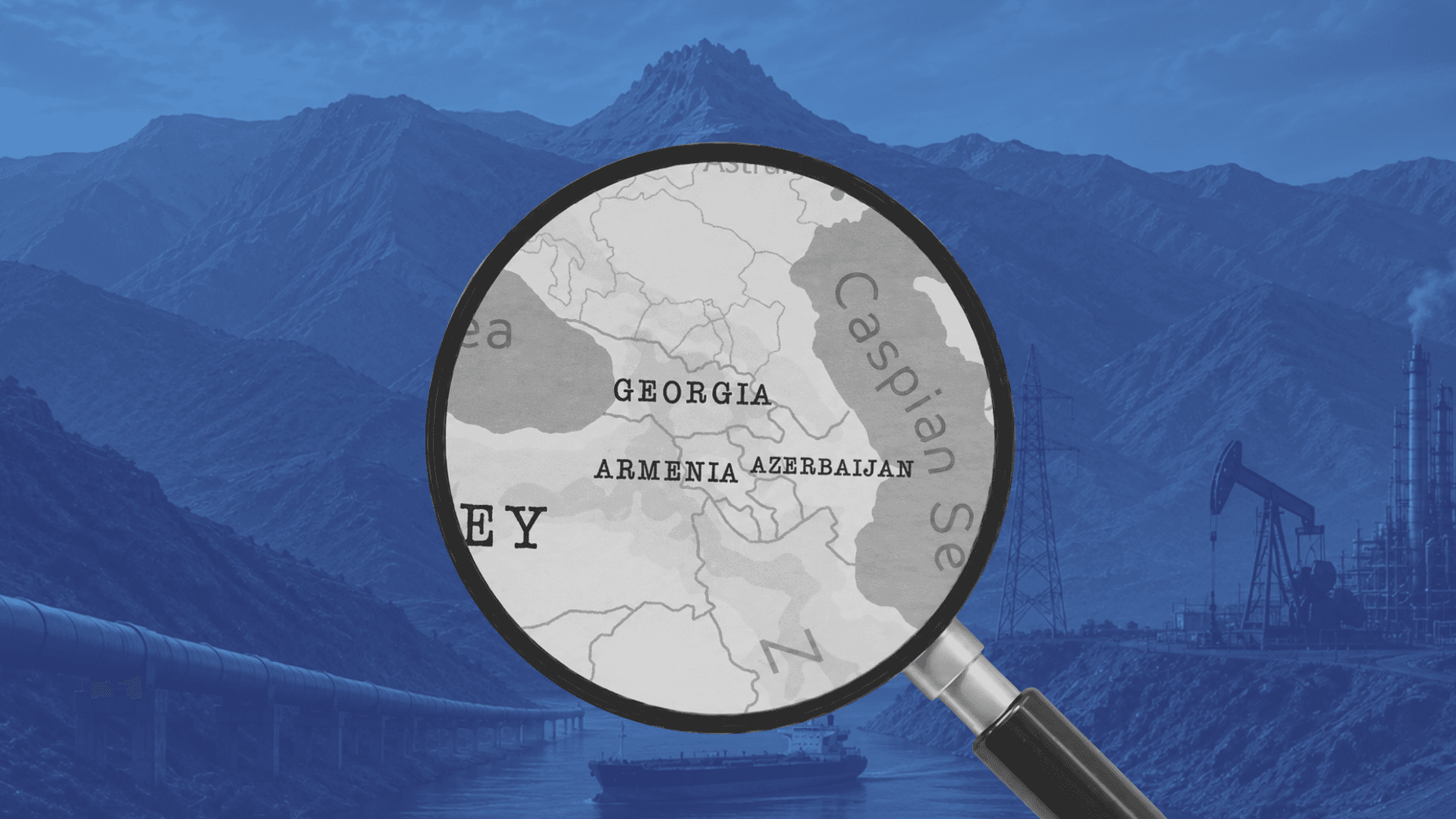
As Europe and Asia search for alternative trade routes, the South Caucasus is becoming a strategic geopolitical actor. However, its potential as a connector depends on whether the region can overcome persistent bilateral disputes, divergent geopolitical alignments, and cross-border infrastructure gaps.
The South Caucasus sits at the intersection of several major connectivity projects, yet geography alone does not create a successful corridor. Situated between the west and the east, for decades, the region has been defined by conflict. The unresolved dispute between Armenia and Azerbaijan over the Nagorno-Karabakh enclave, Russia’s military presence, Georgia’s territorial conflicts and the region’s position between competing powers defined a region with instability. However, Russia’s war against Ukraine disrupted traditional transport networks and increased the political risks associated with routes crossing Russian territory. At the same time, instability around Iran and uncertainty around major maritime chokepoints at the Strait of Hormuz reinforced the significance of alternative routes.
As governments and businesses seek more trustworthy supply chains, the South Caucasus can be viewed as a bridge between continents. The search for alternative trade and energy routes between Europe and Asia is creating an opportunity for Georgia, Armenia and Azerbaijan to revive their role along the modern Silk Road. The region remains politically fragmented, with Armenia, Azerbaijan and Georgia pursuing different relationships with each other, the EU and other regional powers, such as Sino-Russian influences. Therefore, the key question is whether the South Caucasus will seize its chance or stay politically divided.
Historical perspective
Located between the Black Sea and the Caspian Sea, and bordering Russia, Türkiye and Iran, the South Caucasus connects Europe with Asia. Historically, this geography has been both an advantage and a vulnerability. Armenia, Azerbaijan and Georgia have served as crossroads for empires, wars and trade for centuries. The traditional Silk Road also passed through the wider Caucasus, connecting markets across Europe and Asia. Yet the region’s modern history has been full of conflicts and less defined by trade.
Following the collapse of the Soviet Union, unresolved borders and conflicts created major barriers to regional integration. Armenia’s borders with Türkiye and Azerbaijan remained closed for decades. The Nagorno-Karabakh conflict prevented normal economic relations between Armenia and Azerbaijan. Russia’s ongoing conflict with Georgia, political influence and continued presence in Abkhazia and South Ossetia created additional major security challenges not only for Georgia, but for the whole region.
As a result, the three South Caucasus states developed very different economic and geopolitical trajectories. Georgia positioned itself as a western-oriented transit state, developing transport links with Türkiye, Azerbaijan and European markets. Azerbaijan used its energy resources to build a consequential network of pipelines and infrastructure. Armenia, facing closed borders with two of its neighbours, remained more economically dependent on Russia and Iran while gradually seeking cooperation with the European Union. However, today’s picture looks different.
Three Countries, Three Relationships with the European Union
The European Union’s relationship with the South Caucasus is defined by divergence. All three countries participate in the Eastern Partnership framework, but their relationships with Brussels have developed in distinct directions. Armenia is deepening political cooperation. Azerbaijan remains a strategic but selective partner. Georgia, despite having achieved EU candidate status, has suspended its accession process.
Armenia: Deepening Political Cooperation
Armenia has moved significantly closer to the European Union in recent years. EU-Armenia relations are based on the Comprehensive and Enhanced Partnership Agreement, signed in 2017, which fully entered into force in 2021. Unlike a traditional free trade agreement, CEPA provides a broad framework for political cooperation and domestic reforms, including work on democracy, transparency, the rule of law, judicial reform and economic opportunities. It has also strengthened cooperation in sectors including energy, transport, environment and trade. The economic cooperation is crucial, even if the EU is not Armenia’s dominant trading partner. In 2025, the EU accounted for 11.3% of Armenia’s total trade, making it the country’s third-largest trading partner. It represented 7.9% of Armenian exports and 13.5% of imports, with Armenian exports to the EU consisting largely of manufactured and mining products. Trade in services is also expanding, increasing by 20% between 2023 and 2024 and generating a positive balance for the EU in 2024.
This relationship is even more relevant after Armenia’s growing dissatisfaction with its traditional security arrangements. Russia’s failure to prevent Azerbaijan’s 2023 operation in Nagorno-Karabakh became a particularly crucial moment in Armenian security strategy. Armenia subsequently froze its participation in the Russian-led Collective Security Treaty Organisation and deepened cooperation with European partners.
At the same time, Armenia cannot simply abandon its existing economic relationships. It remains a member of the Eurasian Economic Union and maintains significant economic connections with Russia. Hence, while Yerevan is moving closer to Europe economically, it remains connected to Eurasian structures.
Azerbaijan: Strategic Partnership Without Integration
Azerbaijan’s relationship with the European Union follows a captivating model. EU-Azerbaijan relations remain based on the Partnership and Cooperation Agreement, which entered into force in 1999. Negotiations on an upgraded framework began in 2017. The main focus of cooperation priorities is on institutions, economic development, connectivity, energy efficiency, climate action and mobility. The economic relationship is substantial. The EU is Azerbaijan’s largest trading partner, accounting for 38.7% of its total trade in 2025. It is also Azerbaijan’s dominant export market, receiving 70.2% of Azerbaijani exports, while accounting for 11.1% of its imports. EU imports from Azerbaijan are overwhelmingly concentrated in mineral fuels and related products, alongside chemicals, while European exports to Azerbaijan are dominated by machinery, transport equipment and manufactured goods. Azerbaijan’s ongoing negotiations to join the World Trade Organisation could further shape the country’s future trade relations with the EU and the wider global economy. Energy remains the foundation of this partnership.
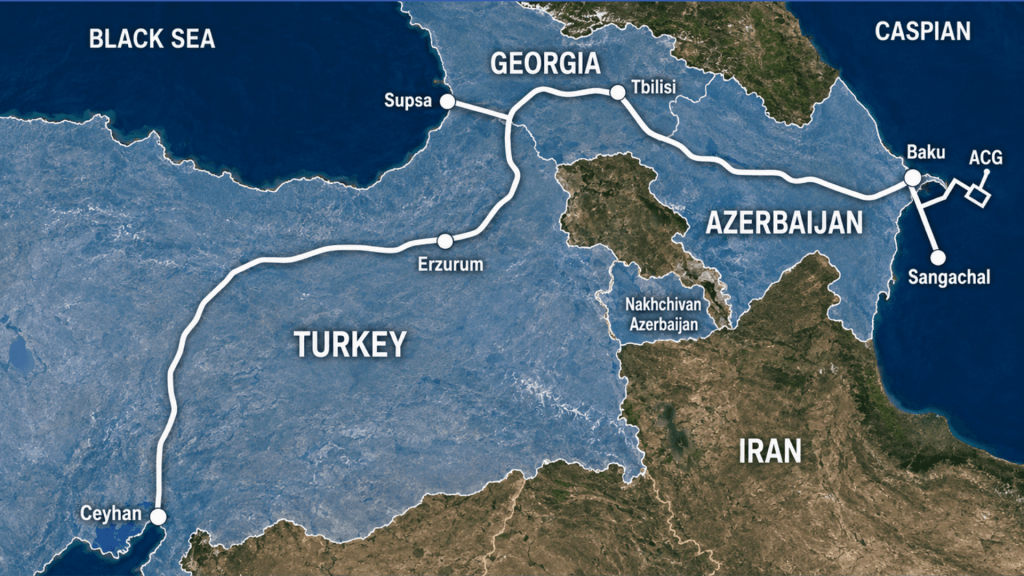
Azerbaijan is a significant strategic actor due to its oil and gas infrastructure. The Baku-Tbilisi-Ceyhan pipeline connects Caspian oil resources with Türkiye and international markets, while the Southern Gas Corridor has become increasingly relevant to European efforts to diversify energy supplies. Hence, Brussels needs Azerbaijan as an energy and connectivity partner. Baku values access to European markets and investment, however, avoids the political integration and institutional reforms associated with EU accession.
Georgia: European Integration Full of Uncertainty
Georgia occupies a unique position in the South Caucasus. It is the region’s principal gateway to the Black Sea and, consequently, its most direct physical connection to European markets. Its railways, roads and ports provide the main western outlet for goods moving from Azerbaijan and Armenia towards Europe. Infrastructure such as the Baku-Tbilisi-Kars railway and the Baku-Tbilisi-Ceyhan pipeline has reinforced this role, making Georgia an indispensable transit state for east-west energy and trade routes. Georgia was one of the first among the three South Caucasus countries to develop the deepest institutional and economic relationship with the European Union. The EU and Georgia signed an Association Agreement in June 2014, which entered into force in July 2016. The Deep and Comprehensive Free Trade Area has been provisionally applied since September 2014 and provides preferential access to the EU market while progressively aligning Georgian regulations with European standards.
Georgia remains a crucial economic partner with Europe. In 2025, bilateral trade between the EU and Georgia reached approximately €5.2 billion. EU exports to Georgia amounted to around €4.3 billion, led by machinery and transport equipment, chemical products, food and raw materials, and textiles. The EU imported approximately €900 million in goods from Georgia, including fuel and mining products, food and raw materials, chemicals and textiles. Yet Georgia’s economic integration with Europe increasingly contrasts with the deterioration of its political relationship with Brussels. Georgia applied for EU membership in March 2022 and was granted candidate status in December 2023. However, the accession process was suspended in 2024 amid growing concerns in Brussels over democratic standards, the rule of law and the government’s political direction. This has created a contradiction in Georgia’s relationship with Europe.
Georgia still remains physically indispensable to Europe’s connectivity ambitions, even as its political path towards European integration has become increasingly uncertain. As Europe seeks more resilient routes connecting it with Central Asia and China, Georgia’s geographical value is likely to grow. The country is a key western link in the Middle Corridor, connecting Central Asia to European markets through the Caspian Sea, Azerbaijan, Georgia and the Black Sea. This has encouraged Tbilisi to expand its political and economic engagement eastward to support future trade flows.
Georgia’s Continuing Ties with the East
Georgia has increasingly strengthened relations with Central Asia. On 29 June 2026, Georgia and Kazakhstan signed a joint declaration elevating their bilateral relationship, while on 3 July 2026 Georgia and Uzbekistan signed a strategic partnership agreement during an official visit to Tbilisi. These developments reflect Georgia’s broader effort to position itself as a commercial bridge between Central Asian producers and European markets. Expanding trade corridors requires more than infrastructure: customs coordination, border management, digitalisation, investment protection and common logistics standards are equally indispensable. Georgia’s growing engagement with Central Asian states is an effort to build the political alliance behind the Middle Corridor.
China is another intriguing part of this strategy. Georgia and China established diplomatic relations in 1992 and upgraded their relationship to a strategic partnership in 2023. Their economic ties are deepened by a bilateral Free Trade Agreement, in force since 2018, which provides tariff-free access for most Georgian goods. In June 2026, the two countries further upgraded their relationship to a comprehensive strategic partnership. Georgia positioned itself as a transit link within China’s broader connectivity initiatives, including the Belt and Road framework, while Chinese investment has expanded across infrastructure, energy and telecommunications.
Georgia at the Crossroads
For Georgia, this engagement towards east does not necessarily represent an alternative to Europe. Rather, it reflects the logic of its geography. As the western anchor of the Middle Corridor, Georgia’s value depends precisely on its ability to connect markets in Central Asia and Asia with Europe. The strategic challenge for Tbilisi will therefore be to ensure that expanding relationships with Kazakhstan, Uzbekistan, China and other regional actors strengthen, rather than gradually replace, its long-term European economic orientation. The wider implication is clear. Even if Georgia’s EU accession process remains as status quo, its economic partnership may remain the same, if not developed further. This creates an uncomfortable but critical reality for Brussels, Europe’s connectivity ambitions depend partially on a country whose political relationship with the EU has become one of the most uncertain in the wider neighbourhood.
Trade, Energy and Connectivity: Competing Routes Across the South Caucasus
South Caucasus’s strategic value lies in its role as a crossroad for competing and overlapping transport, energy and connectivity routes. Three developments are particularly substantial.
The Trans-Caspian International Transport Route, commonly known as the Middle Corridor, provides the region’s principal existing east-west trade connection. The Baku–Tbilisi–Ceyhan and South Caucasus pipelines are essential for energy movement. Meanwhile, new projects, particularly TRIPP and the proposed routes through southern Armenia, could strengthen competition within the region and increase connectivity even more.
Overall, these initiatives together reveal both the South Caucasus’s greatest opportunity and its greatest weakness. The region has multiple routes capable of linking Europe with Central Asia and beyond, but these routes have developed through different political alliances rather than within a unified regional economic system.
The Trans-Caspian International Transport Route: The Existing East-West Backbone
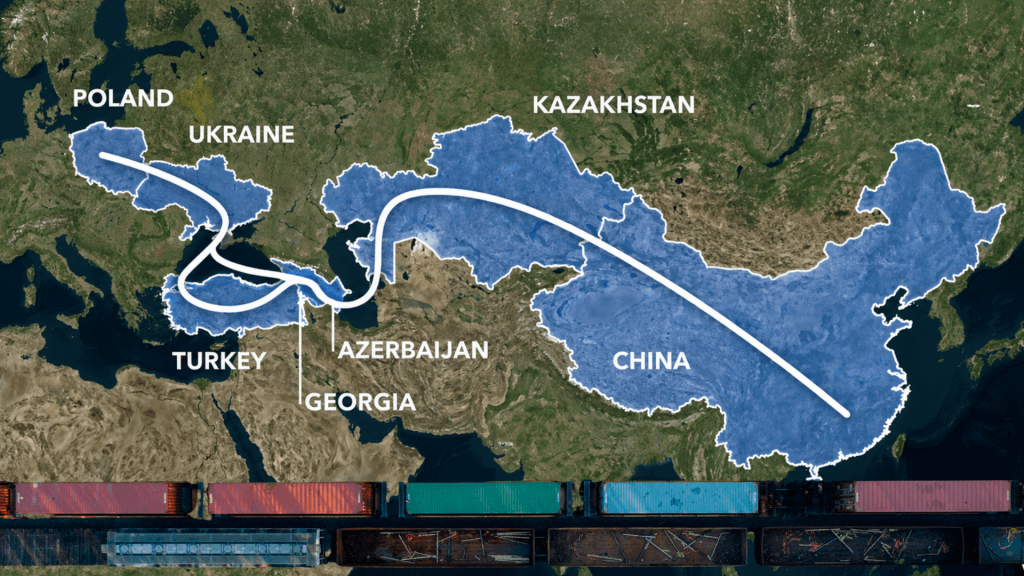
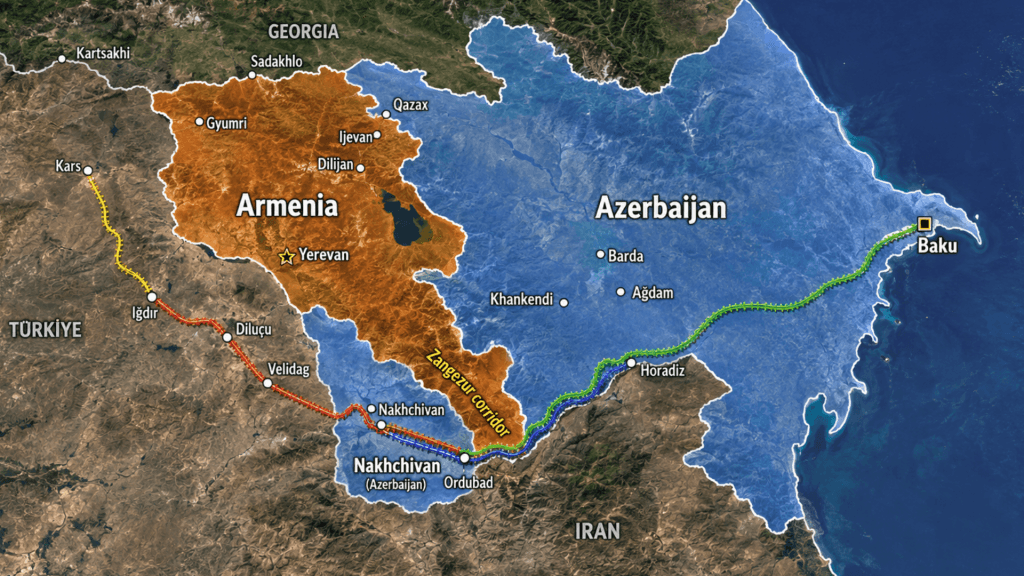
The most developed transport framework is the Trans-Caspian International Transport Route, better known as the Middle Corridor. The route connects China and Central Asia with Europe by crossing Kazakhstan, the Caspian Sea, Azerbaijan, Georgia and Türkiye before reaching European markets. Within the South Caucasus, Azerbaijan and Georgia provide the critical land connection between the Caspian and the Black Sea and Mediterranean transport systems. The Baku–Tbilisi–Kars railway is a central link between Azerbaijan, Georgia and Türkiye. As they provide a direct rail connection towards European markets. The route has become more strategically relevant since Russia’s full-scale invasion of Ukraine increased the political and commercial risks associated with Russian transport networks. The growing demand for alternative routes is already translating into investment in capacity. Following modernisation, the Baku–Tbilisi–Kars railway is expected to increase its annual carrying capacity from 1 million to 5 million tonnes. In 2025, container shipments transiting Georgia from China and Kazakhstan increased by 33%, while freight volumes on the Baku–Tbilisi–Kars route grew significantly.
However, the Middle Corridor is not a single uninterrupted transport system. Goods moving between Asia and Europe must cross multiple borders, rely on maritime connections across the Caspian and Black Seas and pass through countries with different customs procedures. This creates a fundamental difference between building a route and operating a competitive corridor. Therefore, the commercial viability of the TITR depends equally on reducing border delays, coordinating customs procedures, improving port capacity and ensuring predictable transit rules. The Middle Corridor therefore demonstrates the South Caucasus’s existing strategic value.
The Baku–Tbilisi–Ceyhan System: Key Energy route of the South Caucasus
The Baku–Tbilisi–Ceyhan pipeline and the wider South Caucasus energy network represent its most successful example of long-term cross-border connectivity. The pipeline connects Caspian oil resources with Türkiye and international markets through Georgia. Alongside it, the South Caucasus Pipeline transports natural gas from Azerbaijan’s Shah Deniz field towards Türkiye and European markets. The pipeline runs for 691 kilometres, including 249 kilometres through Georgia, and was designed to transport up to 21–24 billion cubic metres of natural gas annually at full capacity. Georgia is not only a transit country within this system but also has access to gas supplies under preferential arrangements.
This infrastructure established the Azerbaijan–Georgia–Türkiye axis as the region’s most durable model of economic cooperation. Each country benefits differently from the system. Azerbaijan gains access to international energy markets, Georgia benefits from transit and energy supplies, and Türkiye strengthens its position as an energy and transport hub connecting the Caspian region with Europe. For the EU, this energy architecture has become crucial the context of efforts to diversify energy supplies. The strategic significance of the South Caucasus is therefore not limited to its potential as a future trade corridor. It already plays a practical role in Europe’s energy connectivity.
However, this model also exposes the limits of regional integration. Armenia has historically remained outside the main Azerbaijan–Georgia–Türkiye connectivity routes. The region’s most successful infrastructure projects have therefore been built around selective political partnerships rather than cooperation among all three South Caucasus states. This distinction is necessary when considering the region’s next generation of connectivity projects.
TRIPP: From Peace Framework to Transport Corridor
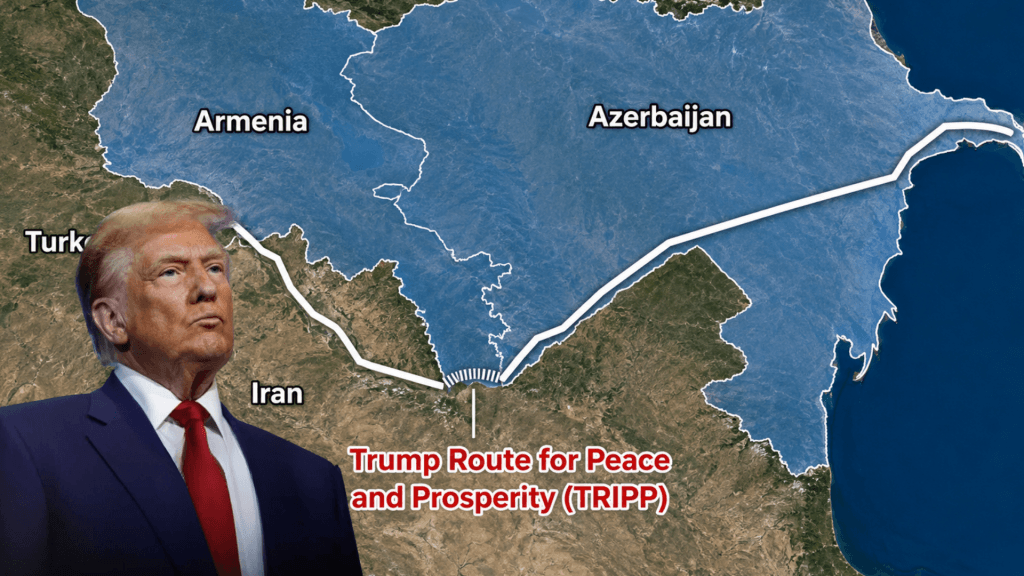
The Trump Route for International Peace and Prosperity represents the most ambitious attempt to reshape this existing structure. Initially it was conceived as a transport connection between Azerbaijan and its exclave of Nakhchivan through Armenia. Hence, TRIPP is discussed as a wider connectivity framework incorporating transport, energy and potentially digital infrastructure. Its significance lies in the potential to connect infrastructure that has historically been separated by conflict and involve Armenia directly in east-west connectivity. Discussions also included electricity interconnections and broader energy integration beyond mere movement of goods. In January 2026, Armenia and Azerbaijan announced plans to integrate their energy systems under the TRIPP framework, allowing electricity to be imported and exported between the two countries. This illustrates how the project could create economic interdependence beyond conventional transport infrastructure. This is what distinguishes TRIPP from existing routes. It has the potential to transform the regional economy by linking transport, electricity and potentially digital networks.
At the same time, TRIPP remains politically controversial. Unlike the BTK railway or BTC pipeline, which were developed among states with established strategic partnerships, TRIPP depends on cooperation between countries whose relationship has been shaped by decades of conflict. Its success will therefore depend on more than physical construction. Financing, security guarantees, customs arrangements, border management and agreement over the governance of infrastructure will all determine whether TRIPP becomes a functioning commercial corridor or remains primarily a geopolitical project.
Zangezur: The Political Limits of Connectivity
The debate surrounding the Zangezur Corridor, which emerged after the 2020 Nagorno-Karabakh War, represents the most contentious dimension of South Caucasus connectivity. At its core is the question of how Azerbaijan can establish a direct transport connection with Nakhchivan through Armenia’s Syunik region. From an economic perspective, a direct connection could reduce transport distances, improve logistics and strengthen links between Azerbaijan, Türkiye and wider Eurasian markets. It could also increase the South Caucasus’s relevance within the broader Middle Corridor.
The project, however, cannot be understood only in economic terms. Armenia’s concerns focus on sovereignty, security and control over transit infrastructure. Yerevan has opposed arrangements that could create an extraterritorial route beyond Armenian jurisdiction and instead supports reopening regional communications under frameworks that preserve full Armenian sovereignty.
This disagreement has transformed a mere transport project into a geopolitical dispute. Iran fears that a new route could reduce its significance as a transit country and weaken its strategic connection with Armenia. Türkiye sees stronger east-west links as consistent with its wider regional ambitions. Russia must balance potential economic benefits against the risk of further losing influence over regional connectivity. The existence of alternative routes demonstrates the economic consequences of this political deadlock. Azerbaijan has developed the Aras Corridor through Iran as an alternative connection to Nakhchivan. This means that political disagreements can redirect investment and create entirely different trade geographies.
Conflict, Political Risk and Competition
The most significant constraint to South Caucasus connectivity remains in political instability. The Armenia-Azerbaijan conflict has historically prevented direct regional connections and continues to shape the development of new infrastructure. Disagreements over sovereignty and control can delay projects, discourage investment, and lead countries to develop bypass routes rather than cooperative ones. This creates a paradox. The same geopolitical instability that increases international demand for alternative routes through the South Caucasus also increases the risks of investing in the region. Instability surrounding Iran further illustrates this contradiction. Greater uncertainty over existing trade and energy routes strengthens the strategic rationale for alternative South Caucasus corridors. Yet projects located close to volatile security environments also face increased risks of disruption and uncertainty.
Finally, the proliferation of routes could also increase competition between the three states. The BTK, TRIPP, the proposed routes through Syunik and the Aras Corridor do not necessarily serve identical political interests. For Georgia, new routes through Armenia could reduce its position as the region’s principal transit gateway. For Armenia, new connections could end decades of relative isolation and diversify its external economic links. For Azerbaijan, multiple routes would reduce dependence on individual transit countries and strengthen its position as a regional hub. It is true that diversification increases resilience by ensuring that no single route remains dominant. However, excessive competition could divide investment between parallel projects and encourage infrastructure to be designed around bypassing political rivals rather than integrating the region. The central challenge is therefore not the absence of routes. Its problem is the absence of a shared political and institutional framework capable of making those routes part of an integrated regional system.
The region’s future economic power will depend on whether these corridors can eventually reinforce one another. If transport, energy and digital projects are developed through coordinated and predictable arrangements, the South Caucasus could emerge as one of the principal bridges between Europe, Central Asia and Asia. If political competition continues to determine which routes are built and who controls them, the region may instead become a fusion of competing corridors whose strategic position exceeds their ability to generate genuine regional integration.