At a first glance, three developments over the past several days (a NATO summit, a government reshuffle in Kyiv, and the announcement of the Washington’s sanctions package aimed at Russia) are separate stories. Looking at them together, they follow a common theme of an alliance trying to secure more support for Ukraine as the individuals and structures carrying that support face growing uncertainty.
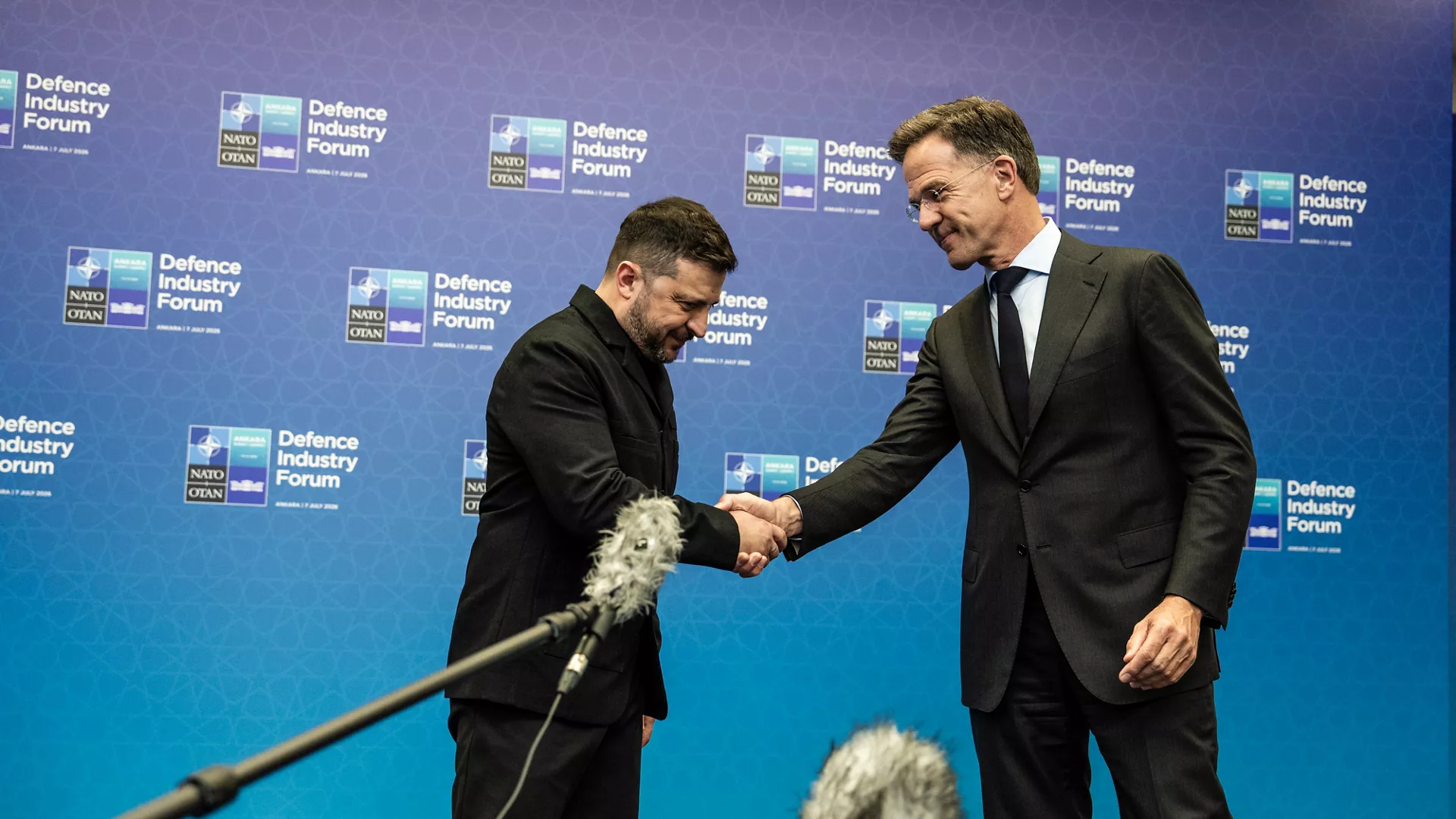
NATO’s summit in Ankara last week produced the alliance’s strongest financial commitment to Ukraine in months. Member states pledged €70 billion in military support for 2026, while also promising to match the same figure again in 2027. Roughly 30 billion euros of the 2026 figure will run through a European Union loan program, with the rest made up of bilateral pledges from individual countries. German Chancellor Friedrich Merz was reportedly central to landing on this fixed number after an earlier proposal (which included calculating contributions to a percentage of each country’s economic output) failed to gather enough support. Additionally, the Trump administration officially approved a landmark deal to license the Patriot air defence systems to Ukraine. These particular interceptors have become Ukraine’s main line of defence against Russian ballistic missiles in the past years. The licensing pledge could be a quintessential boost to Ukrainian military because Patriot supply has consistently lagged behind demand – even a smaller domestic production line would reduce Ukraine’s dependence on allocations from the global supply chain. Whether this translates into missiles on launchers within the next year, or remains more of a long-term industrial project, will depend on how quickly the licensing terms are finalised with the manufacturer.
The summit pointed toward a period of sustained (although possibly unevenly distributed) spending. The declaration leaves open exactly how the financial burden will be split among allies, which means that in the coming months individual countries will likely negotiate their specific contributions rather than issuing a single coordinated statement. Companies in the defence industry, especially those that work on drone production and ammunition manufacturing, should expect continued demand. They should also expect continued friction over financing mechanisms, as Trump criticised the US allies he considers insufficiently committed on defence spending and on backing US actions against Iran during the summit.
Four Directions Forward
Ukraine’s government reshuffle, announced just days after the summit, can be regarded as a direct response to the diplomatic workload NATO’s pledges just created. Following Zelenskyy’s announcement of a diplomatic strategy shift, Prime Minister Yulia Svyrydenko officially submitted her letter of resignation on 13 July, with some lawmakers expecting her to become Ukraine’s next ambassador to the United States. Svyrydenko, an economist who negotiated minerals agreement with Washington last year, is seen in Kyiv as one of the few Ukrainian officials with a relatively close working relationship with the Trump administration, making her a likely choice to manage what Zelenskyy now treats as Ukraine’s single most important bilateral relationship.
Zelenskyy framed the broader reshuffle as a restructuring of Ukrainian foreign policy into distinct and personally managed tracks. The United States comes first, covering the Patriot licensing agreement and wider security cooperation. The relations with Poland and Hungary come second, as Kyiv’s ties with these two neighbours have grown rather cold over the years. In the case of Warsaw over unresolved historical disputes, whereas in the case of Budapest over Hungary’s general scepticism of Ukraine’s EU membership.
Third is the Gulf and the wider Middle East. The Ukrainian administration has actively cultivated the relations with these countries, especially since the breakout of the war in Iran. This cultivation notably included agreements to export Ukrainian drone technology to the Gulf states. Last but not least is China, a relationship Kyiv has approached cautiously because of Beijing’s economic and geopolitical ties to Moscow.
The order itself is a political signal. Placing Washington first confirms that, whatever tensions have existed from time to time between Trump and Zelenskyy, Kyiv still regards US backing as the precondition for everything else, including European air defence cooperation and its EU accession bid. Placing Poland and Hungary second acknowledges that unresolved bilateral friction with two member states can, in different ways, slow or complicate the EU accession process. The practical implication of such an approach is a Ukrainian government likely to move faster and more predictably on US-linked defence and reconstruction deals than on the slower, more politically sensitive work of repairing relations with Warsaw and Budapest, an area where progress will be gradual and worth monitoring rather than assuming.
A Bill That Might Outlive Its Author
Senator Lindsey Graham, one of the US Senate’s most consistent advocates for Ukraine, travelled to Kyiv on 10 July, directly after the NATO summit, and announced that he and a bipartisan group of colleagues reached agreement with the White House on an updated version of the Russia sanctions bill. The legislation, which Graham had described as “bone-crushing”, would authorise steep tariffs (in earlier drafts as high as 500%) on countries that continue buying Russian oil and gas, alongside new restrictions on Russian banks and sovereign debt. With a rare bipartisan supermajority of around 85 co-sponsors already secured, the bill’s main obstacle was never Senate support, but the White House’s willingness to let it move forward, since presidential approval determines if such sanctions become mandatory or remain optional tools. Graham’s announcement suggested that obstacle had finally been cleared, given his close relationship with Trump in the previous years.
Graham died suddenly on 11 July, less than two days after leaving Kyiv, from what his office described as a brief and sudden illness. His death removes the legislator most responsible for building and holding together the bill, though not necessarily the coalition itself. Other sponsors, including Senators Blumenthal, Shaheen and Wicker, have publicly urged Congress to pass the bill quickly. Whether that translates into tangible results is very uncertain. While the bill’s supermajority of co-sponsors and Trump’s explicit endorsement clear its path forward, Graham’s personal relationships with both Senate leadership and the White House was crucial in keeping the legislation moving every time it slowed down in the past, and no other sponsor currently holds equivalent influence over both.
Should the bill pass largely intact, the consequences for European and global energy markets would be immense. Combined with the increasing number of Ukrainian attacks on Russian infrastructure, additional strain from the US sanctions is expected to weaken an already struggling Russian economy. Secondary tariffs at anything close to the levels previously mentioned would put pressure on Russia’s remaining major oil customers, especially China and India, and could tighten global energy supply chains in ways that affect European buyers even though the EU itself is not the target of those sanctions. Companies with any exposure to Russian energy supply chains, shipping, insurance or trade finance linked to Russian commodities should treat the bill’s progress as worth tracking closely over the coming weeks, since its fate now depends on whether Congress can carry Graham’s momentum forward without him.