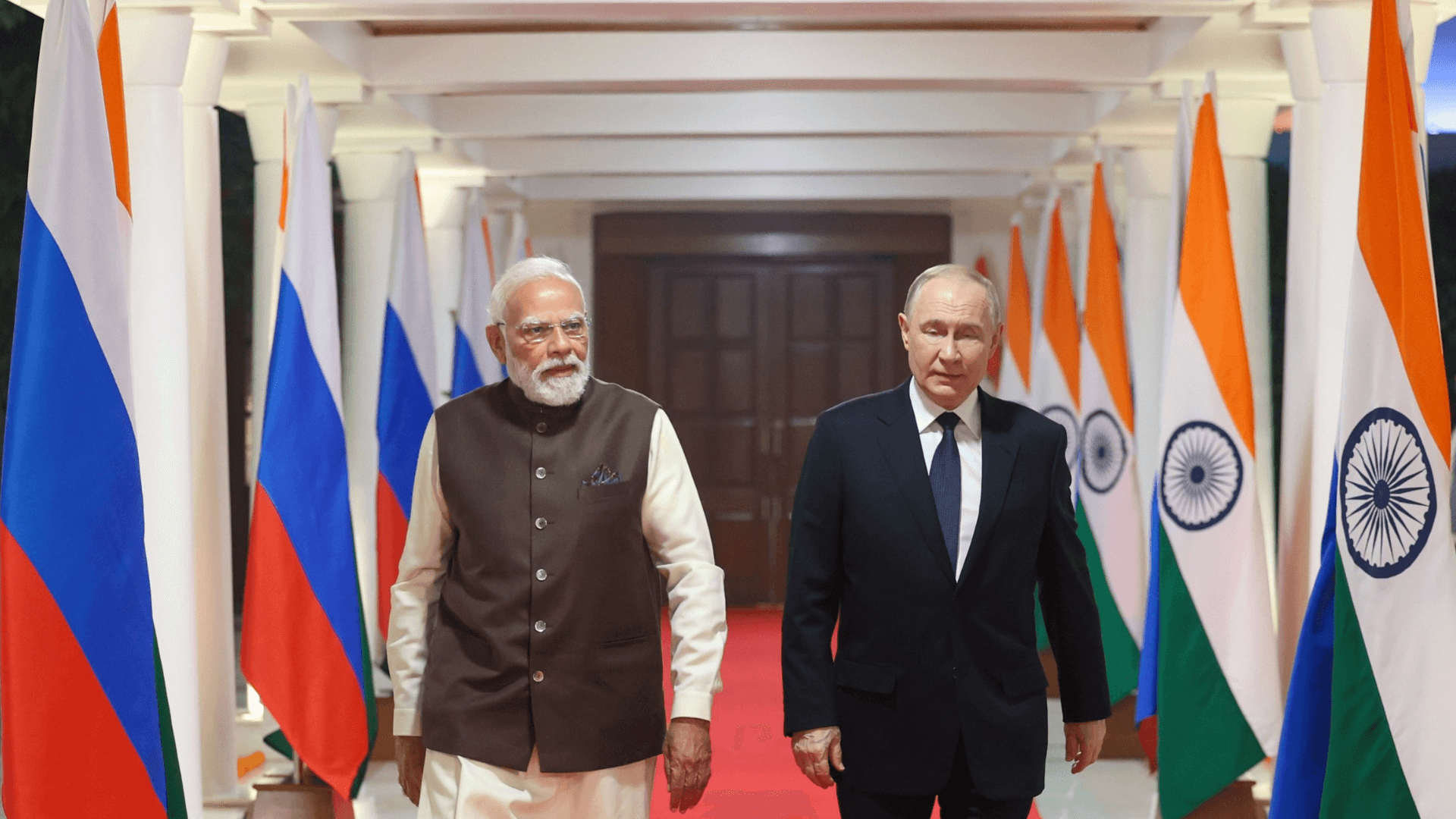
Russian President Vladimir Putin visited New Delhi from 4–5 December 2025 for the 23rd India-Russia Annual Summit. The summit took place under intense geopolitical pressure, characterised by the Trump administration’s imposition of 50% tariffs on Indian imports and specific penalties on energy trade intended to curb New Delhi’s engagement with Russia.
The summit served as a “stress test” for India’s doctrine of strategic autonomy. Rather than succumbing to Western coercion, India utilised the event to reaffirm its “Special and Privileged Strategic Partnership” with Russia. The leaders finalised or signed 28 agreements, ranging from the co-production of fifth-generation fighter jets to the integration of national payment systems. Significantly, the leaders also announced the opening of two new Indian Consulates General in Yekaterinburg and Kazan to deepen inter-regional ties.
For European policymakers, the primary takeaway is unambiguous: India has refused to isolate Russia. Instead, it is deepening economic and military ties to secure its own interests, a move that directly helps Putin sustain the war in Ukraine by providing Moscow with essential economic lifelines and reducing its diplomatic isolation.
Key Summit Outcomes
The summit moved the relationship beyond a simple “buyer-seller” dynamic toward joint production and institutionalised economic resilience against sanctions.
Defence & Security
Defence remains the backbone of the bilateral relationship, with Russia supplying 36% of India’s weapons imports between 2020 and 2024.
- Agreements were reached to accelerate the delivery of remaining S-400 Triumf surface-to-air missile squadrons. Of the five contracted units, only three have been delivered, with the remaining two scheduled for 2026 and 2027. Discussions also extended to the potential acquisition of the next-generation S-500 missile system.
- A major development was the agreement on the co-production of Su-57 “Felon” stealth fighter jets. Russia offered technology transfer to bridge India’s capability gaps vis-à-vis China until India’s indigenous AMCA jet becomes operational around 2034.
- The ratification of the Reciprocal Exchange of Logistics Support Agreement (RELOS) grants armed forces mutual access to military facilities for refuelling, repair, maintenance and berthing. This was complemented by a specific MoU on the “Training of Specialists for Ships Operating in Polar Waters,” signalling India’s strategic intent to operate in the Arctic alongside Russia.
Energy & Economic Architecture
To immunise their trade against Western sanctions, both nations established parallel financial and logistical mechanisms.
- A key outcome was the integration of India’s RuPay and Russia’s Mir payment networks. Official statements confirmed that 96% of bilateral transactions are now already being settled in national currencies (Rubles and Rupees).
- India secured long-term contracts with non-sanctioned entities such as Lukoil. India also discussed securing equity stakes in the massive Vostok Oil project in the Arctic to hedge against future price volatility.
- A roadmap was formalised to increase bilateral trade to $100 billion by 2030. This includes a newly adopted “Programme for the Development of Strategic Areas of Economic Cooperation till 2030” and a deal with Russia’s URALCHEM to establish a urea fertiliser plant in Russia to secure India’s agricultural supply chains.
Institutional & Legal Frameworks
Communiques issued by Russia and India following the summit reveal a push for broader institutional integration:
- Leaders directed officials to intensify negotiations for an FTA between India and the Eurasian Economic Union (EAEU), covering Russia, Belarus, Kazakhstan, Armenia and Kyrgyzstan.
- Both sides agreed to fast-track a new bilateral agreement on the “Promotion and Protection of Investments” to safeguard cross-border capital.
- A Migration and Mobility Partnership Agreement was signed to facilitate the movement of skilled workers and researchers between the two nations.
Nuclear & Environment
- Agreements are expected regarding the construction of new units at the Kudankulam Nuclear Power Plant. Official statements confirmed discussions on allotting a specific site for a second Russian-built nuclear power plant in India, in addition to collaboration on Small Modular Reactors (SMRs).
- Russia officially agreed to join the India-led “International Big Cat Alliance,” aiming to protect tiger and leopard populations.
Strategic Drivers
Understanding why India continues to pivot toward Russia despite Western pressure is essential for European strategic calibration.
India’s Calculus: Strategic Autonomy & The China Factor
India views the summit as a demonstration that it will not subordinate its national interests to Western diplomatic coercion.
- A primary driver for India is the “China Factor”. New Delhi views strong ties with Moscow as a necessary wedge to prevent Russia from becoming a “junior partner” or complete satellite of Beijing.
- India explicitly rejects the binary choice between Russia and the West, maintaining a stance of “pragmatic neutrality”.
Russia’s Calculus: Breaking Isolation
For Moscow, the summit was a geopolitical necessity to demonstrate that it is not isolated and retains partnerships with major global powers. The economic agreements provide a “lifeline” in addition to Chinese support, funnelling billions into Moscow’s war chest while evading banking sanctions.
Implications for Europe
The outcomes of the summit present distinct challenges for European foreign policy and security objectives.
Prolongation of the War in Ukraine
The summit will have a “net effect in prolonging the war’s duration”.
- By institutionalising mechanisms to bypass sanctions (RuPay-Mir integration, Rupee-Ruble trade), India is helping Moscow evade the financial attrition intended by Western sanctions.
- The purchase of discounted Russian oil funnels billions of dollars to the Kremlin, sustaining its war chest. The new equity discussions in Vostok Oil suggest this financial support will be structural and long-term, not just opportunistic.
Dilution of Western Sanctions Power
The formalisation of the RELOS agreement and the RuPay-Mir integration represent a structural challenge to Western financial hegemony.
- The creation of a “$100 billion trade roadmap” that operates largely outside the USD/EUR banking system sets a precedent for other “Global South” nations to trade with sanctioned entities.
The Diplomatic Reality Check
The summit highlights the limitations of European soft power in the Global South.
- India hosted Putin despite the threat of “50% + 25%” tariffs from the US.
- While India positions itself as a “diplomatic bridge,” its rejection of the Peace Deal combined with fresh military support effectively bolsters the Russian position.
Photo: Official X account of Narendra Modi, Prime Minister of India