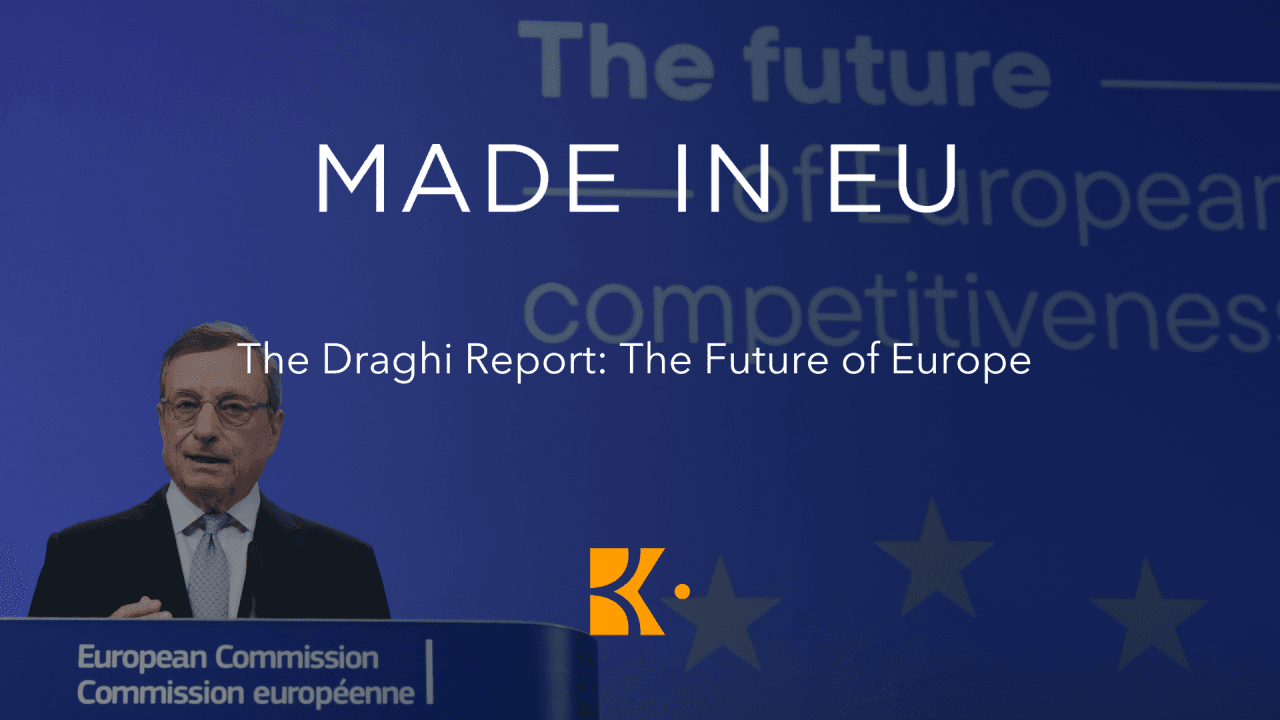
Unveiled on September 9th in Brussels, Mario Draghi’s report, “The Future of European Competitiveness,” presents an in-depth analysis and a daring plan for the economic prospects of the European Union.
In the infamous report, Draghi, as it seems, makes the last call for the European future, indicating that the EU is facing a prolonged period of economic stagnation, posing a risk to prosperity and societal well-being across Europe.
To reverse this trajectory, the former ECB chief outlines three key priorities: closing the innovation gap with the U.S. and China in critical technologies, leveraging the global shift towards decarbonization, and securing supply chains against growing geopolitical risks. The comprehensive 328-page report puts forward a mix of industry-specific — focusing on energy, pharmaceuticals, AI, and transportation — along with broader strategies aimed at fostering innovation, upgrading workforce skills, and improving governance.
A key recommendation of the report is an urgent call for an unprecedented financial commitment, urging the EU to invest €750-800 billion annually, or about 5% of its GDP. Of this amount, €450 billion would be dedicated solely to the energy transition. For comparison, the Marshall Plan required only 1-2% of GDP annually from 1948 to 1951.
Nevertheless, the report’s proposal extends beyond financial investments. It calls for greater cohesion within the EU, emphasizing the need to streamline regulations and prioritize subsidiarity—ensuring EU action only where it adds value. The report also suggests revising competition laws to facilitate mergers that could strengthen European companies, making them better positioned to compete globally, especially against China. An illustrative case is the thwarted 2019 merger between Siemens and Alstom in the high-speed rail sector, which the former Italian Prime Minister argues should have been approved for the sake of economic security.
While the report’s warnings are not groundbreaking, Draghi’s contribution emphasizes the pressing need for coordinated action.
French President Emmanuel Macron also expressed similar concerns, warning of Europe’s “mortal risk” earlier this year. This situation emerges as the EU enters a new institutional cycle following the European elections, offering a chance for reform.
European Commission President Ursula von der Leyen, who commissioned the report, is likely to leverage Draghi’s influence to push for significant policy changes. The recommendations of the two former Italian Prime Ministers, Draghi and Enrico Letta, are expected to play a central role in shaping the EU’s upcoming agenda.
While the report initially received a positive response from various political groups in the European Parliament, it faces significant challenges due to a leadership vacuum within the EU. France’s influence has decreased due to Macron’s political struggles and domestic issues, while Chancellor Olaf Scholz’s weakened coalition has limited Germany’s ability to provide strong leadership. Scholz’s smallest ally, the FDP, has already criticized the report and strongly opposed the idea of common debt.
Even under better conditions, implementing the proposals would have been challenging. Besides the contentious issue of common debt, other controversial topics persist among Member States, such as increasing the EU’s own financial resources and reforming the energy market to separate renewable energy prices from fossil fuels.
Efforts to complete a capital markets union, a long-standing initiative revived by the Letta report, continue to face resistance from smaller member states. Additionally, any attempt to expand qualified majority voting to more policy areas is met with scepticism across the EU-27 and, ironically, is vetoed by the largest EU countries.
The report will soon face two critical tests. The first will occur at the informal European Council meeting on November 7th in Budapest, where Draghi is expected to present his recommendations. This follows immediately after the U.S. presidential election, which could shift the EU’s political landscape. The question remains whether this will be the right moment to propose bold reforms to the European Member States.
Another sign of how seriously the report is being considered will come during negotiations for the EU’s next multi-annual financial framework, which will cover 2028 to 2034. The size and allocation of the budget will be a clear measure of whether Draghi’s vision has gained traction and whether the EU is ready to adopt a more ambitious, forward-looking approach to its economic future.
Will Draghi’s and Letta’s reports maintain the interest of Member States, or will they be set aside until it is too late?