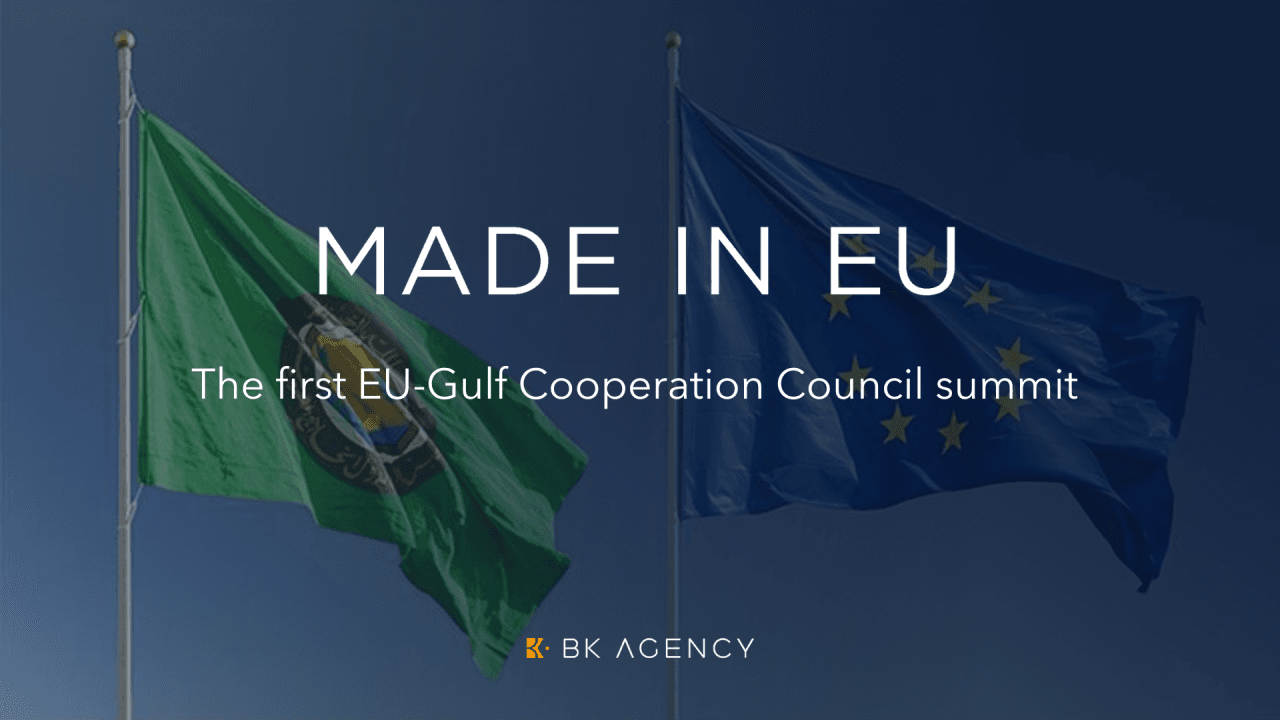
This week, the outgoing President of the European Council, Charles Michel, and the Emir of Qatar, H.H. Sheikh Tamim bin Hamad Al Thani (as the rotating President of the Gulf Cooperation Council), will co-chair the first-ever summit between the European Union and the GCC.
To mark the importance of the summit, the Saudi crown prince, Mohammed bin Salman, is attending the event’s opening. Together with relevance, his presence brings controversy. In 2018 Western democracies pointed the finger against the crown prince for the murder of the Saudi US-based journalist Jamal Khashoggi. The same year, an investigation conducted by the CIA concluded that bin Salman had ordered the assassination at the Saudi consulate in Istanbul. However, the public outrage at the time didn’t last long: Covid first and Russia’s war against Ukraine later made Western countries – in need of alternative energy resources to supply the demand – to soften their stances. Moreover, the European Union could consider that Saudi Arabia is in the position to play a vital role in finding a diplomatic solution to the Middle East crisis and avoid in this way the escalation of the conflict to the regional dimension.
Relations between the European Union and the GCC (composed – besides of Saudi Arabia – by Kuwait, the United Arab Emirates, Qatar, Bahrain, and Oman) are based on a cooperation agreement signed in 1989. This agreement establishes dialogue and collaboration between the EU and GCC on several topics, from trade to climate and scientific research.
However, in February 2022, this cooperation evolved into something more tangible and accelerated when an EU-GCC Joint Council of Foreign Ministers endorsed a Joint Cooperation Programme for 2022-2027, updated in October 2023. The programme outlines specific joint activities and deepens cooperation across numerous sectors strictly related to global challenges: trade barriers, climate change, green transition, and counterterrorism.
To give you some numbers, the European Union is the second-largest trade partner for the GCC countries, generating €170bn in trade in 2023. The EU mainly imports mineral fuels from GCC countries (over 75% of the total trade between the two blocks in 2023), and since the 2020 Russian aggression against Ukraine, EU fuel imports have more than tripled.
But it is not just about trade: both blocks harbour common broader ambitions. A taste of it came during last year’s G20 meeting in New Delhi, which endorsed the India-Middle East-Europe Economic Corridor (IMEC). This would allow GCC countries to serve as a hub between Asia, Africa, and Europe to counterbalance the Chinese economic overdependence of many countries in these blocks.
On the geopolitical front, at least two issues need to be addressed. One is the many parallel ties that Gulf countries still entertain with Russia: it dates back to July 2023, the last (sixth) joint ministerial meeting between the GCC and the Russian Federation, when both blocks stood together with the UAE over a dispute on three islands. It is, indeed, in the numbers that we find the confirmation of this: for example, in October 2022 and April 2023, OPEC + (which includes among its members Russia, Saudi Arabia, Kuwait, and UAE) decided to reduce global crude oil production. These decisions benefited GCC states, which were rewarded with higher prices. Still, the benefits for Russia were much more significant, as they reduced the impact of the Western sanctions from a predicted 15% cut to GDP in FY23 to an estimated reduction of only 7-10%.
Another issue is the Middle East crisis. While the EU (at least in the person of the High Representative Josep Borrell) and the GCC are aligned on condemning the October 7 terrorist attacks and calling for a ceasefire in Gaza, coordination still needs to be found on if and how the EU wants to support GCC efforts to contain the explosion of the conflict to a regional dimension. This means how the EU intends to position itself in the Saudi-Iran détente after the 2023 Beijing de-escalation agreement, potentially giving Saudi Arabia the role of mediator between the West and Iran in the Middle East dynamics.
This week’s summit will probably not deliver answers, but it will likely give us a clearer perspective on how far the EU and the GCC countries will want to push their cooperation.
The European Council
This week’s European Council will be about two heads of government who do not share anything in politics other than being in a position to lighten the mood of the 27-block leaders: the Hungarian Prime Minister Viktor Orbán and his Polish counterpart, Donald Tusk.
Two more Hungarian vetoes need to be overcome. The Hungarian PM is blocking two strategic dossiers for EU support to Ukraine. The first is the 50-billion-dollar loan (about 45 billion euros) promised by the G7 in June. The second is the 5-billion-euro allocation from the European Peace Facility for arms supplies in 2024.
On the first one, the financial mechanism is ready. The 27 member states have agreed on the three legislative texts that set up the loan structure and regulate the European share. However, to participate with 20 billion dollars, the United States has set a condition for the EU: to ensure that extraordinary revenues are available for over six months, within which the EU sanctions (used to finance the bill) must be renewed each time. On this fourth proposal, Orbán has vetoed, clearly indicating that he is waiting for the US presidential elections in November before making any decision.
To take cover, the EU has prepared for a loan even without the United States. Its share (in theory, 20 billion dollars) could rise to 35 billion euros. Orbán’s veto was avoided thanks to the instrument chosen: a macro-financial assistance program on which qualified majority voting is taking place until the end of 2024. Thanks to contributions from Canada, the United Kingdom, and Japan and (still) reduced participation from the United States, the 50 billion dollars promised by the G7 should still be reached. However, the European Union would project an image of fragmentation and disagreement supporting Kyiv. An agreement must be reached at the EU and G7 level through the International Monetary Fund (IMF) meetings, which begin in Washington on October 21. An IMF loan to Ukraine also depends on the G7 loan. In addition, the EU must launch its macro-financial assistance program by the end of the year because, starting in 2025, the vote will be unanimous, giving Orbán another veto at his disposal.
Orbán’s second veto concerns the 5 billion euros allocated to creating the European Peace Facility’s Assistance Fund for Ukraine. An agreement was reached last March to make these resources available for the purchase and supply of weapons to Ukraine. Orbán’s veto was overcome with the commitment to use the Hungarian quota (1.2 per cent of the total) for non-lethal material. But then Hungary suddenly changed its mind, and the 5 billion for weapons to Kyiv remained blocked, along with another 1.5 billion euros in back payments to member states that transferred part of their stocks to Kyiv.
To get out of the mud, there is a chance that member states’ contributions to the Assistance Fund for Ukraine will no longer be mandatory but voluntary. The collateral effect would be that countries would be forced to pass by their respective national parliament for authorisation. Due to the precarious political situation at home, big players like France and Germany would not be keen to make such a move.
The second unexpected hot topic on the agenda comes from Polish Prime Minister Donald Tusk’s proposal to temporarily suspend the right to asylum for migrants crossing the Belarus border in a speech to his party in which he promised a new, stricter strategy on migration.
Russia’s close ally, Belarus, has been orchestrating a strategy to undermine the European Union’s stability. For several years, they have facilitated transporting migrants from Middle Eastern and African countries to their borders. These people are then pressured to enter EU countries illegally. This tactic, often described as “hybrid warfare,” aims to create discord within the EU. Finland has encountered comparable challenges, ultimately leading to its decision to close its Russian border in July.
The proposal comes after Tusk announced that he would ask the European Commission to recognise this decision, which has not officially reacted. Some provisions of the new Pact on Migration and Asylum allow for stricter limits and conditions for the right to asylum in the event of instrumentalisation of migration by hostile regimes, but not suspension. Poland registered 7,700 requests for international protection in 2023, according to Eurostat. Over this year, it has received between 500 and 1,500 asylum applications monthly.
Warsaw’s assertive stance evokes past disputes with Brussels. However, while potentially unsettling for the Commission, Tusk’s declaration will unlikely face the same pushback as his predecessor Mateusz Morawiecki experienced. Tusk is prominent in the von der Leyen’s European People’s Party.
Tusk’s actions should be viewed through the lens of Poland’s internal politics, particularly with the upcoming presidential election in May. In recent polls, Tusk’s political creature Civic Platform has maintained a reasonable advantage on Law and Justice. Tusk appears intent on preventing the right from outmaneuvering him on migration issues.
All things considered, everything written so far speaks a single political language in Brussels: stalemate.
The NATO Defence Ministers’ meeting
It’s time to start rethinking the future of the Transatlantic Alliance. This week, NATO Defence Ministers are meeting in Brussels to discuss an ambitious yet challenging topic on the agenda: rethinking the Alliance and its decades-old policy on relations with the Russian Federation.
The question is: why now? The NATO-Russia relationship irremediably deteriorated after the Kremlin decided to move to war against Ukraine in 2022. Since then, while Russia held NATO responsible for its military invasion due to the Alliance’s eastward expansion in Europe, NATO has considered Russia (or Vladimir Putin?) the “most significant threat to Allies’ security”.
Still, the dramatic change in tone needs to be expressed in writing. Formally, NATO still maintains the “Founding Act” with Russia. This document, which dates back to 1997, six years after the collapse of the Soviet Union, settled relations between the Allies and the newborn Russian Federation with the shared vision to “build a stable, peaceful, and undivided Europe”.
Thereafter, there was so much water under the bridge before 2022. The two crucial events were the Russian invasion of Georgia in 2008 and the illegal annexation of Crimea in 2014. Around these main events, increasingly frequent campaigns of disinformation, threats, and attempts to influence the political life of many former Soviet Republics fed the worries of the Allies.
While unofficial discussions have been ongoing over the past few years, this week’s meeting is the first occasion to discuss this topic at a ministerial level. Mark Rutte, the new Secretary-General of the Transatlantic Alliance, has set the objective of arriving at the next alliance summit in The Hague, scheduled for June 2025, with a shared strategy across the 32 members.
And from here, a bulb glows on everyone’s head: the first big elephant in the room is the US election, with Donald Trump’s advisers calling for a “radical reorientation” of the Alliance and the Tycoon’s renowned “respectful” relationship with Vladimir Putin.
However, issues also arise on the other side of the Atlantic, with member countries like Hungary and Slovakia continuing to entertain stable contacts with the Kremlin and its allies like China.
This week will give us first indications not only on the ‘diplomatic tightness’ of the Atlantic Alliance but also on the ability of the new Secretary-General Mark Rutte to channel the different diplomatic positions into a single geopolitical and, probably, military strategy.
Explore the findings in our latest report to discover how supporting women entrepreneurs can drive sustained economic progress.

Download the report.