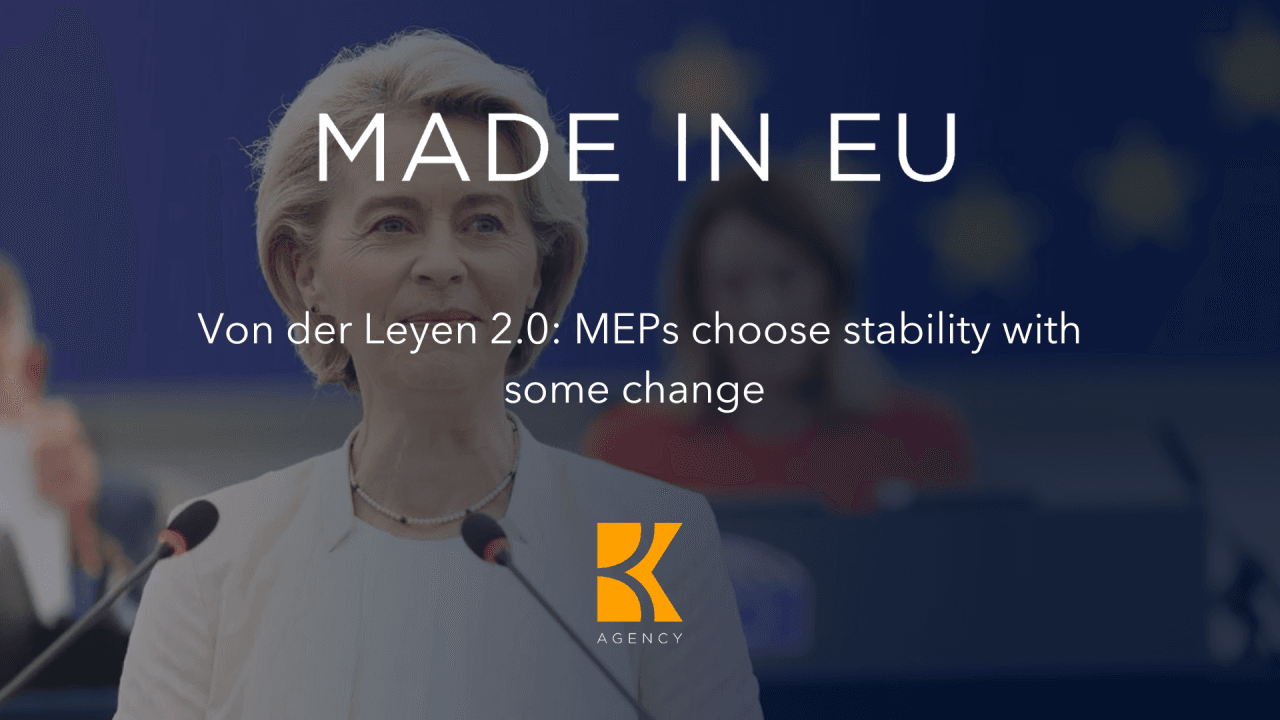
Ursula von der Leyen has just been reconfirmed as President of the European Commission with 401 votes of the Members of the European Parliament in her favour, well above the 361-vote threshold required for an absolute majority. This vote spared European politics from being thrown into chaos and confusion, which would have required European leaders to find a new candidate for the job.
How we got there
Von der Leyen’s big challenge was to keep most of her coalition on board—the EPP, S&D, and Renew—while also convincing the Greens and avoiding alienating part of the ECR group, notably the Italian delegation expression of Giorgia Meloni’s party. Those votes may have shielded von der Leyen from some free runners inside the major supporting groups.
It is evident now that her effort was successful even without the support of Meloni’s MEP. The Greens were all interested in being part of the coalition supporting von der Leyen to remain influential after the poor performance in June’s elections. In another sign they were willing to play this game, on Tuesday, they supported the reappointment of EPP’s Roberta Metsola as President of the European Parliament, a significant change from 2022 when they proposed Alice Bah Kuhnke as a candidate to challenge her. In the same spirit, we had a sense of The Greens’ voting intentions this morning when some MEPs, although unhappy with von der Leyen’s speech, supported the candidate in the name of a “pro-European majority” during the debate after.
On the other side of the political spectrum, the Italian Prime Minister was initially cut off from the negotiations in Brussels to choose the top jobs in the European institutions. Although Meloni has ruled out ordering her 24 MEPs to back von der Leyen for a second term until the vote, it is now confirmed that they did not vote for von der Leyen. Meloni’s decision has an important implication for the Italian government: the chances for Italy to access a crucial portfolio in the next Commission’s composition are now low. On a different note, the support from other delegations of the ECR party is a clear indication that the next European Commission’s agenda must take into account a right-leaning Parliament, notably on issues such as migration and the Green Deal. This is somehow a variation of the cordon sanitaire as we knew it from the last legislature, as it is likely that the ECR (or at least the vast majority of its MEPs) will get positions in the distribution of Chairs and Vice Chairs of Committees, therefore being able to influence the political debate and decision-making process.
Von der Leyen’s political guidelines
In a 20-minute speech to announce her priorities for the second term, it is indeed earlier this morning that von der Leyen suggested that a change of course in the EU’s green agenda will probably be the most considerable alteration compared to her first mandate. Among the several topics she addressed, she recommitted to the EU’s climate goals but limited her discussion on nature restoration – one of the most controversial chapters of the European Green Deal – to positive rhetoric. An assist to the agricultural sector, to which she also pledged to reward farmers for conservation efforts and promised a “Strategic Dialogue on Farming”.
Regarding the budget, von der Leyen promised robust support for European industry, proposing a ‘Clean Industrial Deal’ within 100 days if reelected. This initiative would be funded through an ‘Industrial Decarbonisation Accelerator’ and a Competitiveness Fund aimed at strategic clean technologies. She assured expedited processes for energy projects but left funding details ambiguous, noting that the Competitiveness Fund would be part of the EU’s 2028-2035 budget and that the EU would need new revenue sources, meaning no new EU debt instruments but something able to mobilise investments on critical sectors across the EU, in line with what was done with The Investment Plan for Europe, better known as the Juncker Plan in 2015.
What’s next
Today’s vote opens the way for forming the next European Commission. During the summer, von der Leyen will receive candidates for Commissioner from Member States, and in September, she will present the organigramme with mission letters. From then on, a process of scrutiny will start that may last until the end of October when the new Commission is supposed to be sworn in.