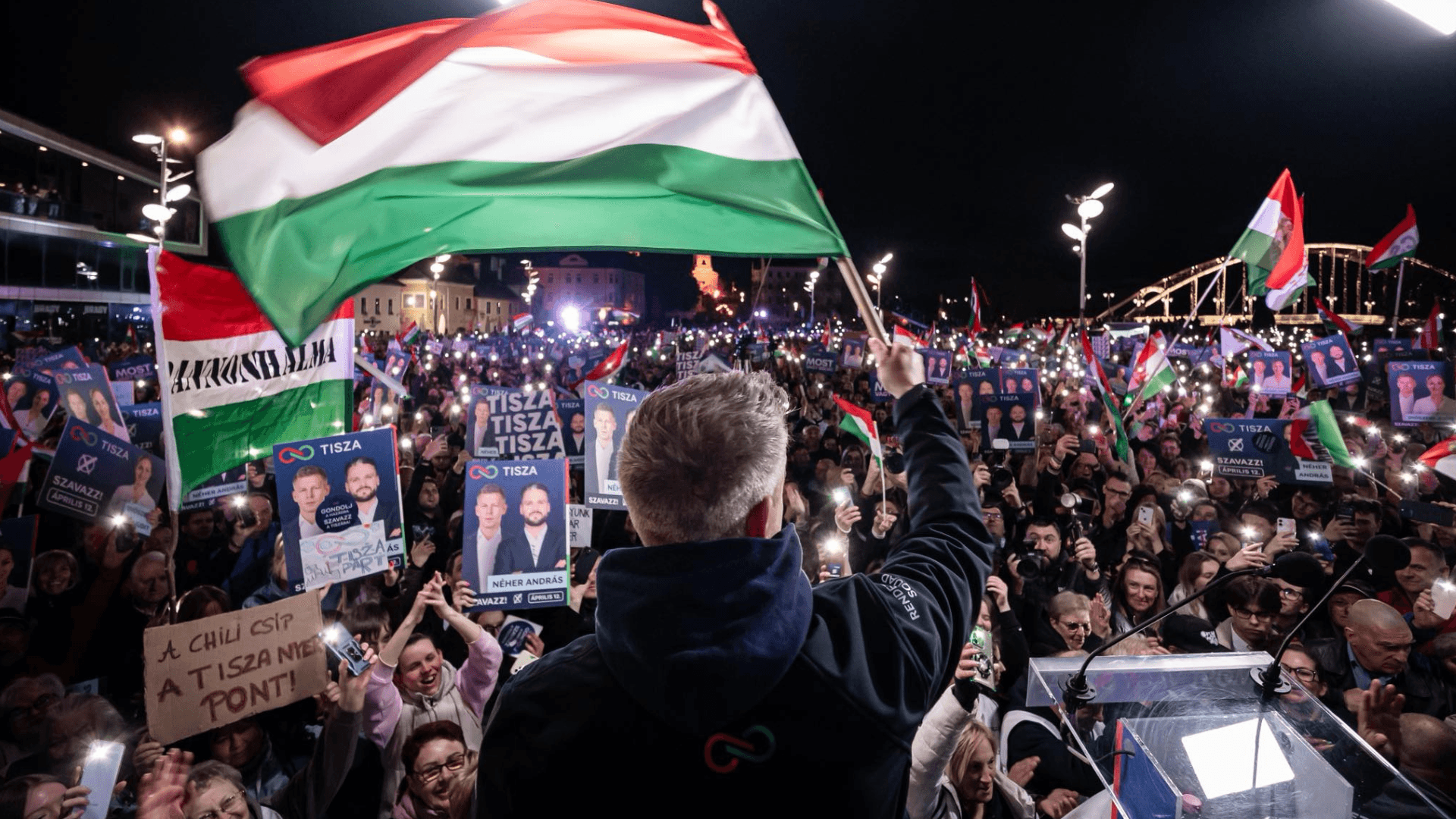
Viktor Orban took his first electoral loss in 16 years, with the moderate conservative Tisza party acquiring a constitutional majority in the parliament. However, another threat to the EU’s cohesion is arising on the Southeastern border of the European Union.
The political map of Central Europe has been subject to one of the most important transformations in nearly two decades. The results of the Hungarian parliamentary elections on 12 April have sent a strong message that was heard loud and sound both in the institutional corridors of Brussels and the financial hubs of London and Frankfurt. For sixteen years, the political landscape in Budapest was defined by a centralised model of governance under Viktor Orban’s Fidesz party that frequently clashed with the official EU policy. In the past 24 hours, that entire framework has been changed. As Péter Magyar and his Tisza party secure 138 seats in a 199 member Parliament, the focus is shifting towards what are the next steps to be taken.
Magyar’s Landslide Guarantees Supermajority
Yesterday’s election results in Hungary represent signify a complete restructuring of the country’s constitutional reality. Magyar’s Tisza secured a constitutional majority of more than 66% of MPs, which was a feat previously thought to be the exclusive domain of the outgoing Fidesz administration. This “supermajority” means that Magyar has the legal mandate to not only form a cabinet but to rewrite the laws and institutional frameworks that have governed Hungary since 2010. The background of this shift is rooted in the mixture of overall dissatisfaction with economic situation and a charismatic leadership that emerged from inside the system itself, as Magyar used to be a part of Fidesz until recently.
On a local level, the importance of this win is huge. The immediate challenge for the incoming Magyar administration will be the so-called institutional fortress, meaning the network of loyalists currently holding fixed-term positions in the judiciary, the media authority, the central bank, and other institutions. However, with a two-thirds majority, the new government has the legislative power to reorganise these bodies. The Hungarian citizens expressed their demand for a more transparent governance model based on the rule of law, though the process of dismantling sixteen years of institutional consolidation will likely be a slow and difficult process.
Internationally, the win is a massive relief for the European Union and a setback for Moscow. Hungary is expected to shift from being a veto power within the European Council to a proactive participant in EU integration. We can expect an immediate normalisation of relations with Brussels, which will likely lead to the rapid unblocking of billions of Euros in Cohesion and Recovery funds that were previously frozen due to concerns regarding the rule of law. Geopolitically, this could also represent a turn in Hungary’s stance on Ukraine. Under Magyar, Budapest is expected to align with the regional pro-NATO and pro-EU consensus, effectively dissolving the illiberal axis that had formed between Hungary and Slovakia under Fico’s leadership.
Russian Influence Fading Away
The immediate signal for market players is cautious optimism with the acknowledgment of a massive transition that is likely coming. The Hungarian Forint showed an immediate strengthening against the Euro as the results became clear, reflecting market confidence in a more predictable regulatory environment. A shift away from special taxes on foreign-owned sectors like banking and energy is expected – these were a trademark of the previous administration. The transition phase will still carry its own risks. The new government will need to audit state accounts and potentially deal with the fallout of centralised contracts, which could then lead to temporary legal friction in sectors heavily reliant on state procurement.
Looking further ahead, the Magyar administration is likely to prioritise the “Europeanisation” of the Hungarian economy. This includes moves toward Eurozone entry preparations and a restructuring of the energy sector to reduce dependence on Russian gas – both of which will take a lot of time and effort from the government. Hungary is attempting to reclaim its position as a regional liberal leader, and the success of this transition will depend on how effectively the Tisza party can manage the high expectations of its diverse voter base while maintaining fiscal discipline in the face of significant institutional cleanup.
Going South: Bulgaria is Next
As the historic events in Budapest conclude, the analytical focus moves to Sofia. On Sunday, April 19, Bulgaria will head to the polls for yet another parliamentary election, attempting to resolve a period of fragmented governance that the country has been part of for several years. This is going to be seventh parliamentary election in the previous five years, and unlike the decisive landslide in Hungary, the Bulgarian political landscape remains divided between the reformist bloc, led by We Continue the Change – Democratic Bulgaria (PP-DB), the traditional centrist-right power of Boyko Borisov’s GERB which is currently leading a minority government, and the newly formed centrist-left Progressive Bulgaria (PB) led by the ex-president Rumen Radev. The emergence Radev’s party has fundamentally altered the electoral math, polling highest and positioning a third major player at the center of the Bulgarian power struggle. On top of that, several smaller right-wing parties might significantly influence the end result of elections.
The background of this election is defined by a shift from voter fatigue to a desire for a third way. For years, Bulgarian politics was a deadlocked battle between the reformist PP-DB and GERB. The entry of Radev into the direct parliamentary arena has disrupted this duopoly. Leveraging the high approval ratings he had during his presidency, Radev has positioned Progressive Bulgaria as a sovereigntist alternative that promises institutional stability without the perceived baggage of the older parties, and a more eurosceptic stance than both the ruling GERB and the opposition PP-DB. Currently polling as the frontrunner, Radev’s party appeals to a broad demographic that feels alienated by the legacy parties.
Possible Scenarios: Radev’s Government(s) and New Elections
There are three most likely scenarios after the elections. One of the scenarios is the constitution of an illiberal government between Radev’s party, the legacy left-wing Bulgarian Socialist Party, right-wing Sword, and far-right Velichie, in case that they cross the electoral threshold of 4%. This would mean a consolidation of another eurosceptic force inside the EU just several days after the long-time anti-EU Fidesz was voted out of office in Hungary. The second option would be the coalition between Radev’s party and the opposition PP-DB, creating a more moderate centrist government – that being said, both parties have signaled that they are currently not interested in cooperating, accusing the other of being corrupt. Third and possibly the most unorthodox scenario would be the purposeful delay of negotiations, resulting in another snap elections that will be combined with the presidential elections scheduled for autumn this year. That way, all the other parties will have more time to respond to the newly emerged PB, and Radev will also have even more time to further mobilise abstainers, and absorb the electorate of smaller parties that fall below the threshold.
Looking Ahead
This election is a critical litmus test for the country’s institutional maturity. While the entry into the Eurozone was a historic milestone, the integration process is not yet complete, particularly regarding the full removal of land border controls within the Schengen. A government that can demonstrate stability and a clear pro-European trajectory will be in a much stronger position to finalise these negotiations. Conversely, a deadlocked parliament or a government that puts emphasis toward a more transactional and balanced foreign policy could lead to a period of strategic vacuum. For the PP-DB, the goal remains deep judicial reform, while GERB continues to market itself as the experienced player in a time of economic transition. Radev’s party essentially acts as a wildcard that could either provide a new path to stability or lead to an even more complex round of coalition talks.
Observing the broader picture, political events in Hungary and Bulgaria signal a new chapter for Central and Eastern European countries. Tisza’s victory may create a sense of momentum for reformist forces in Sofia, but the specific challenges of a new currency regime make the Bulgarian situation unique. Stakeholders should expect a period of post-election negotiation that focuses heavily on fiscal policy and the management of Eurozone integration. Whether Bulgaria settles into a “third way” under Radev or remains fractured, the era of predictable two-party struggles in Sofia is over. The next few months will be marked by analysing how these two very different transitions play out in real-time.
Image source: Official X account of Péter Magyar, President of the Tisza Party