This week, we explore the outcome of the first EU–Central Asia Summit, along with Finland’s strategic response to emerging security threats. Enjoy!
The First EU-Central Asia Summit in Samarkand
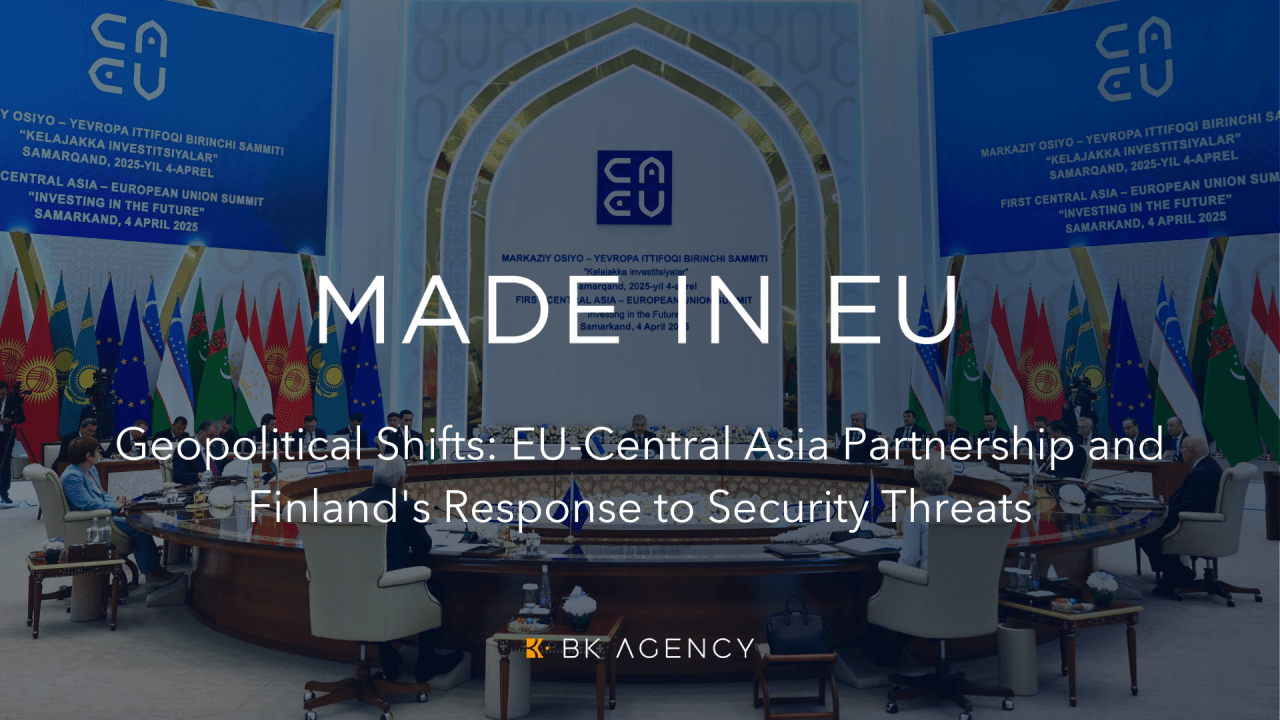
On 4 April, EU representatives met with the leaders of five countries from Central Asia – Kazakhstan, Kyrgyzstan, Tajikistan, Turkmenistan and Uzbekistan – at the first Summit dedicated to the region. The EU announced its intention to deepen its relations with the countries through a strategic partnership, a more comprehensive cooperation to address current geopolitical and security challenges.
The Summit coincides with the 30th anniversary of the countries’ relations with the EU and highlights the strategic importance of the region. As part of the strategic partnership, von der Leyen announced a €12 billion investment that will be allocated primarily to projects in transport (€3 billion), critical raw materials (€2.5 billion), water, energy and climate (€6.4 billion), as well as digital connectivity.
A Stronger Strategic Partnership
The strategic partnership can support local industries and economic diversification and contribute to the EU’s strategic independence. One example is the investment in the Trans-Caspian Transport Corridor, an infrastructure network connecting Southeast Asia and Europe through Kazakhstan, Azerbaijan and Georgia. Once completed, this corridor could increase trade flows and provide an alternative for businesses that aim to reduce dependency on traditional routes through Russia. Investing in the region’s critical raw materials can also support diversification from China, making Central Asia a crucial partner for the EU in its attempt to achieve climate neutrality and boost its autonomy in key sectors.
Security was also a key word in the discussions. During the Summit, the EU emphasised the need to strengthen regional resilience to the challenges posed by the continued Russian aggression against Ukraine and the parties agreed that achieving just and lasting peace is fundamental. That said, according to some reports, the EU might still be expecting a greater alignment of the countries’ position with the EU’s, considering that all of them have abstained from votes on Russia in the UN and have circumvented European sanctions.
Finland responds to security threats
Building resilience to security threats is also at the top of the agenda of the EU and of its Member States. Last week, Finland announced that it was going to leave the 1997 Ottawa Convention, a treaty that bans anti-personnel landmines, less than a month after Poland, Latvia, Estonia and Lithuania made the same decision. This would allow Finland to stockpile landmines, most likely on its eastern border. The country is also going to increase its investment in defence to 3 percent of GDP by 2029, exceeding the 2 percent NATO target.
Finnish President Alexander Stubb stressed that the moves are part of a strategy to increase its defence capabilities to deter threats from Russia and contribute to European security. Indeed, the country shares a 1,300-kilometre border with Russia and has been increasingly the target of hybrid warfare tactics since at least 2022. Amongst these are damages to undersea power cables.
In the latest incident, in December 2024, the Estlink 2 electricity cable was cut, leading Finnish authorities to investigate whether a Russian ship was involved. While Russia’s involvement has been hard to prove, since 2022, the number of incidents where telecom, gas and power links have been damaged in the Baltic Sea has increased. Experts have noted that these incidents affect connectivity but also increase the feeling of vulnerability and uncertainty in societies.
Dialogue with international partners
A strong response to security threats would inevitably require a collective and coordinated approach to Western defence, including long-term partners such as the US. While this unity has been increasingly questioned since Trump’s election, European leaders have not ceased their attempts to maintain dialogue. On 1 April, President Stubb travelled to the US for an informal meeting with US President Donald Trump. The talks focused on enhancing defence cooperation and, at their conclusion, the US President underlined that he would be looking forward to strengthening the partnership between the two countries. This sentiment was also reinforced by the Finnish Defence Minister Antti Häkkänen, who underlined that Europe should strengthen its capabilities but also continue to cooperate with the US.
Concerted action for European security
Amid continued geopolitical challenges, the EU has shown that it is seeking to strengthen its leading role in defence to deter the threat from Russia. Reinforcing its partnerships with allies and deepening those with new regions plays a key role in developing overarching approaches to security challenges. While the robustness of these partnerships will have to be tested over time, it is certain that the interconnectedness of global security issues requires international cooperation for concerted action.