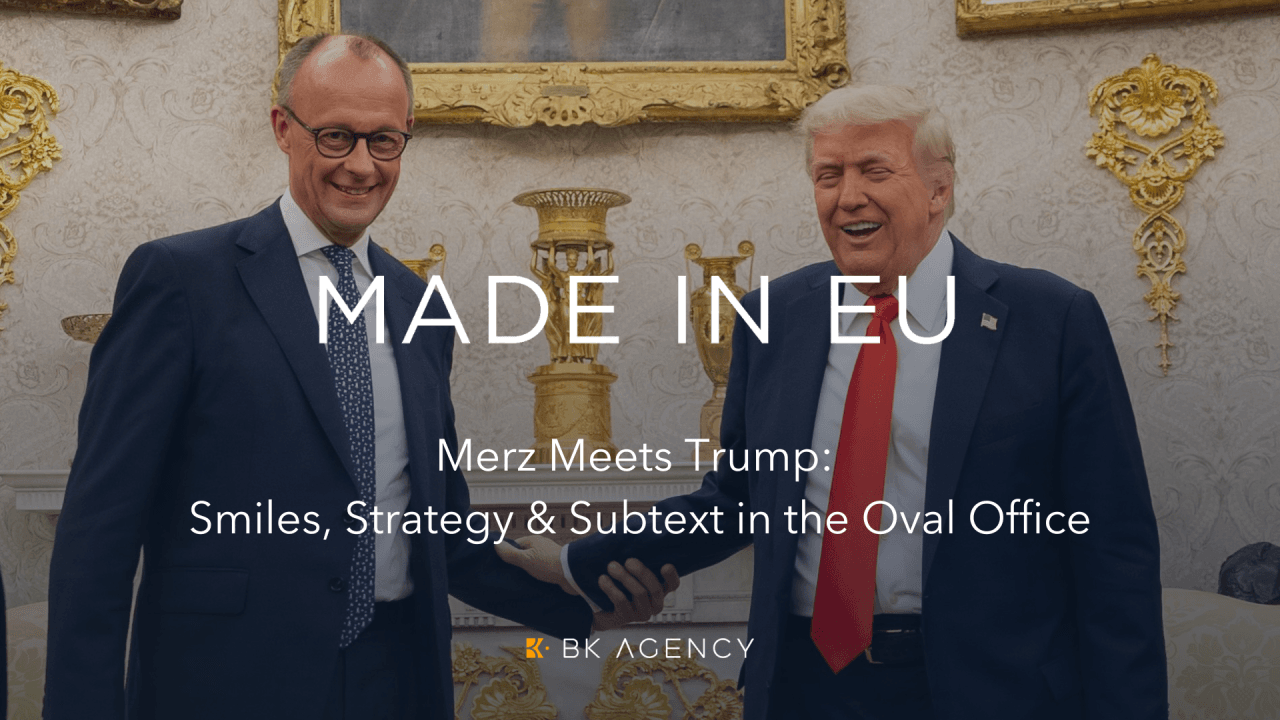
Friedrich Merz, Germany’s recently appointed Chancellor, pulled off what many in Europe might call a diplomatic tightrope walk during his high-stakes visit to the White House this week. With U.S. tariffs looming and the Ukraine war grinding on, Merz arrived in Washington with a to-do list and a delicate balancing act: charm Trump, avoid a public clash, and push EU priorities—all without triggering the former president’s famously short fuse. By most accounts, mission accomplished.
Merz came armed with a strategy whispered among seasoned European leaders: let Trump talk. He did—while Merz listened, praised American strength, corrected just one historical blunder (a WWII reference by President Trump), and even presented Trump with a carefully chosen gift: a framed copy of the birth certificate of Frederick Trump, Donald’s German grandfather.
It worked. Trump seemed genuinely taken with Merz, calling him “a very good man to deal with” and “a very great representative of Germany.” He even praised Merz’s English and suggested the two had a “good rapport”—a stark contrast to his frosty relationship with former Chancellor Angela Merkel.
Merz didn’t leave substance entirely at the door. He managed to raise key EU concerns—from defusing the transatlantic trade conflict to urging stronger U.S. pressure on Russia. With a 50% tariff threat on nearly all EU goods just weeks away, Trump struck a surprisingly upbeat note: “I think all we want is just to have a good relationship. The rest will just sort of follow very easily. We’ll have a good trade deal.”
Of course, Trump being Trump, contradictions followed. While he acknowledged that the EU handles trade negotiations—“mostly determined by the European Union”—he also wavered: “We’ll end up hopefully with a trade deal, or… we’ll do the tariffs… I’m okay with the tariffs.” Merz held his ground—but wisely avoided overplaying his hand or expressing discomfort with the President.
Unlike others who’ve faced Oval Office ambushes, Merz walked away not just unscathed but looking confident and composed.
Later in the day, live on Fox News, Merz played another game, reminding the conservative audience of past transatlantic dynamics. When asked whether Russia would’ve invaded Ukraine had Trump been president in 2022, Merz dodged: “It makes no sense to discuss the past.” Still, he noted that under Republican leadership, the U.S. had supported Ukraine’s 2008 NATO bid—unlike France and Germany. He added a pointed historical footnote: “Ukraine was then a big nuclear power… and thereafter Russia attacked Ukraine.”
Merz left Washington with no concrete deal—but also with no damage, something not every European leader has managed. For a first Oval Office encounter with a volatile but still highly influential Trump, Merz’s visit may go down as a textbook case of how to mix diplomacy with flattery, push substance without provoking, and keep the bigger picture in mind.
In Europe, the visit signals that Germany is still considered an important power on the other side of the Atlantic. It also gives Europe another card to play: the heads of state of the three largest EU economies—France, Italy, and Germany—are now all welcome in Trump’s Oval Office. It’s time for European countries to set aside internal squabbles and focus on reinforcing transatlantic ties—working together, rather than apart, with the United States.