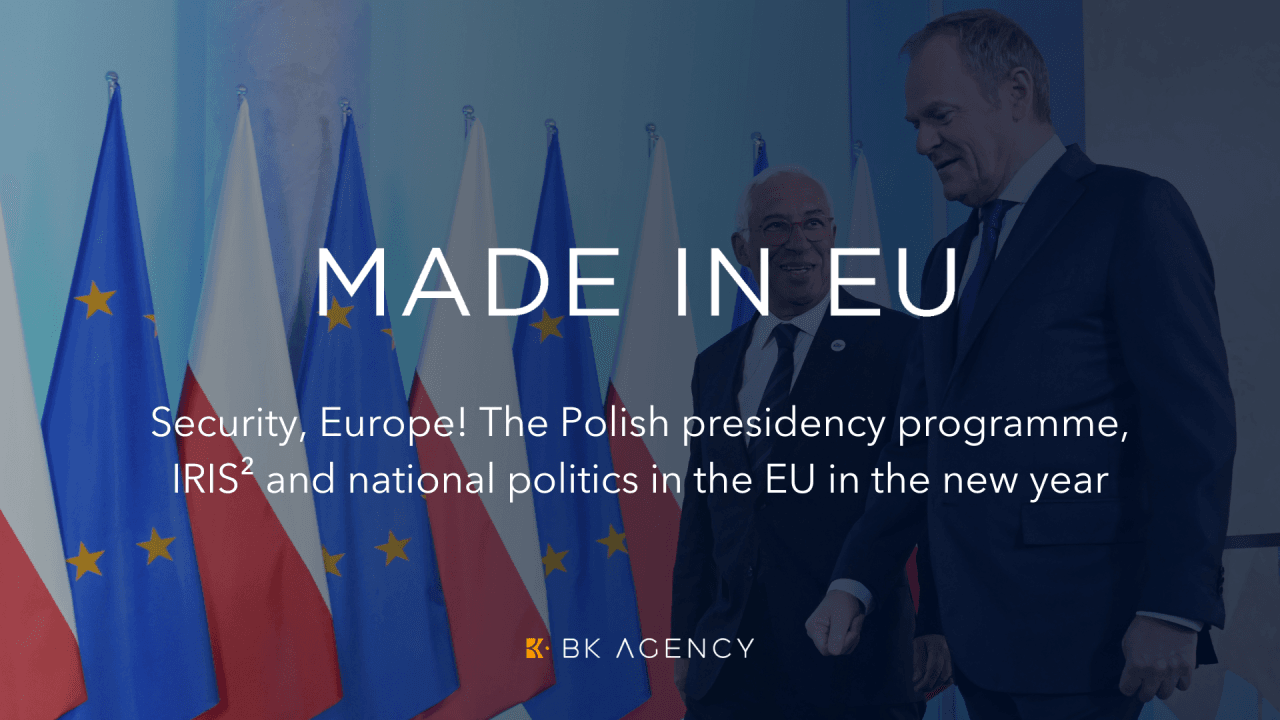
Security, Europe!’ is the headline of Poland’s programme for its 6-month presidency of the Council of European Union starting on 01 January. The country is the first in the new presidency trio including Denmark and Cyprus, that will succeed it in June 2025 and January 2026 respectively. The focus of its programme will be security in all its dimensions: external, internal, information, economic, energy, food and health. This is also an underlying priority for the trio in this 18-month term.
Key elements in ensuring security for Europe will be not only the realignment of EU Member States in their support for Ukraine and the achievement of peace that benefits Kyiv but also increased investment and spending in defence at the European and national level to ensure European competitiveness and independence from other international actors. A major question remains though whether the EU has the capacity to promptly meet its Member States’ security demands – which could lead them to turn to other competitors in the market.
The case of Italy, Starlink and IRIS²
According to some sources cited by Bloomberg in an article published over the weekend, the Italian government is believed to be discussing an alleged €1.5 billion security deal with SpaceX, for it to provide secure internet via its Starlink system for Italian government operations, communication services for the military in the Mediterranean, and satellite services for emergencies like terrorist attacks or natural disasters. The existence of an agreement has been denied by the government, which underlined in a statement that talks with SpaceX are “part of the normal consultations that State institutions have with companies.” Nonetheless, commentators have noticed that the agreement would not be incompatible with European agreements for operating systems like Starlink, in particular the IRIS² programme.
The IRIS² space programme – an ambitious €10bn programme comprising 290 satellites – was launched right before the end of the year by the European Commission to ensure security for governments and armies in light of increased cybersecurity concerns as well as long-term security challenges which have become more evident with Russia’s full-scale invasion of Ukraine. The programme is designed to strengthen Europe’s strategic autonomy and technological leadership and to offer a European alternative to Elon Musk’s Starlink network.
Nonetheless, the programme which was initially expected to be operational by 2024 has been facing significant delays, leaving a gap in the EU’s immediate future. While optimistic about the potential of the programme, some experts have also noted that IRIS² faces significant challenges compared to Starlink, including less funding and regulatory fragmentation, where companies seeking to collaborate have barriers in regulations and different political interests.
For the EU to play the central role it wishes to in the block’s security, it must prove to be able to move unitedly, finding agreements that can prompt investment, strengthen European research and development capacities and support businesses and start-ups with innovative ideas. The European Commission and the Member States must prove that they can create a strong environment in the EU to foster innovation and while agreeing on security and defence priorities.
The political situation in EU Member States
Yet at the onset of 2025, the political situation in Europe does not seem to be stable enough to support the strong action needed. Several countries face domestic political challenges operating under caretaking governments, or non-functioning or extremely fragile ones. As we discussed in a previous newsletter, the EU’s leading powers, France and Germany, are both distracted by fragile and non-functioning governments and by the strengthening of far-right parties, which tend to
Austria is also on the brink of a potential strong shift to the right. In the country, the collapse of coalition talks between the centre-right Austrian People’s Party (ÖVP), the centre-left Social Democrats (SPÖ) and the liberal NEOS led to the resignation of centre-right Chancellor Nehammer, leaving the space for a potential government formed by the far-right Freedom Party (FPÖ). The alliance between the three parties was seen as the best solution to avoid a government led by the FPÖ but negotiations fell over budget cuts and pension reform.
Although the FPÖ had come first at the elections in September by gaining roughly 29% of the votes, Austrian president Van der Bellen tasked the ÖVP (which came second with 26% of votes) to form a coalition government, given that leaders of all the other parties had ruled out an alliance with the FPÖ’s leader Herbert Kickl. FPÖ is known for its Eurosceptic and Russia-friendly stances, as well as its strong positions on asylum and migration. Kickl has repeatedly reiterated his intention to create a ‘Fortress Austria’ and to introduce firm rules on legal immigration and on the return of asylum seekers to their original countries.
While the FPÖ has already been a partner in several coalition governments, it leading the country is a different question. A coalition with the ÖVP would inevitably lead the two parties to have to confront each other on differences over their support for Ukraine and their views on the European Union. The FPÖ – which is critical of the EU – has already strongly opposed aid for Ukraine and sanctions against Russia, as well as current plans for a missile defence system.
What this means for European security
Austria could become the missing piece in the creation of a Russia-friendly and Eurosceptic bloc in Central Europe – joining Hungary, Slovakia and (depending on the upcoming elections) Czechia, with repercussions at a European level as well in talks on Ukraine and defence and security. This only adds to an already fragile situation at the European level, where agreement over continued support to Ukraine seems to be waning.
Security has always been a policy area marked by disagreement between Member States. Nonetheless, the time seems to be right for significant change. The central role that security and defence have acquired on the EU’s agenda, including through the creation of a Commissioner portfolio dedicated to space and defence and through ambitious initiatives such as IRIS², alongside the Commission’s increasing attention to European competitiveness and strategic independence offer a window of opportunity for the EU to take the lead – even in the face of domestic political challenges. This can happen through strong leadership at the European level. In this, the Polish presidency of the Council is perfectly placed: Through an ambitious programme and concrete initiatives, it can set the pace for the security work of the next European Commission and define the overall policy direction.