Serbia’s foreign policy over the last twenty years is characterised by chronic fence sitting, with all the governments attempting to balance between the West and the East, culminating in the shut-down of its largest refinery due to the US-imposed sanctions.
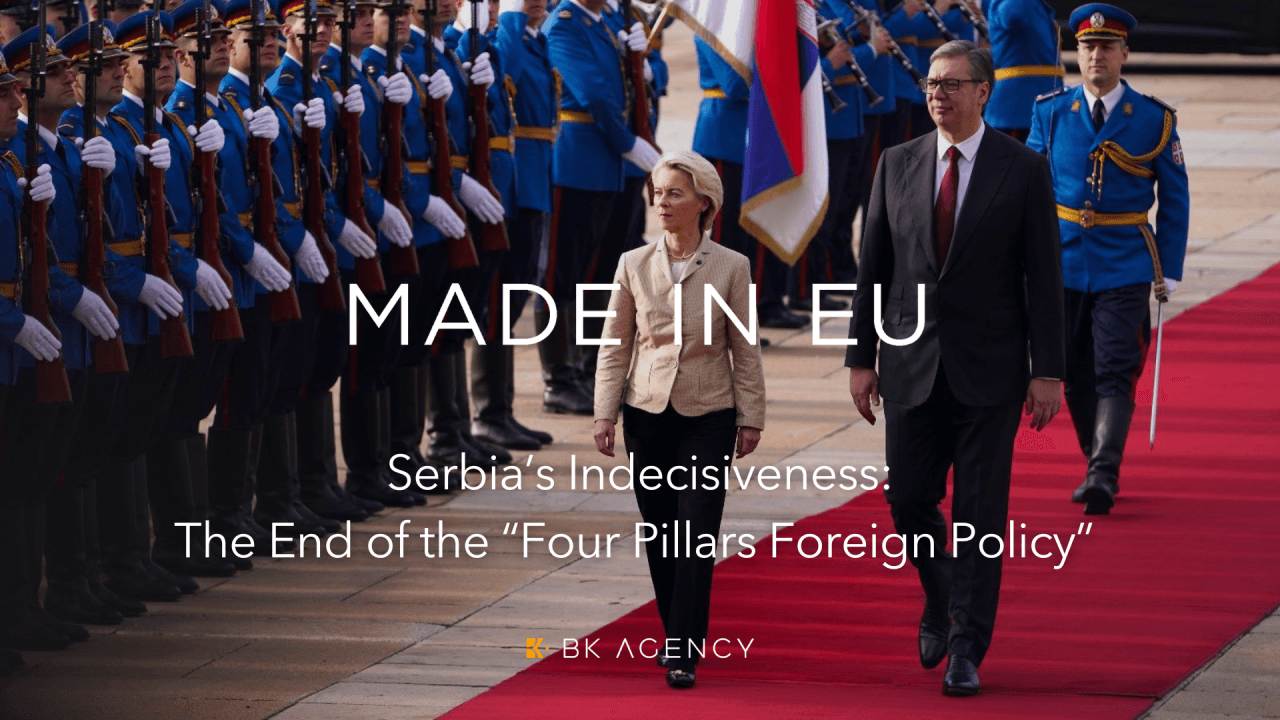
Serbia’s Indecisiveness: The End of the “Four Pillars Foreign Policy”
The ruling Serbian Progressive Party (SNS) is facing its largest political crisis since they took power in 2012, because of the protests that have been going on for more than 12 months, and sanctions on Serbia’s oil industry by the USA, that made the country’s main refinery shut down on 2 December. Student-led protests began more than a year ago in response to the tragedy that took place on 1 November 2024 in Novi Sad. The roof of the city’s railway station, which was solemnly opened on July 5 the same year after a comprehensive reconstruction in the presence of the highest state officials, collapsed, killing 16 people. The protests are, against all odds, continuing to this day with undiminished support.
The contractor for the reconstruction was the Chinese consortium CRIC and CCCC, and 65 million euros were allocated to the project budget. Although the government tried to delete all available data about it from public records immediately after the tragedy, evidence confirmed that the roof was part of the approved project scope.
Corruption is seen by many as an integral part of almost every contract signed by the state, especially in the field of infrastructure. Contracts are often inflated, with funds poorly or opaquely accounted for, all at the expense of the quality of construction (e.g. using cheaper materials than foreseen in the project). Partners in such contracts are usually either domestic, private companies close to people at the top or companies linked to foreign authoritarian regimes, particularly Russia, and other non-democratic systems.
For the first time, SNS has had significant issues trying to do damage control, as the protests were almost completely decentralized, and all the decisions about them were made within a direct-democracy atmosphere at universities where every student could contribute to the action plan. The government started responding to the peaceful protests increasingly harshly as the time went by, with protestors alleging numerous incidents of police brutality and abuse of power, and a concerted campaign against the students mounted by government controlled and affiliated media channels.
The International Response
Naturally, these protests gained a lot of international attention. A cohort of students decided to hop on the bicycles and ride from Serbia to Strasbourg, trying to get attention from the Council of Europe. At the same time, opposition parties that were supporting the overall rebellion against the current government have lobbied actively for the cause inside the European Union institutions. These efforts resulted into two key European documents that gave headaches to President Aleksandar Vučić and his party: Resolution on Polarisation and Growing Repression in Serbia by the European Parliament and the annual EU Enlargement Package by the Commission.
Serbia’s official “four pillars” foreign policy since 2004 has been trying to remain relatively neutral and to balance between the partners in Brussels, Moscow, Washington DC, and Beijing. In the era of geopolitical repolarisation, this model has been proving itself to be inefficient, with all the centres of power, especially Brussels and Moscow, urging Serbia to finally choose a side. This pressure has intensified since the beginning of the war in Ukraine, as the Balkan country decided to remain fairly neutral and not impose the economic sanctions on Russia.
The governments in China and Russia unequivocally opposed the protests, with the Kremlin accusing the West of trying to stage a “coloured revolution”, while the EU has been signaling increasingly anti-government stance in the previous several months.
The Parliament’s resolution condemned the violence committed by the government and supported the citizens’ rights to free assembly and freedom of speech. On the other hand, the Commission’s new Enlargement Package for this year has been stricter than usual in evaluating Serbia’s progress towards the European Union membership.
Sanctions on Serbia’s Oil Industry
To make things even more complicated for the government, Serbia’s largest state partly state-owned owned oil company NIS has been under United States sanctions since October this year because the majority stake is owned by the Russian-based Gazprom Neft. This company, which was sold to the Russians at a symbolic price during the previous regime, has since stopped accepting payments with Visa and MasterCard, making their gas stations less attractive to ordinary people.
Even though these sanctions were announced, and even delayed several times, the government has been hesitant to acquire Gazprom’s shares, and it doesn’t seem likely the oil company will get nationalised in the foreseeable future. On 30 November, President Vučić proclaimed that the NIS refinery will shut down on 2 December, unless the US State Department and OFAC agree to prolong the licence that would allow the company to operate. Since the United States have been straightforward about not lifting sanctions as long as the Russian-affiliated subjects are owners, the chance of the US giving a green light is near zero. Serbian officials and market actors are aware of this, which explains the increase of the derivates import in the recent days.
The message from the West is very clear: Serbia must choose its strategic direction. The government’s harsh response to peaceful protests and Russia’s role in Serbian economy are just some of the reasons. Serbia also serves as a regional hub for training Russian saboteurs, where they are trained to destabilize and spark mass riots in the neighbouring countries as a part of Russia’s hybrid warfare. Those efforts were just recently preempted when Moldovan police arrested over seventy Serbian-trained agents ahead of the presidential elections.
Similarly, the Kremlin has repeatedly expressed their dissatisfaction with Serbia’s efforts towards European integration, as well as the allegations that the Serbian government is selling military weapons to Ukraine.
The Future of Serbia
There are several possible scenarios on how the political tensions both domestically and abroad could end. The first one would be for SNS to change their playbook and choose to pursue their European path, impose sanctions on Russia, and fulfill the demands of the protestors. It would also likely lead to lifting the sanctions from the West. This version of the events is highly unlikely given the government’s track record so far, and given the fact that releasing the files regarding the reconstruction could jeopardize government top officials and Vučić’s main allies.
The second scenario would entail de-facto ditching the Western powers, and slowly becoming closer and closer with Russia, mirroring the trajectory of Georgia’s current government. This would possibly mean more sanctions and the cancellation of rather vast European benefits that Serbia currently enjoys, and a reprise of what was happening in the country throughout the last decade of the previous century.
The third scenario would be the transition of power, whether through elections or other methods, to another political player. As the Progressives’ rating has never been lower, this would seem as a very probable scenario. However, what happens after the transition is far from guaranteed to stabilise the country.
There is no clear political player that would be an anti-thesis to SNS. On one hand, the existing opposition parties have been criticised by the students and the general opposition-oriented population for years of inaction, as well as partaking in the government before. On the other hand, the student movement, that enjoys significant support, said that they will select candidates for an electoral list once the elections are announced.
The problem is that no one knows who these people will be, which is also why EU and European politicians have been hesitant to pledge their unequivocal support for the student-led protests. While a significant portion of protesting citizens are pro-European, there are elements of the russophilic far-right and far-left that have infiltrated the movement, as well as the allegations of Russian controlled assets inside its core structures, contributing to the noticeable rightward shift in recent months.
Given that most of Serbia’s population have a relatively strong anti-Western sentiment, largely as a consequence of the West’s opposition to Serbia during the Balkan wars and Russia’s hybrid warfare, some interpret this shift towards a more populist and nationalistic approach by the students as pragmatic, citing that there is no way to get elected in Serbia on a purely pro-Western and liberal platform. Because of that, the messages from the protests and people affiliated with them have started to look more and more like a critique of SNS being too pro-European, rather than the regime not being aligned with the European values enough.
The next step for the European Union is to continue to reaffirm the importance of Serbia’s European trajectory, as well as explain to the general public that the only credible exit from the doom loop of Serbia’s chronic political instability is to pursue the EU membership and get rid of the overwhelming Russian influence in all political spheres, the way that most post-communist countries in Europe have already done decades ago.
In the first decade of Aleksandar Vučić’s rule, Serbia began its transformation from a democratic to a hybrid regime, while in the second decade, the government in Serbia has begun to increasingly resemble authoritarian systems. Suppression of freedom of speech and freedom of the media, corruption, and regime violence against citizens have become everyday phenomena. In case the student-approved list really wins the upcoming 2027 election (or an earlier snap election, should it happen), the future of Serbia will depend entirely on whether the people in the government are truly committed EU integrations. Otherwise, Serbia can expect the continuation of a failed foreign policy and abandonment by all of its Western geostrategic partners which will result in new sanctions, lesser economic output, and a further degradation of human rights and civil liberties.