This week, we look at the latest events in Türkiye that have heightened political tensions in the country, and the recently published White Paper that is set to change the future of European defence. Enjoy!
Türkiye in turmoil – Protests over the arrest of Erdoğan’s rival Ekrem İmamoğlu
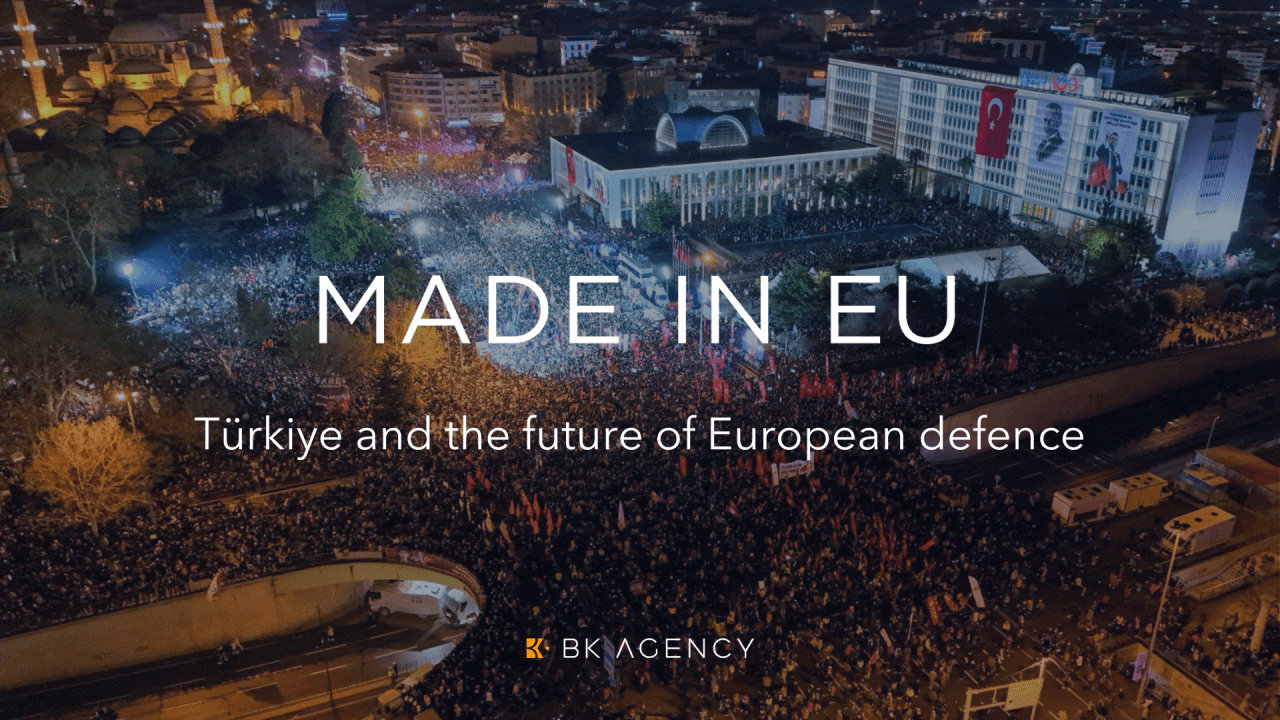
On 19 March, Ekrem İmamoğlu, the current mayor of Istanbul and the main political rival of current President Erdoğan, was arrested on charges of corruption and support for terrorist organisations. His arrest sparked the most widespread protests in Türkiye in over a decade, as tens of thousands of citizens mobilised across the country. More than 1,100 participants in the demonstrations have already been arrested, including at least 10 journalists. Authorities have also requested the suspension of hundreds of accounts on X, especially those spreading information to mobilise protests.
According to analysts, this comes at a crucial moment, as İmamoğlu was about to be officially nominated as the party’s presidential candidate. Although the authorities have denied that there is any political motivation behind İmamoğlu’s detention, it will significantly jeopardise his efforts to replace Erdoğan in the next presidential elections. The mayor is currently the only presidential candidate of the Republican People’s Party (CHP), the main opposition party to Erdoğan’s ruling AK Party (AKP). During the March 2024 local elections, the party had already secured a clear victory across many Turkish regions, with nearly 38% of the national vote. Discontent with the current political economic and political governance, as well as state intervention and concerns over migration were the main drivers in votes for the CHP.

On the eve of the 2023 Türkiye presidential election, B&K Agency looked deeper into the personality of Recep Tayyip Erdoğan. While the circumstances have changed, the influence of the key figure behind Türkiye’s political affairs remains. Read more on Recep Tayyip Erdoğan
The European response
Despite political differences, the EU has been meeting regularly with Ankara. In April 2025, an EU-Türkiye High-Level Dialogue on economic issues is expected to take place. While European leaders urged Türkiye to respect democratic values in light of the protests, no mention was made of suspending the upcoming dialogue. Some believe that this might be linked to the role that the country could play as a strategic partner in the future of European defence.
In fact, over the past years, Türkiye has become an increasingly important actor in international security, especially for the EU. Türkiye is NATO’s second largest military power after the US, and the country has a strong defence industry. It has been supporting the defence efforts of other NATO members by contributing with military equipment and has also been sending arms and ammunition to Ukraine. Additionally, its presence in the Black Sea and the Bosphorus Strait has allowed it to become a crucial mediator with Russia.
The White Paper on European Defence
Since Trump’s return to the White House, it has been clear that the EU needs to increase investments into its own security and pursue coordinated action with strategic partners. According to many experts, including Türkiye in European spending schemes and developing industry trade deals centred on security with the country could be critical to strengthen the European Defence Technological and Industrial Base.
The recently published White Paper on European Defence – Readiness 2030 does not exclude such a possibility. The White Paper, for instance, calls for the “development of cross-border industrial partnerships to coordinate reserves of defence products, components and related raw materials”, with NATO, but also individual NATO members seen as strategic partners.
A future area of collaboration between the EU and Türkiye could emerge under the Security Action for Europe (SAFE) instrument proposed by the Commission. The SAFE loan instrument is expected to mobilise €150 billion for investments in key defence areas such as drones, and cybersecurity. According to the regulation, candidate countries, potential candidate countries or countries with which the EU has a Security and Defence Partnership would be allowed to participate in common procurements made by Member States and supported by SAFE. For this to happen though, Türkiye would have to sign a defence agreement with the EU.
Pragmatic cooperation on security
While it is still unclear how the current events will impact EU-Türkiye relations, especially on security, it is increasingly possible that European leaders will support a form of pragmatic cooperation, based on common priorities. This will mean striking a balance between interests and a long-term engagement on issues such as democratic values or the rule of law. This is the position that the future German government under the expected new Chancellor Mertz is likely to take according to some. In February, the leader of the CDU/CSU had already indicated that he believed in strengthening European foreign-policy cooperation with Türkiye in response to security challenges. Still, the historical opposition of Greece and Cyprus to cooperation with the country might play a role in hindering future defence plans.
As the EU becomes increasingly responsible for its own security, strategic partnerships with other countries are a priority that must be reckoned with. Nonetheless, this will mean striking a balance between the support of European values and other short-term priorities, a balance that might be hard to achieve in certain instances. In addition, as defence and security are still largely in the hands of Member States, individual preferences and historical differences might still challenge expanding partnerships. For the EU to become a strong international actor, bold strategic decisions will have to be made, balancing different priorities to achieve a unified approach.