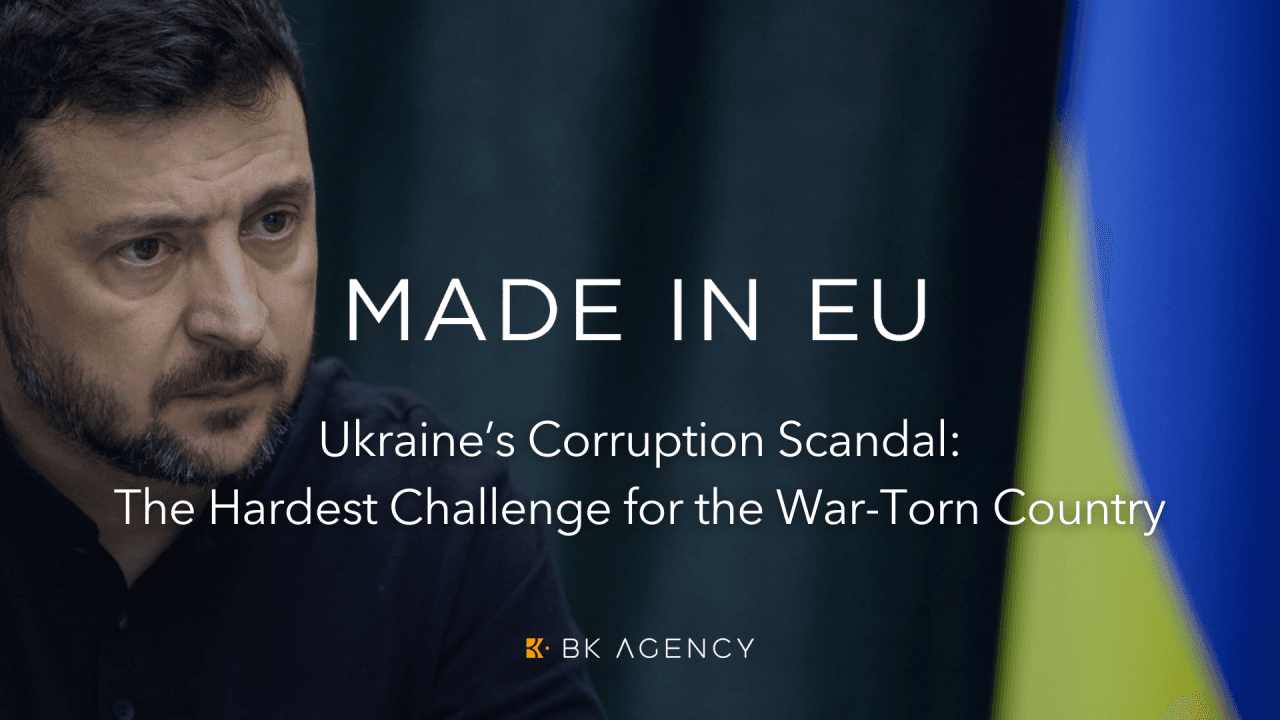
The new corruption scandal is shaking up the Ukrainian government, all while the Brussels is trying to find a way to financially support Kyiv’s defence efforts further.
Ukraine’s Corruption Scandal: The Hardest Challenge for the War-Torn Country
A significant corruption scandal is shaking Ukraine’s energy sector, which led to a political fallout. The National Anti-Corruption Bureau of Ukraine uncovered a scheme code-named “Midas” and internally known as “Schlagbaum”, where an organised criminal group allegedly systematically extorted bribes, typically amounting to 10-15% of contract sums, from state-owned Energoatom’s suppliers. The alleged leader of the operation was businessman Timur Mindich (“Carlson”), an owner of Kvartal 95 studio and a friend of President Volodymyr Zelenskyy. The president is accused of using his influence and connections with high-ranking officials. The scheme involved controlling Energoatom’s financial flows and money laundering through a sophisticated illegal office (“laundering facility”) in Kyiv, which allegedly processed at least $100 million.
Resignations and Arrests
The scandal immediately triggered a series of high-level resignations and dismissals. President Zelenskyy demanded the departure of Justice Minister German Halushchenko, formerly the Energy Minister, who was allegedly an accomplice to the scheme, and of the current Energy Minister Svitlana Hrynchuk, citing a loss of trust. Both ministers submitted their resignations, and on 19 November, the Ukrainian Parliament approved them. While Mindich and his alleged money-laundering partner, Oleksandr Tsukerman, reportedly fled the country hours before the searches began, five other suspects were arrested. Some of them have since been released on multi-million bail.
The scandal, popularly referred to as “Mindich-gate” by the press, comes at a difficult time for Ukraine amid the Russian aggression. The situation has generated mixed reactions from Western partners – some view the quick reaction as a positive sign of the independence of anti-corruption institutions, while others have used it to question continued financial aid due to concerns about the future corruption scandals occurring.
The Corruption and Its Consequences
The significance of this scandal is vast, to say the least. It impacts wartime stability, domestic politics and international financing. Firstly, the corruption targets one of the most vital strategic assets of any country at war: the energy sector, which is under constant attacks from the Russian forces. The alleged theft included funds potentially designated for the security and protection of infrastructure, which is why the populace is outraged, especially amid blackouts and the hardship of war. Domestically, this crisis tests the morale of both the government and its citizens at a time when national unity is more important than ever.
Secondly, the proximity of Mindich to the highest levels of government represents the most serious challenge to President Zelenskyy’s image since the war started. It raises questions about the extent of political influence on state-owned enterprises and the concentration of power. And last but not least, the incident introduces friction into Ukraine’s relationships with its Western partners. International donors, including the European Union and the United States, have conditioned their substantial financial and military aid on concrete anti-corruption progress. In addition to that, this situation could potentially delay progress on Ukraine’s application for EU membership, which requires demonstrably independent governance.
The Help Still on the Way
This news could not have come at a worse time for Ukraine. The European Commission is now seeking to overcome Belgian resistance to using €140 billion in Russian sovereign assets (mostly held in the Belgian financial depository Euroclear) as a collateral for a loan to Ukraine. The Commission is offering financial and legal guarantees from all EU member states. This move is intended to alleviate Belgium’s concern of being exposed to Russian retaliation alone, including expensive international legal challenges grounded in Russia’s bilateral investment treaties.
The plan still faces legal complexities and political opposition from member states such as Hungary and Slovakia, which have been pretty reluctant to participate in any scheme that funds their neighbour’s defence. The next step will be a high-level EU summit, scheduled on 10 December in Lviv, where leaders must formally approve the financial mechanism, potentially as an intergovernmental agreement in order to avoid legal challenges requiring unanimity. If the plan gets adopted, it will mark the EU’s long-term financial commitment to Ukraine and give Kyiv a predictable stream of funding. At the same time, it could escalate tensions with Moscow, which has already stated that the legal challenges and retaliatory measures are headed Europe’s way. The core expectation is that the necessity of funding Ukraine will drive some kind of solution, whether through. Formal activation of these funds, or a similar mechanism using the assets’ profits, is highly probable in the immediate future.
The resignations of Ministers Halushchenko and Hrynchuk are not the end of the crisis – some expect larger changes within the top government officials, while others are even calling for the resignation of President Zelenskyy. Whatever the aftermath might be, the EU will definitely not want to signal to Russia that their support of Ukraine is under question at any point, and any change of Europe’s general geopolitical direction is highly unlikely.