In today’s newsletter, we analyse the results of the Shanghai Cooperation Organisation meeting and what it means for Europe’s global initiatives. Enjoy!
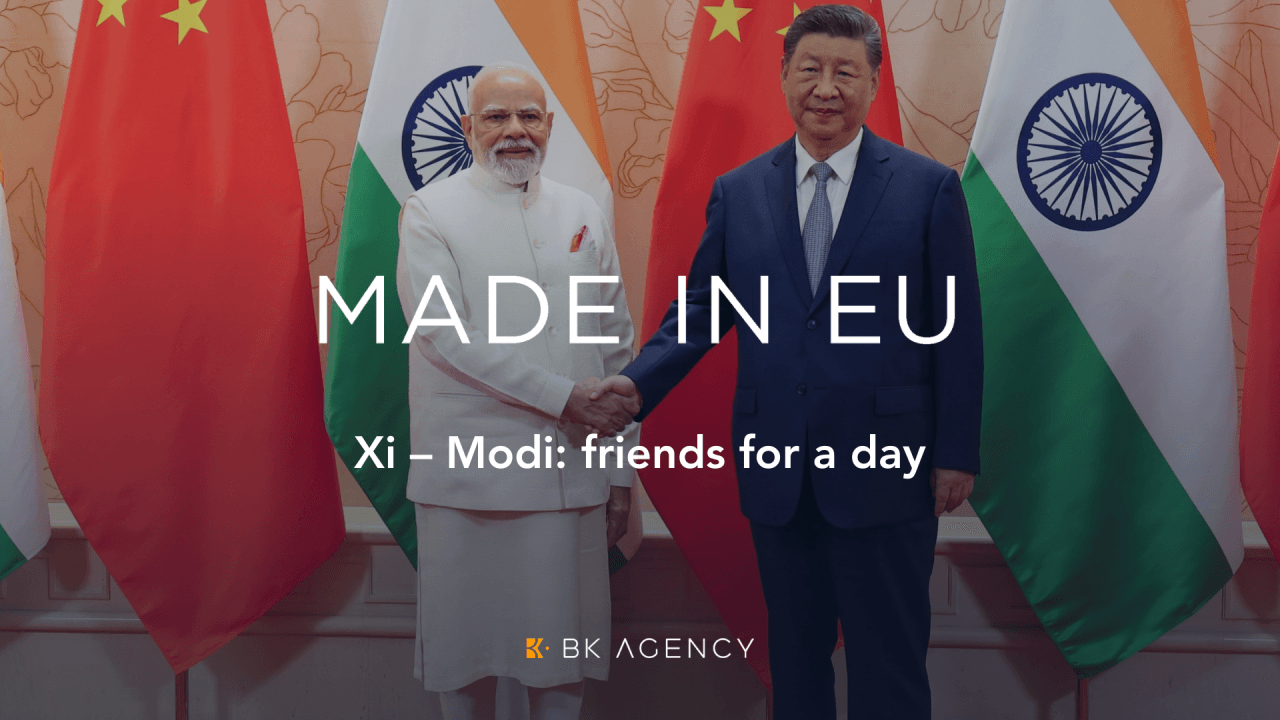
Xi – Modi: friends for a day
The meeting between the Chinese President Xi Jinping and the Indian Prime Minister Narendra Modi in Tianjin, which was held just a few days ago, has been portrayed in parts of the Western media as a landmark moment in Sino-Indian reconciliation. Yet, behind the headlines lies a far more cautious reality. Deep mistrust, strategic dissonance and competing visions continue to define the relationship between the two powers.
From a Chinese point of view, India’s role in the Shanghai Cooperation Organisation since 2017 was intended to extend the organisation’s influence. Instead, it has imported long-standing regional tensions. Chinese policy voices, in an op-Ed in the official Communist Party newspaper, the Global Times, now speak of Delhi as a “cancer within” the organisation, systematically obstructing Belt and Road-linked initiatives while aligning with Western interests when advantageous.
For India, the recent summit is far from historic. The border dispute, revived by the Galwan clash in 2020, remains unresolved and is emblematic of China’s unpredictability. Continued provocations, such as Beijing’s renaming of locations in Arunachal Pradesh from Indian to Chinese in May 2025, the ongoing expansion of Chinese naval activity in the Indian Ocean, and the Kashmir corridor funded by China’s Belt and Road Initiative after a request from Pakistan, further solidify India’s elite’s unwavering commitment to their anti-Chinese stance.
Economically, the imbalance is also quite visible. In 2024, India’s trade deficit with China reached nearly 98 billion dollars, raising concerns about India’s dependency rather than mutual trust. Fundamentally, the disagreement is not about tactics, but about worldviews. India’s vision of a multipolar Asia clashes with Xi’s projection of China as the central, unchallenged actor. The handshake in Tianjin, then, signals not a breakthrough, but a fragile, temporary truce that was more for the headlines than for real, tangible changes.
SCO and European Union – a real rivalry
For Europe, the implications of this rivalry are good and bad at the same time. The SCO may appear fragmented, but its influence on Eurasia, particularly on connectivity, governance models and regional alignments, is significant. It functions as a platform where alternative regional frameworks evolve, often without the participation of the EU. This is where Europe’s vulnerabilities become clear. The EU’s Global Gateway, launched in December 2021 with the ambition of mobilising up to 300 billion euro by 2027 for infrastructure and connectivity projects, is directly challenged by the SCO and Belt and Road initiatives, which are moving faster in Central Asia. Transport corridors running through Kazakhstan, Uzbekistan and Kyrgyzstan are already risking the sidelining of EU-backed alternatives, such as the Trans-Caspian route, which only began to receive meaningful EU investment commitments in 2023.
The same applies to the enforcement of sanctions. Since February 2022, the EU has adopted 18 sanctions packages against Russia. Yet SCO member states continue to provide Moscow with economic breathing space. Kazakhstan’s trade with Russia rose by more than 25 percent in 2023 despite sanctions, and the trend continued into 2024. This highlights how regional integration under the SCO facilitates circumvention. Europe’s credibility as a sanctions enforcer is therefore weakened by the absence of effective leverage in Central Asia.
Energy underscores this vulnerability even more clearly. The EU has dramatically reduced its reliance on Russian gas, cutting imports from roughly 45 percent of total fossil gas in 2021 to just 3 percent by 2025 under the REPowerEU programme. But this diversification depends increasingly on Central Asia. In 2024, the EU’s total trade with the region was close to 60 billion euros, with imports — much of which were hydrocarbons — amounting to over 32 billion euros.
The stability of these flows is now influenced by SCO decisions and by the political bargaining within the organisation. Europe therefore finds itself exposed: its most ambitious connectivity strategy is at risk of being overtaken, its sanctions are being eroded, and its energy diversification is becoming entangled in institutions where it has no voice.
The paradox is that the SCO’s internal rivalries, particularly between Beijing and Delhi, prevent it from acting as a fully cohesive bloc. However, these same rivalries ensure that it remains a constant arena of negotiation, adaptation and experimentation in Eurasian politics. For Europe, the challenge is to move beyond dismissing the SCO as ineffective, and recognise that even in its fragmented form, it is reshaping the strategic environment in which EU energy security, connectivity policy and geopolitical credibility are at stake.