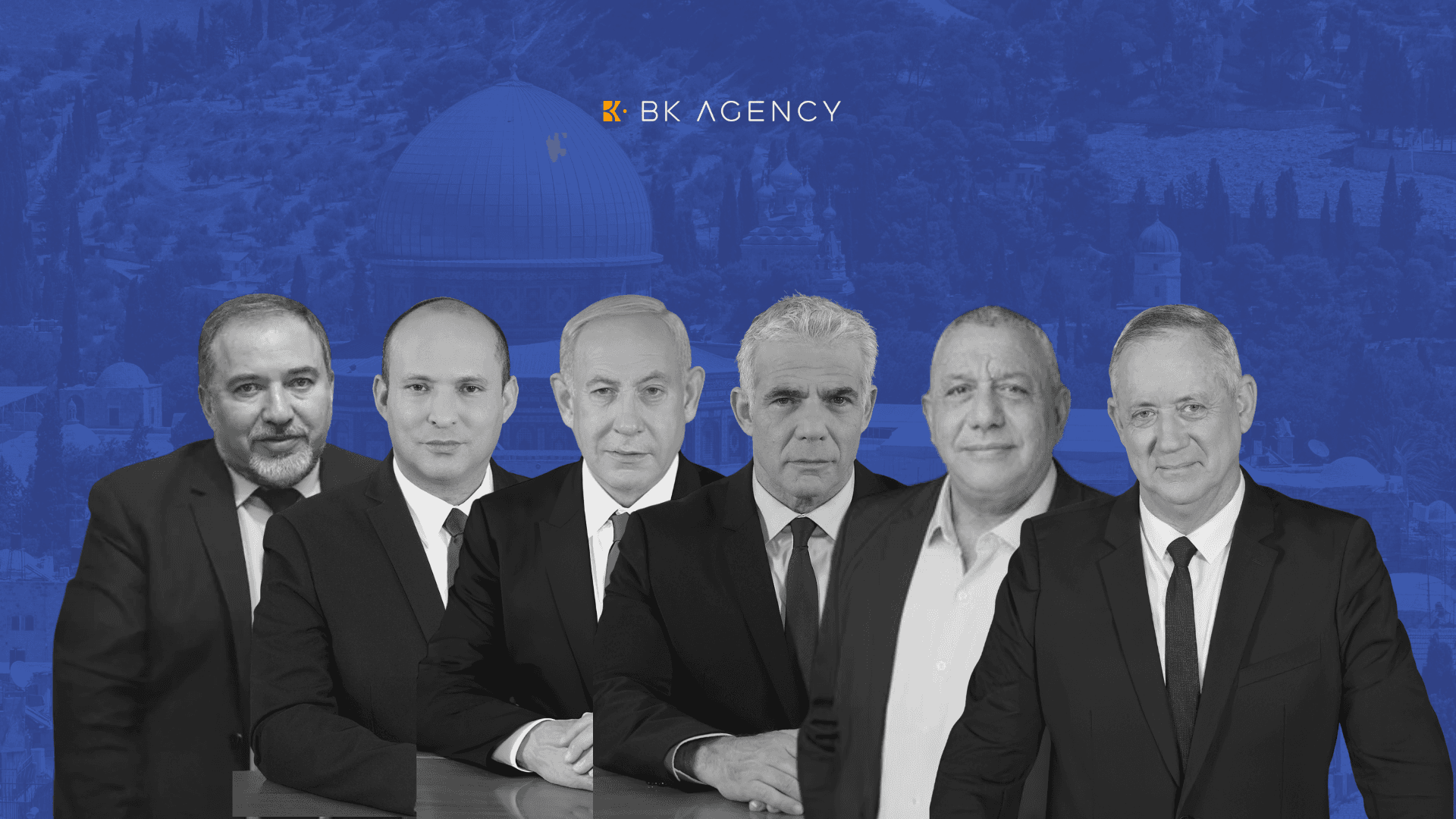
On 27 October, Israelis will vote for the 26th Knesset in what is often described as the most important election in the country’s history. It will be the first since the Hamas’ 7 October attack and the wars in Gaza, Lebanon and Iran that followed. For many voters, the ballot amounts to a referendum on Prime Minister Benjamin Netanyahu’s handling of that entire period, from the security concerns of October 7 itself to the management of the wars that reshaped the region afterward.
A Coalition in Crisis
Netanyahu’s government that has been in power since late 2022 is regarded as the country’s most religious and right-wing one yet. The coalition is centered around Netanyahu’s Likud, together with the religious Shas and United Torah Judaism parties and far-right Religious Zionist Party and Otzma Yehudit. It has governed through difficult circumstances, including the October 7 attack, the Gaza war that followed, fighting against Hezbollah in Lebanon, and conflict with the Islamic regime in Iran. Netanyahu has also spent this period on trial for three corruption charges, making him the first incumbent Israeli PM to face criminal prosecution. His testimony ended in June 2026, although the likelihood of a verdict before the election is low. President Trump has repeatedly pressed Israeli President Isaac Herzog to pardon Netanyahu, but so far without success – Herzog has instead pushed for a negotiated settlement between prosecutors and the defence.
The coalition nearly collapsed before its term was due to end, over the evergreen question of whether ultra-Orthodox students should be exempt from mandatory military conscription in Israel. Israel’s Supreme Court has repeatedly ruled that the blanket exemption is unconstitutional, and with the military under sustained strain from fighting on many fronts, pressure to draft Haredi men rose. When the exemption bill became stuck, Shas and United Torah Judaism briefly pulled back their ministers and advocated to dissolve the Knesset early. Despite that instance of internal conflict, the government majority held together long enough to serve a full term, making it the first Israeli government to do so since 1988.
The Mechanics of the Vote
Israel elects all 120 Knesset members through nationwide proportional representation, which practically means that citizens vote for parties rather than candidates individually. Any party above a 3.25% threshold (giving it roughly four seats) enters parliament. Since no single party has ever won an absolute majority under this system, the negotiations are almost inevitable. The president consults party leaders after the election and gives the opportunity to assemble a coalition to anyone who seems most likely to gather 61 seats. This structure rewards smaller parties and explains why ultra-Orthodox and far-right factions with a relatively small percentage of the national vote have been such an important factor in the Israeli politics in the past.
A Crowded Field
Netanyahu’s Likud remains the largest party in many polls, though its support went from the 32 seats it won last time to projected 20-25 seats. Netanyahu continues to portray himself to the wider audience as a non-replacable and experienced politician who will put security first. However, the reality is that incumbent Prime Minister’s campaign is harmed by the general dissatisfaction over the 7 October intelligence failure and his ongoing trial.
Likud’s most serious challenger is Yashar, a new political force in Israel. This centrist party is led by Gadi Eisenkot, a former IDF chief of staff who joined politics after playing a prominent role in the Gaza war. Since launching his own party last year and formally announcing his candidacy in June this year, Eisenkot rose in the polls. His personal sacrifice (losing a son and two nephews in the war) gave him moral authority among large part of the electorate. Eisenkot’s platform is centered around mandatory universal conscription (including the ultra-Orthodox men), term limits for Prime Ministers, and putting together a commission of inquiry into October 7. Since the launch of the campaign, Yashar surged to 20-22 projected seats, with some polls even putting them above Likud.
Naftali Bennett, a former Prime Minister on the political right, made his political comeback together with Yair Lapid’s centrist Yesh Atid earlier this year to form a list called Together. The alliance combines Bennett’s right-wing security focus and appeal to moderate religious voters with Lapid’s existing structure as the opposition leader. Bennett is campaigning heavily on constitutional reform and economic modernisation, positioning himself as a right-wing alternative who explicitly rejects relying on Arab parties to govern, Initially, the coalition polled very strongly, but it lost momentum after Eisenkot’s campaign was announced.
Elsewhere in the opposition, Avigdor Lieberman’s secular-nationalist Yisrael Beytenu maintains its current Knesset seats by aggressively attacking draft exemptions and subsidies for the ultra-Orthodox. On the left, former general Yair Golan has energised progressive voters after making the merger between the Labour and Meretz paties into the Democrats possible. Conversly, Benny Gantz’s National Unity party fell in the polls to the point of risking exclusion from the Parliament. Even though Gantz was once Netanyahu’s biggest political rival, his base is currently mostly supportive of either Eisenkot’s or Bennett’s parties. Finally, two Arab parties are expected to keep a combined bloc of approximately ten seats. This could potentially be a decisive factor given how uncertain the outcome of the elections is.
The Day After 27 October
Because no one currently has a majority in polling, four general outcomes look the most plausible. In the first, Netanyahu’s current coalition narrowly holds on, either matching or slightly exceeding its current strength. Most recent polls evaluated this bloc at around 50 to 52 seats, short of the 61 needed, but it is worth noting that Israeli polling has been volatile before and a late shift can’t be ruled out. In the second scenario, a government forms under either Eisenkot or Bennett, a bloc that has polled anywhere from 58 to 69 seats depending on the survey. The biggest complication is that parties of this profile have historically needed the Arab factions to reach 61, which is an arrangement several opposition leaders have been reluctant to agree to. Still, at least one recent poll suggested the Jewish opposition parties alone might now clear the threshold.
In the third, more uncertain scenario, not a single combination is stable enough to govern seamlessly, resulting in either a fragile minority government or in a return to the repeated election cycles Israel experienced between 2019 and 2022. Finally, a unity government consisting of current coalition and opposition figures is not completely impossible, particularly given wartime consensus on security matters and Gantz’s past willingness to join a government led by Netanyahu to keep far-right out of key portfolios. However, deep personal rivalries among political leaders make this the least likely of the four paths for now.
The Region and the EU
The election’s outcome will have direct consequences for Gaza’s postwar governance and the direction of any further normalisation with Gulf states under the Abraham Accords framework. Netanyahu’s coalition partners, particularly Smotrich and Ben-Gvir, have pushed rather annexationist policies in the West Bank. A change of government, for example one led by Eisenkot or Bennett, would likely soften that trajectory even if it would not reverse it outright, since most mainstream Israeli parties remain committed to settlement activity in some form. Continuity or change in Jerusalem will also shape how quickly (if at all) Saudi Arabia moves toward the kind of normalisation with Israel that the US has been encouraging as a step in the direction of completing regional infrastructure projects, most notably the India-Middle East-Europe Economic Corridor.
European governments are divided over how to respond to Israeli policy in Gaza and the West Bank. The EU has already sanctioned settler organisations, and several Member States, including Spain, Ireland and until recently Slovenia, have pushed to suspend the Association Agreement between EU and Israel altogether. Such a move was so far blocked by Germany, Italy and others that favoured continued engagement. The International Criminal Court has issued an arrest warrant for Netanyahu over alleged war crimes in Gaza, a step Israel rejects as politically motivated. A change of Israeli government would not resolve these tensions immediately, since the disputes over settlements and Gaza policy go beyond just one administration – however, a government less associated with this rhetoric could slow the momentum toward further measures on behalf of the EU, including the trade restrictions on settlement goods currently under discussion in Brussels.
The immediate risk for companies operating in or trading with Israel is the prolonged uncertainty likely to follow it considering how narrow and uncertain the polling margins are. Businesses with exposure to Israel’s technology and defence sectors, both major pillars of its economy and both closely tied to European partners, should expect continued attention for that relationship in Brussels regardless of who governs as the EU’s disagrees on the issue internally. Firms sourcing from or investing in West Bank settlements face a specific compliance risk, as EU-level restrictions on settlement goods are already in discussions independent of the election outcome. Overall, prolonged coalition uncertainty (whether from a narrow Netanyahu win, an opposition transition, or even another election cycle) would extend the kind of unpredictability that has been there throughout the war years, making election night itself only the first of several milestones worth watching closely.