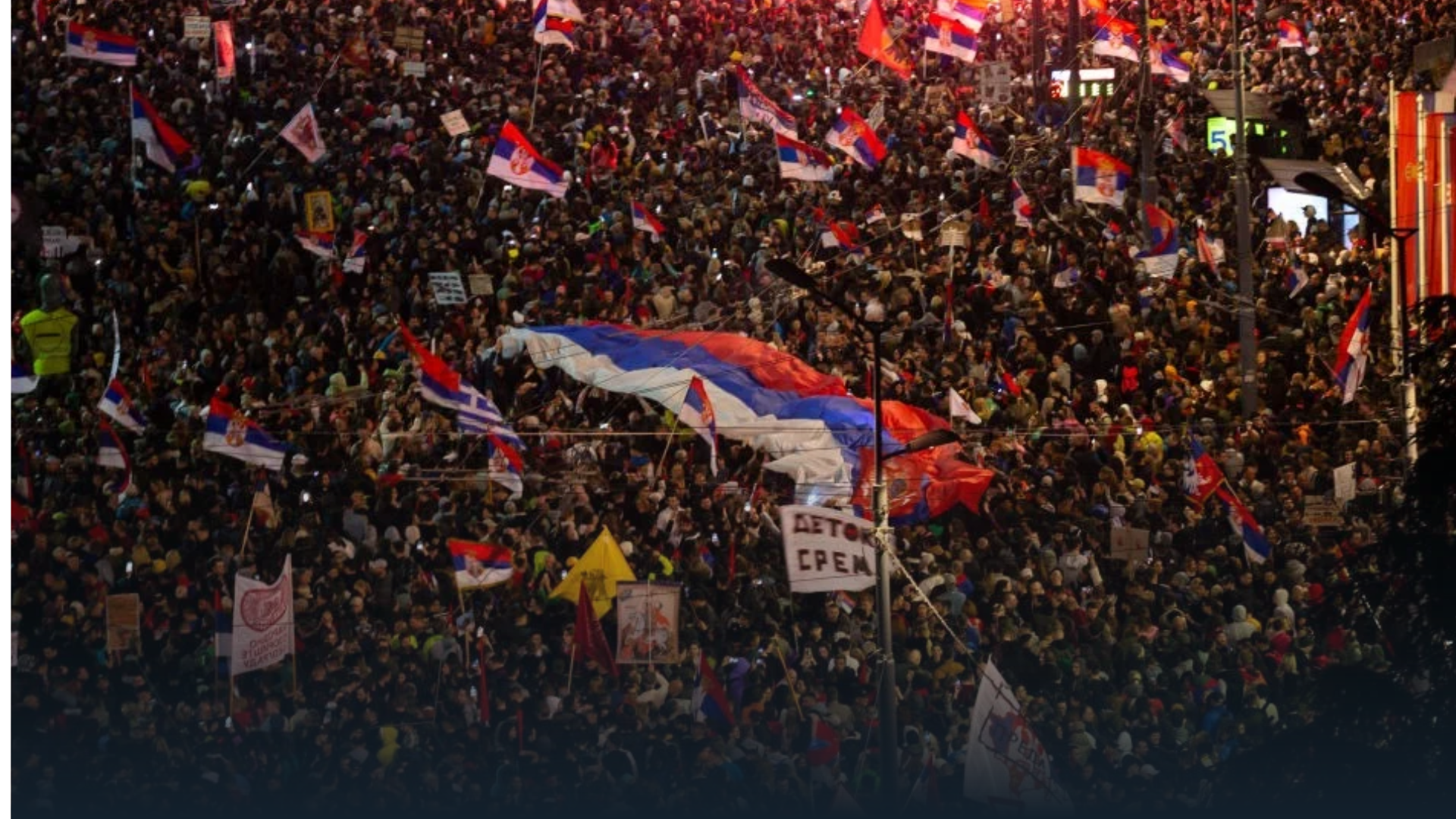
Twenty-six years after the fall of Slobodan Milošević, Serbia has voted for a second democratic transition. In yesterday’s parliamentary elections, the student-backed list won around 52% of the vote, compared with 39.3% for the coalition led by Aleksandar Vučić. The outgoing president was forced to concede defeat during the night.
Born out of the collapse of a station roof at Novi Sad railway station in November 2024, which killed sixteen people, the movement transformed demands for justice into a nationwide mobilization against corruption and state capture. The students succeeded where the traditional opposition had repeatedly failed. They brought together citizens with different political and geopolitical views around a common goal: restoring the rules of law and democratic institutions.
Often described as a leaderless movement, it has in fact developed a sophisticated organizational structure based on assemblies, collective decision-making, and coordination across the country. Its strength lies precisely in having emerged from the grassroots, without depending on traditional political parties or international sponsors. But winning an election does not necessarily mean knowing how to govern.
The decision to focus on broadly shared positions such opposing Kosovo’s independence and supporting EU membership, while leaving aside the more divisive issue of relations with Russia and China made it possible to build a broad majority. Those differences could now resurface.
The students intend to entrust the government to a technocratic transitional administration, tasked with reforming institutions and organizing new free elections within twelve to eighteen months. It is an understandable choice, but not without contradictions for a movement that has made direct participation its defining feature.
The Future of Vučić
Vučić will not disappear from the political scene. The Serbian Progressive Party retains a substantial parliamentary presence and an extensive network across the country, although its cohesion has largely depended on access to state resources. Once that access is lost, the party could begin to unravel, as happened to the Democratic Party after 2012.
The networks of power built over fourteen years extend throughout the public administration, the media and, above all, the police, security services and armed forces. Dismantling them will require time and political skills. On election night, Vučić had already portrayed the winners as instruments of foreign interference, accusing European governments and the American “deep state”, rather than the Trump administration, which he has consistently sought to court.
The presidential elections in September will provide a further test for this party and his allies in the country.
At the international level, it would be a mistake to interpret the vote as a victory for pro-European forces over nationalists. The student movement deliberately avoided taking clear positions on the most divisive geopolitical issues. This does not, however, mean that it lacks a European orientation. The students’ symbolic trips to Strasbourg and Brussels, rather than Moscow or Beijing show that they are willing to start again the serbian European Path. Expecially, since demand for independent institutions, media freedom and a fight against corruption goes to the heart of the criteria for EU membership.
Russia and Kosovo
Relations with Russia and the status of Kosovo remain deeply rooted in Serbian society, making them difficult issues that do not depend solely on Vučić’s choices.
Historically, the Kosovo issue helped bring the Serbian Progressive Party to power in 2013, after the pro-European coalition failed to prevent widespread international recognition of Kosovo. The next prime minister will need to address this longstanding issue, curb the ultranationalist Serbian forces that have been trying to destabilize the border with Kosovo in the past few year, that lead in 2023 to a confrontation with the Nato KFOR soldiers on the boarder, and eventually stabilize the region.
Russia also remains a significant factor. Belgrade and Moscow have been close allies since the Soviet era, and recent investments, along with the energy crisis, have only deepened their ties. While international reports suggest Vučić has successfully balanced close relations with the Kremlin alongside European funding, the next government faces a critical choice. It must decide between returning to old alliance, and risking its EU membership prospects, or aligning with the international community to diversify away from Russia.
A Test also for the European Union
The students’ victory is therefore also a test for Brussels. For years, the European Union, and particularly the German and French governments, prioritized stability and cooperation with Vučić, especially on Kosovo and economic investment, showing excessive tolerance towards the country’s democratic deterioration.
The EU must now change its approach: provide tangible support for democratic reforms without attempting to direct from abroad a transition whose legitimacy comes from Serbian society. It must also avoid imposing divisive geopolitical choices too early, whether on Russia and China or on Kosovo, or reducing the country’s future to a choice between the West and Russia or China. That would be the best way to reinforce Vučić’s narrative, weaken the new majority, and alienate precisely the students who brought about this change.
Above all, Brussels must offer a clear and credible path towards full EU membership. The idea, entertained in recent years, of integrating Serbia economically into the single market without granting it full political rights could soon prove unsustainable in a country capable of rebuilding its democratic institutions.